RSS

Rain, Rivers, Suspension Bridges, and Kiwi Car

The rain let up briefly around sunrise, and there was a brief period of sun around 2PM, as we came north, but otherwise it’s been a consistent downpour, with blustery winds on the coast. We went out for a brief hike from out campsite after breakfast, along a swollen river, crossing two bouncy suspension bridges. The forests here continue to amaze us. California forests are beautiful, but they are ecologically almost desert-like in their sparsity. These are tropical forests and jungles. Ferns, tree ferns, vines, trees, lichens, and shrubs are all a vibrant (and shiny, from the rain) green. Every town we pass through has a water conservation sign on it, with a dial from blue to red. Given how much rain we’ve seen, this seems oxymoronic, but it seems like they don’t have large reservoirs like we do, and I suppose they have rainy summers. 

Our thought had been to either do a gold rush hike through tunnels and timber tracks, or a hike to see two Kauri trees. Unfortunately both involve some steep climbs, which in the rain, with Aleko in a carrier, can be precarious. Plus if he times out when we’re at the end, making him sit soaked through another 90 minutes of rain seems like a bad idea. He lasted about 25 minutes in the morning hike rain. Unfortunately, given the weather, there’s not much to do. We swung by Hot Water Beach (geothermally active beach so at low tide you can dig holes that fill with wonderfully warm water), but low tide was at7:15 and that’s a bit late – night falling as the roaring surf comes in sounds a bit tricky to manage with the Captain. We stopped by a small art and crafts store and bought some gifts as well as a new car for the Captain, a Kiwi bird with wheels and a pull string. So we’ve driven up to a camping spot above Cathedral Cove and are gazing out at the roaring sea as it breaks on the rocks, playing with the Captain, a warm dinner in our bellies. We’ll either spend the night up here or head down to a car park campground in an hour or so. 

– The Professor


Rain, Rivers, Suspension Bridges, and Kiwi Car

The rain let up briefly around sunrise, and there was a brief period of sun around 2PM, as we came north, but otherwise it’s been a consistent downpour, with blustery winds on the coast. We went out for a brief hike from out campsite after breakfast, along a swollen river, crossing two bouncy suspension bridges. The forests here continue to amaze us. California forests are beautiful, but they are ecologically almost desert-like in their sparsity. These are tropical forests and jungles. Ferns, tree ferns, vines, trees, lichens, and shrubs are all a vibrant (and shiny, from the rain) green. Every town we pass through has a water conservation sign on it, with a dial from blue to red. Given how much rain we’ve seen, this seems oxymoronic, but it seems like they don’t have large reservoirs like we do, and I suppose they have rainy summers. 

Our thought had been to either do a gold rush hike through tunnels and timber tracks, or a hike to see two Kauri trees. Unfortunately both involve some steep climbs, which in the rain, with Aleko in a carrier, can be precarious. Plus if he times out when we’re at the end, making him sit soaked through another 90 minutes of rain seems like a bad idea. He lasted about 25 minutes in the morning hike rain. Unfortunately, given the weather, there’s not much to do. We swung by Hot Water Beach (geothermally active beach so at low tide you can dig holes that fill with wonderfully warm water), but low tide was at7:15 and that’s a bit late – night falling as the roaring surf comes in sounds a bit tricky to manage with the Captain. We stopped by a small art and crafts store and bought some gifts as well as a new car for the Captain, a Kiwi bird with wheels and a pull string. So we’ve driven up to a camping spot above Cathedral Cove and are gazing out at the roaring sea as it breaks on the rocks, playing with the Captain, a warm dinner in our bellies. We’ll either spend the night up here or head down to a car park campground in an hour or so. 

– The Professor


Rotorua

After our hike, we continued south, to our second and final cultural stop, Rotorua. Rotorua is a large lake that was once the crater of a volcano. The whole city is geologically and thermally active. Walking through a park near the lake, a railing surrounds a fissure in the ground from which billowing, sulfurous steam emerges. There are many thermal spas, lots of extreme sports (no fewer than two Zorb establishments on the way in), and vents everywhere, with pillars of steam scattered throughout the city. 

In addition to all of these, Rotorua is a center of Maori culture. In the 19th century, Maori from villages in the area became guides for dignitaries to the local pools and geysers, and traveled to Australia and London to perform ceremonies and share their culture. Today, there is a large museum and several active villages that provide tours. We went to the less glitzy of the two, Wharakarewarewa. Our guide showed us the pools in the village, ranging from 90C to a jacuzzi-like bubbling cauldron that is 190C. Several smaller vents have wooden and cement boxes built around them, with lids one can close; these are for cooking. You can put food in a pot, put it in the box, go to work, and when you come home dinner is done. Or, you take food and hang it on a rope on the end of a stick and swish it through a pool, like shabu-shabu at a grand scale. They siphon off some of the hot water, which runs through channels in stone or cement for tens of feet, cooling, before emptying into bathing pools. She said that much as other people in other climates have evolved to extreme conditions, some people in the village can bathe in almost 70C water (158F). 

The rain started to grow heavier, so we decided to head back north. On one hand, we would like to go to Tongariro, to see the volcanoes (Mordor! Mt. Doom!). But with this rain, they will be shrouded in mist and hidden from view. Plus, that will be further south and so mean a longer drive back over the next few days. So instead we are heading to the Coromandel Peninsula, where there are amazing rocky beaches that look like they could give Ton Sai in Thailand a fair comparison, gold rush trails and tunnels, and Hot Water Beach. Tonight we’re at the Dickey’s Flat campground right by Karangahake Gorge. We think we will likely spend our last night (Wednesday) at Ray’s Rest, a beachside campsite on the west shore of the Firth of Thames, so we can quickly get to the airport the next morning. So tomorrow night is up in the air – we’ll see how things go and maybe make our ways up the west coast of the peninsula. 

– The Professor


Jungles, Poison, and Super Rugby

Nobody bothered us parked just outside the park. We woke up to the sounds of all kinds of unfamiliar birds, cicadas, and the occasional bleat from a sheep in the adjacent field. We drove into the (small) park, strapped the Captain into his carrier, and set out for a two hour hike up to the top of a cliff. Wenderholm is an example of a nature reserve that New Zealand is trying to create more of, where they exterminate mammalian pests and return the ecosystem to be much closer to how it was before colonization. So there are signs everywhere about poison and dogs are not allowed, because they might eat the poisoned bait. The park includes what used to be a farm and sits at the mouth of a river. The river ends in a final oxbow that leaves a large, beautiful sandy beach at its end. 

Departing on the hike took a while because the Captain wanted to watch the families of ducks that wandered through the campgrounds. We climbed up to the cliff through jungle, surrounded by a loud chorus of cicadas. Steep portions of the climb had wooden steps or walkways with grippy plastic mesh. Before you start the hike, there are stations to wash and disinfect your shoes. The Captain learned a new word: “jungle!”

On top of the cliff, we could see the Pacific, with a few sharp islands in the distance and one yacht anchored about a mile away. There was one person on the beach. What struck us again was how such a beautiful location, in places we have visited before, would be developed or developing, with hundreds of people. We saw a few other hikers, most of whom were in their fifties or sixties. 

Hike complete, we headed back to Auckland for our evening entertainment: the Auckland Blues were playing the Highlanders in the first match of the Super Rugby series. We drove to nearby the stadium for lunch, finding a small organic grocery store where we could get some cooking staples. The Captain’s been only enthusiastic about eating pasta, so we bought ingredients for a few pasta like dishes we know he likes a lot (homdros, lentils with rice, etc). And wow is meat cheap, so we picked up two steaks. 

We then headed to a camping park within Auckland, parked, showered, and visited the pool before heading on the bus to the match. The park had a small room with a TV and some books. The Captain was so happy to run around on carpet, sit down, and read. 

Getting to the match was a bit of an adventure. We took a bus to Britamart, the central transit hub, then took a train to the stadium. The train was packed with Blues fans, hooting and hollering and cheering. A woman sitting next to the Private Eye commented that it was an embarrassment that rugby is the national sport and these hooligans represent the country. There was a bit of the bullying, brash, and bellicose English punter, but as the Private Eye pointed out, the first time the Giants won the World Series fans did set a MUNI bus on fire. 

It turns out we had awesome seats! We were in the family section (no alcohol), so there were lots of other families there. We were in the front row, right up on the pitch, in the corner. This meant that when play came close to our corner, the players were only 100 or so feet away. We were facing west, so could see the sun set as the match began. We left with the he score close (22-24, Highlanders ahead) so we could miss the crush on the train home. 

 
Leave a comment

Posted by on February 29, 2016 in Uncategorized


Adventure!

It’s been a long time. Now it’s the professor, the private eye, and the little captain. We’re about to depart on our first family adventure: New Zealand. We’re renting a camper for 11 days to explore the north island. We’ll then spend 3 days on Oahu with the private eye’s family, before returning home. We figure that a camper will give us freedom in deciding where to be when, while also keeping us in parks. We hope to take a picture of the captain in Hobbiton, see glow worm caves, see a rugby match, and spend a lot of time hiking.

– The Professor


Leave a comment

Posted by on February 21, 2016 in Uncategorized


Were I To Do It Again…

We spent 100 days abroad: beaches, cities, temples, jungles, rainforest, scuba diving, zip lines, food, culture, poverty, affluence, and many wonderful new friends.

Best day: our first day at Ton Sai/Railay beach, rock climbing for nine hours on magnificent karsts jutting from the Andaman Sea.

Best meal: tied between two sausages, both from street vendors, one in Chiang Mai, one in Luang Prabang. I’d never had such a combination of textures, flavors, and a wonderful spiciness before. Street food was generally best, cheap restaurants not great.

Best food: Singapore.

Best lodgings: Bali Sesak on Gili Trawagnan. A cozy bungalow with AC for the hot midday, a comfortable bed, a private outdoor bathroom with shower, a shaded lounging area under the bungalow, wonderful hosts, all for $18/day.

Most surprising moment: seeing a woman dressed in head-to-toe black, wearing a niqab, laughing and clearly grinning as she held hands with her boyfriend/husband.

Most dangerous moment: riding in the back of pickup trucks on winding mountain roads . Seeing the carnage of a just-happened accident in Laos made the danger very apparent.

Scariest moment: diving in strong current in Gili Trawagnan, needing to climb hand over hand across the floor 30 meters down with 70 bars of air left.

Place that most deserved more time: sort of a cop out due to its size, but Indonesia. We only saw Bali, the Gilis, and Yogyakarta on Java. Sumatra, Borneo, Komodo, Sulawese – all places I wish we had time to see.

Top recommendation: the Gibbon Experience in Laos. Ziplining hundreds of feet above the jungle floor with local guides who were once poachers but now put their siblings through school for English.

Most emotionally moving: Cambodia and its cultural specter of the Khmer Rouge and constant, dangerous reminder through the tremendous danger of the countryside due to land mines and other unexploded ordinance. A tremendously rich history and cultural tradition, almost obliterated in 4 years by madmen.

Hardest thing: in Southeast Asia, the general cultural dislike of public affection. Not being able to hold hands with The Private Eye or put my arm around her in public wore thin pretty quickly.

Things I would do differently:

Bring different (nicer) clothes: I brought mostly very casual clothes and beach wear. But most of the places we were (except the beach vacation spots) dressed more formally and nicely than I expected. Of course if I’d read up on this I would have known, but I didn’t. Once there, finding clothes that fit me well, were nice looking, and easy to clean was nearly impossible. I’d have brought, in addition to my Psylo pants, two pairs of light, easy to clean pants, as well as light shirts with collars (perhaps short sleeved). The most important thing is that they dry quickly. I would bring three sets of mosquito resistant clothing and have arranged somehow that I wouldn’t carry them around SE Asia, just pack them when leaving for Peru.

Bring more first aid supplies: everything seemed to heal more slowly in the tropics. We used up our band aids pretty quickly. Of course it was easy to buy more when they were really needed (my scrape on Gili Trawagnan), but often scratches and such aren’t a big enough motivator to find a store. Specifically, alcohol wipes, band aids, and medical tape.

Carry a sum ($500?) of American dollars in a safe place: there were a few situations where ATMs were either unavailable or we needed to pay a lot of money. Having a stash of US dollars would have saved me a bunch of worry in a few tough spots.

— The Professor


Lima, revisited, and coming home

We arrived in Tarapoto around noon. With our flight back to Lima departing at 5PM, we debated heading into Tarapoto for a few hours or just cooling our heels (literally) at the airport. Our collectivo to Tarapoto had two other passengers. One was a middle aged woman with a pet parrot, which she kept locked up tight in her small handbag. Sometimes it would peek its head out and she would stroke it, until it squawked, at which point its head went back in the bag. She hid it when we passed the police checkpoint; she claimed it was her pet (and its behavior seemed to match that description), but taking birds from the Amazon basin to the highlands is an easy way to have the police ask a lot of questions. Animal smuggling is quite real and a significant problem.

We had arranged for a taxi pickup at the airport through our hostel. When we arrived, after a short trip to the near supermarket, we experienced the terrific and so long missed luxury of hot showers. With shampoo. And soap. A scrubbing. I washed my hair twice. While we were clean, though, are clothes were not. Señora had washed them, but she had done so with river water, so practically everything we owned had a smell to it. We hand hand washed a few things for our first of two days in Lima (note to future travelers: white vinegar is great for getting smells out, soak clothes for 30 minutes or so in a sink of cold water with a few tablespoons). First thing the next morning, we took all of the rest of our clothes to a laundry. Oh, having a bag full of clean, clean-smelling clothes, it was so comforting.

In our two days, we went to the Museo Larco, the church of San Francisco, which has a crypt, the Plaza de Armas, the old town, and wandered some around Miraflores. Our conclusion is that Lima is a wonderful city to live in. It’s cool, dry, has a love of literature, wonderful food, the ocean, nightlife, wide sidewalks, parks, many of the details that make it remind me of San Francisco. But for tourism it’s pretty thin, in part because earthquakes mean there isn’t much that’s very old. The Museo Larco is stellar, but besides that… well, except the laser light water show at Parque Reserva.

IMG_3338

Watch The Private Eye leap in front of the watery fire:

Imagine a medium sized park, about the size of Dolores Park, with a dozen or so fountains, some of which change and shift their flow over time. At 7:15, the music starts, the projectors turn on, and they, along with lasers, begin a multimedia experience of ridiculous scale with sheets and streams of water as the canvas.

With not that much to do, The Private Eye and I spent most of our last two days languorously enjoying an introduction to city life. We had excellent coffee, strolled in parks, and retold stories of our trip to each other. I joked that after eight days in the rainforest, a 17th century painting of St. Francis just doesn’t seem that… exciting. I think each of us is going to come up with a best of list, and we might perhaps put together a “what we’d do differently next time” post.

IMG_3382 IMG_3348 IMG_3295

We are now in UA 927, 38,000 feet up, somewhere over Nevada, on our final flight from Houston to San Francisco. These last two hours seem more difficult than any others during our trip. I’ve watched the in-flight movie, Life of Pi, we have played a game or two of Ticket to Ride, now I am anxiously counting the minutes until we land. I read Bleak House in Peru, but now I can’t seem to read more than a few pages of Hard Times before my mind wanders. Tomorrow morning I’ll get on my bike, ride to Caltrain, go to the new company offices in the morning, then the university in the afternoon. Tonight, we’ll be seeing a lot of friends at the Orbit Room.

The captain just told us the seatbelt sign will be on in 5 minutes, we will be landing in 25! Home!

— The Professor


Leaving The Amazon Basin

At 8 am, we boarded a slow boat back to Yurimaguas. Jefe did not come with us this time, he was apparently helping the police to stop poachers (!) and couldn’t make it. The boat was traveling against the current this time, so we spent a pleasant lazy 22 hours in hammocks watching the river go by, and the sun set, and the moon rise, and the flat front of the boat glide like a flying carpet under the stars. Our fellow passengers were people,and chickens, and one rabbit.

I saw two dolphins as we got underway. One gray dolphin, and one bufeo.

We got into Yurimaguas at around 6 am. We showered at a hotel, then caught a collectivo back to Tarapoto. We flew back to Lima, where we were to spend two days, and then return to San Francisco.

– The Private Eye


A Few Practical Things About the Rainforest

The Private Eye has written about our experiences canoeing in the white and black water of an Amazonian tributary, and I don’t think I can say any more. But there were a few things that surprised me.

  • The climate: simply put, it wasn’t that hot on the river. Ubud was hotter. When the sun was out, sure, it was warm, but since the river water is from the mountains, it was reasonably cool. This was only true on the river; when we ventured onto land, sweat poured in buckets due to the 100% humidity. The knees of my pants were soaked, and I wondered if I had stepped in slightly too deep water for my boots. I hadn’t; it was the sweat coursing down my legs and then hitting fabric right above the boot.
  • The fish: there were so many fish, the sound of a splash as one nabbed an insect from the surface was frequent. Drop some food scraps in the river, and 20 or so would congregate to feast. Most nets we stopped at had numerous fish in them. Our guide, when fishing with a pole, gave up after 3 minutes, because if he hadn’t caught something by then, it was too long.
  • The water: there were times when there was no land for hours. It wasn’t just a river: it was an enormous flood plain. My guess is that the water was 6-8 feet above its low point. Because we were so close to the mountains, there were no real industrial uses of the river upstream of us. This meant that locals could drink the water freely, and later in the trip our water was boiled river water.
  • Fire: cooking was over an open fire, with either some bricks or a few pieces of rebar to hold pots up. We started fires with matches and… large pieces of clear plastic cups. They burn easily, hot, and for a while. Wood for the fire was chopped from logs left in the cabana, and once our guide chopped down a small tree to then chop a few logs.
  • Safety: I think the only really dangerous situations would be a traumatic injury, because of distance from a radio, or both of our guides falling unconscious when we were deep in the reserve, because we might get lost trying to make our way back upriver. Both of those were exceedingly unlikely; this is their day-to-day life. Having local guides, who knew everyone else we met on the river, meant there was no danger from people. It’s a very small community. In Yurimaguas people tried to aggressively sell themselves as guides until we said we were with Jefe; then smiled, said OK, offered to help us with our bags. I would not have felt safe if we were just ourselves.
  • The fauna density: partially because of the amount of time we spent on the river, and partially its undisturbed state, we saw many, many animals. Often we wouldn’t stop, later in the trip. Of course, we didn’t see them; our guide did, and pointed them out to us, at which point they became apparent. The jungle in Laos was silent in comparison, even when gazing oveer the canopy at sunset and sunrise. I wonder if this is true in California redwood forests as well, which at times seem so desolate. I had once read that soil in the Amazon is very nutrient poor; I had incorrectly assumed this meant there was sparse life. Instead, it’s because the forest so quickly takes up the nutrients, otherwise the rain will leach them away.

— The Professor


Day 8 in La Selva, March 23

It was our last day in the rainforest. We woke to the sounds of howler monkeys again. On the river, the whitewater changed to black, and the current was strong, and all three rowers put forth good effort. The trees were shorter, here, in high water.

IMG_3252 IMG_3245 IMG_3236 IMG_3201

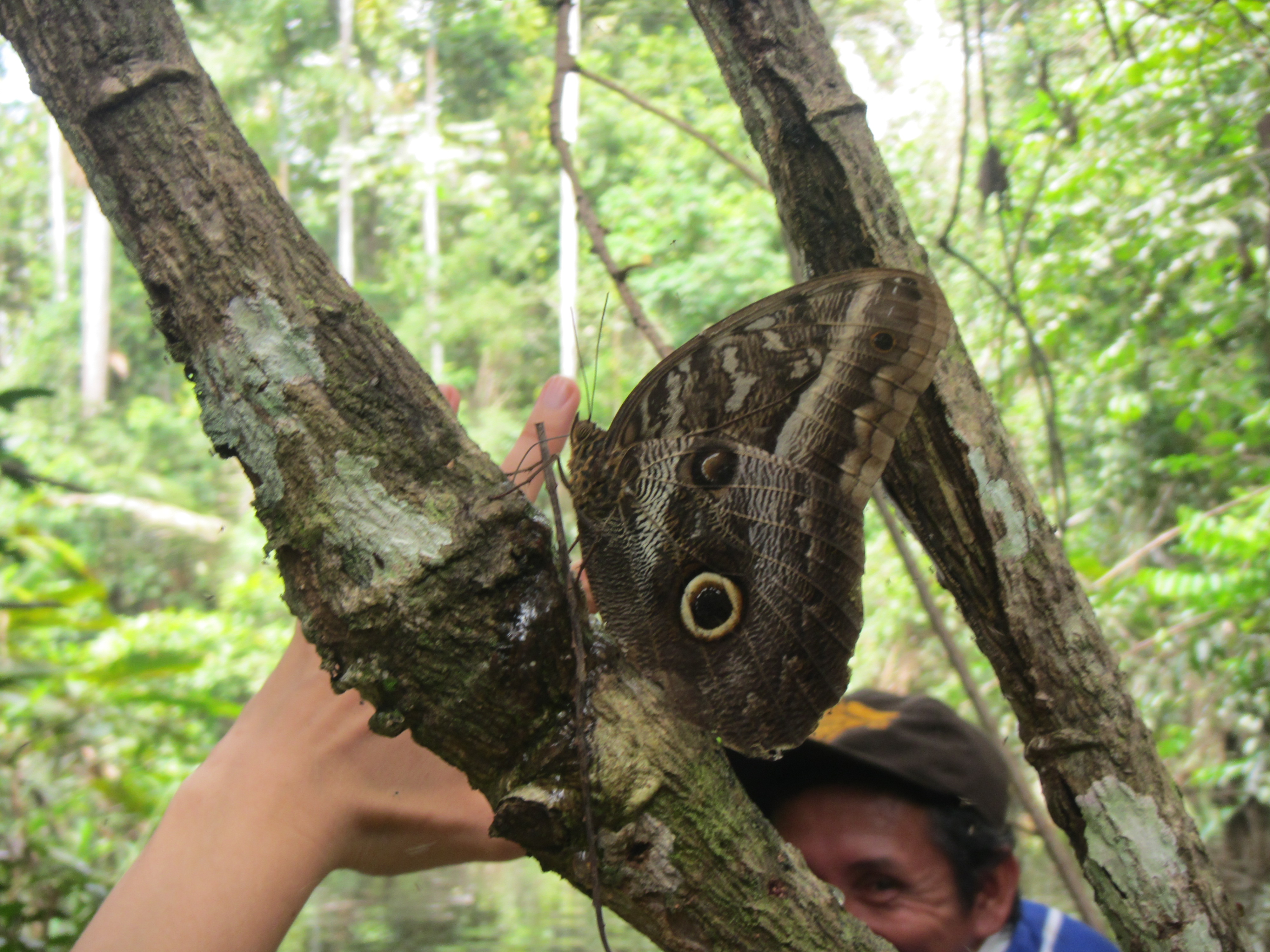
We saw squirrel monkeys parading through the trees, and what Señor called a night monkey – I think it was a kinkajou, but I only saw it briefly. Toucans flew and alighted near us. Traveling westward, we saw a sloth scratching itself, and later, a sloth with her baby clinging to her belly, feeding slowly on leaves.

Just before we left, we came across a bonbon of an animal: saddleback marmosets. They are remarkable for both their cuteness and their matriarchal, polyandrous ways.

Heliconias appeared again, red against the green. The sun came out of the clouds, and all was quiet and beautiful.

And then it was over. We reached the shore of the river by the ranger check-in. Señora made lunch, which we ate, and then went back to Lagunas.

IMG_3291

That night we had dinner with Jefe and his wife and daughter, as well as Señora, Señor, their youngest daughter, and their grandson. Afterwards, Señor, Señora, the Professor and I went to La Canoa, the biggest discoteca in town. It is out in the open air, and when the municipal power cuts out at 11 pm, it fires up a generator and keeps the party going until three.

Señora wouldn’t dance, she said, because of the emotional pain in her heart. I told her I hoped she would dance again one day. But Señor dances still, and he and Señora both smiled broadly when he danced two songs with me. The Professor and I danced with some other folks from the tour company as well, but mostly we danced with each other.

Baile baile baile! We had a wonderful time, and then said our farewells.

– The Private Eye