Our last day in Ubud, February 7th, was hectic.
While down near the Monkey Forest, visiting Andy in his studio, we came across a tailor/leatherworker. Hanging in his shop was a leather jacket I thought The Private Eye might like. Back in college (a decade and a half ago), she bought a light leather jacket at The Gap. It became one of her most worn coats, due to its combination of useful features: a lining warm enough for a cool but not cold night, a hood, side pockets without zippers that scratch your wrists, and an inside pocket for a wallet and phone. The jacket has been slowly falling apart, and so for the past year or two I’ve been looking for a replacement. This jacket seemed perfect. Heavy goat leather, so it can take the beatings of everyday use, a hood, an excellent cut, her size, and a beautiful teal lining. The day before we left, I showed her the coat and in a prearranged dance of signals so the shop owner would not know her degree of interest, she tried it on and said she loved it. There was one catch: to make a new coat would take 2-3 days, and we were leaving tomorrow. So perhaps he could sell us this one? And add side pockets? Without zippers? And an inside pocket? And repair/replace the lining because it’s a little worn from show? The answer to all of these questions was yes, and at a fantastic price. The one catch: it would not be ready until 3.
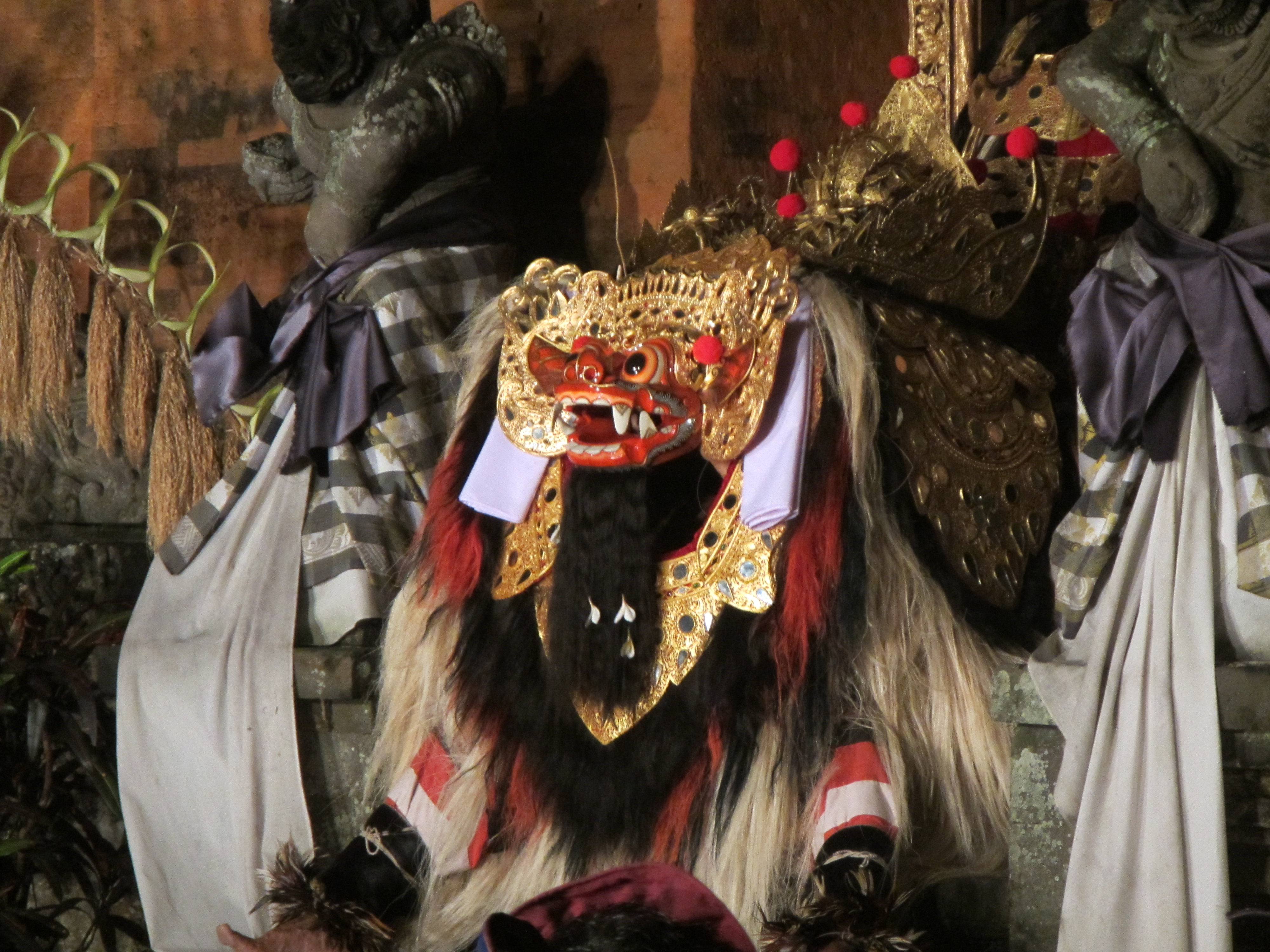
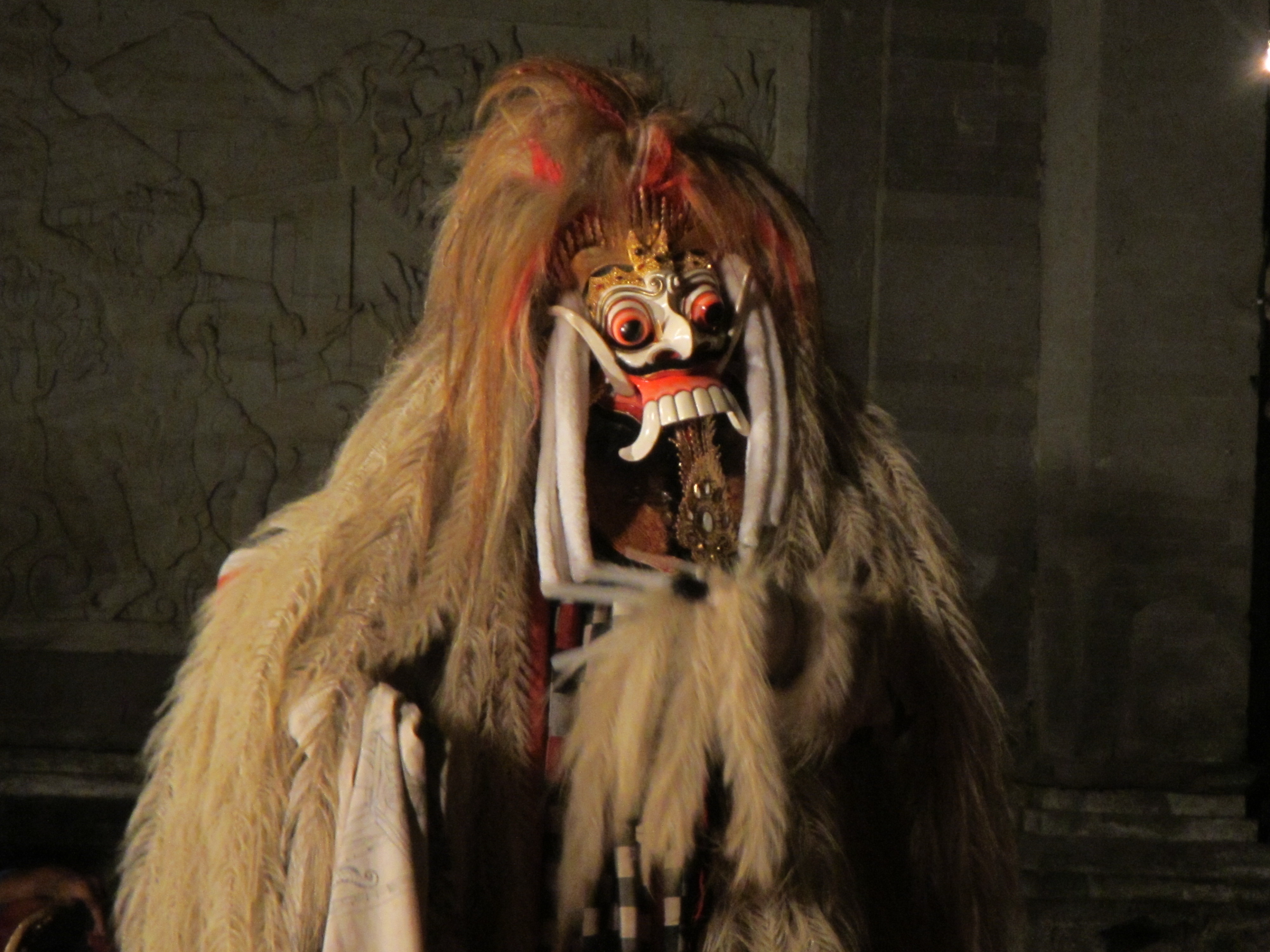
And just in case it sounds like I always bargain low prices, I don’t. When the shopkeeper quickly agrees, then smiles, and touches the money to similar items for good luck, then you know it could have been cheaper. Like the Barong mask I bought at Gunung Kawi.
So we planned to leave Ubud at 3 or so. We took care of all of our last tasks (a carved wooden mask for Cleverpig, register for Burning Man ticket sale, a gift for furrybluehouse, some Internet banking, returning our library books, a waxing for The Private Eye), and arrived at the Monkey Forest parking lot at 2.
You see, by this point we had several bags of stuff for our real lives – presents for friends, a few souvenirs (Barong mask for my lab!), two pairs of pants from a cool but cheap designer, and now a leather jacket. Our taxi agreed to leave for Ubud at 3, but could not do much later. So once I picked up the jacket, I hired a scooter (R10k) to take me to the post office to mail this all home. With one hand I held onto the diver, with the other I held the four bags. Sending it all by sea (2-3 months) and packing cost about $80. So then hop on a scooter back (driven by an old man who drove a harder bargain, R14k), and call Made, the driver, to tell him we are ready.
And what a good driver Made (mah-DAY) is! We would recommend him to everyone. He drove us to the puppet and mask museum in Ubud and when we discussed Amed, he gave us a price that later research showed to be very fair (R350k, or $40) for a 2 hour drive. We had a wonderful conversation during the drive. We talked about Bali, his children (two daughters, learning Balinese dance), America, the permanency of residences and families in Bali, village life, immigrating to Bali (village head gives you rules to follow…), and Indonesia. In March and April he works for an American company that organizes a bicycle ride in Bali, the rest of the year is for hire. If you are ever in Bali and want a good driver, ask and we can give you his information. It can be hard to find a good driver and just meeting people on the street is hit or miss.
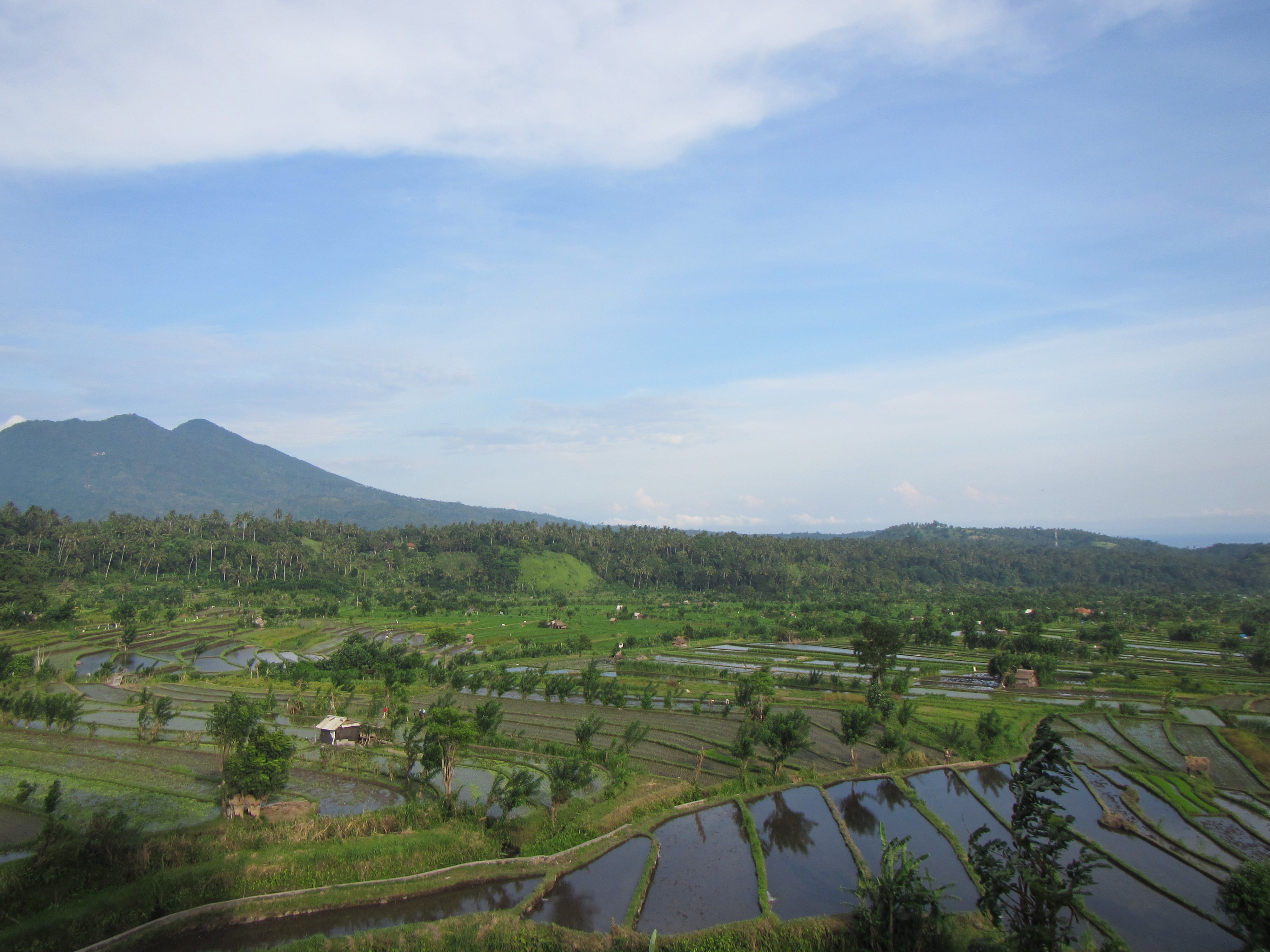
The drive began as Ubud traffic, but towards the end became beautiful. Roads high above terraced rice fields, huge banyan trees, and the ever-increasingly looming power of Gunung Agung, whose top was shrouded by a single, lonely cloud.

It’s the low season in Bali. Ubud still has a good number of visitors, travelers, and tourists, but Amed is very quiet. It’s a line of bungalows, warungs, and dive shops along the road parallel to the beach. In the low season, the local industries are fishing and salt making. The Liberty dive is off the shore from Tulamben, which is a 10-15 minute drive northwest; we chose to stay in Amed because the beach is tiny black pebbles rather than big black rocks and the town has more to it than just diving.
We picked Eco Divers because they have a reputation for being environmentally conscious. Seemed a reasonable distinguishing feature. We arranged to dive the next day, they helped us find a bungalow (which we chose to not spend a second night in – while nice looking and clean its architecture is such that it stays hot at night, our second night, tonight, is in a bungalow run by our dive guide, on the beach, cooler, nice, and an even better price), and arrange for a boat to the Gilis. The dive price was high; I’m willing to negotiate for goods and sleeping, but diving doesn’t seem like something to drive a price on, and a great dive is so much better than a good one.
After Sail Rock, we weren’t sure how many days we would like to dive. We figured that if conditions were poor, we’d hang around and wait to dive until they were excellent. This was a little frustrating to Eco Divers (How many nights? Not sure. How many days of diving? Not sure?), but we didn’t want to commit to many days hanging out on a beach and also didn’t want to leaves before a great dive.
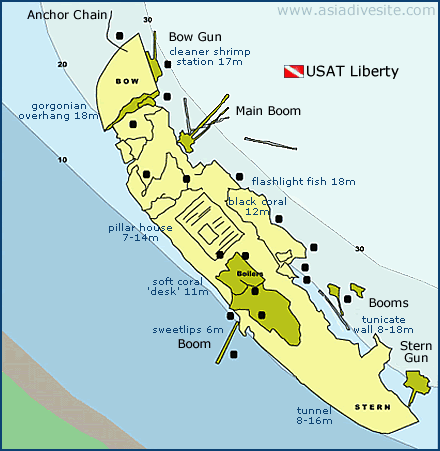
And what a dive it was. The Liberty was a transport ship in World War II, fitted with two guns for self defense. The ship was 120 meters from bow to stern. In 1942 it was hit by a Japanese torpedo and limped to Bali, where it was grounded and sat on the beach until 1963. When Gunung Agung erupted, the ship rolled off the beach and settled to the sea floor about 30 meters from the shore, where it has been since. The stern is the highest point, about 8 meters below the surface. The bow is down at 26 meters (hence our deep dive training!). I wish I could have taken pictures, but renting cameras is expensive and our point and shoot can only go to 10 meters. Here are some pictures I found on the web:

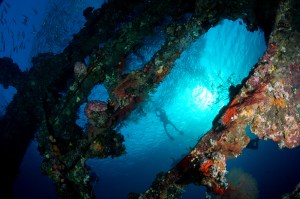
So it’s an enormous ship. Even with the 50 meter visibility (!!!!), you can’t see the ship end to end. Many supporting structures and internals have broken free, leading to side towers of life and a whole metropolitan area of coral and fish. We saw a pair of 4 foot long yellowfin tuna, a 5 foot long sea turtle, schools of tens of different kinds of fish, an enormous grouper, coral of all colors of the rainbow, scorpionfish, and so much more. In Ko Tao, there were what I thought to be large plate coral, maybe 3 feet in radius. On and around the Liberty, there were coral with a radius of 5 feet or more.
For our first dive, we were practically alone; we arrived first and only saw other divers as we left the wreck. Even on the second dive, there were only a few other groups.
On the first dive, we approached at the stern and took a path alongside the ship on the side facing away from shore, until we reached the bow. We then entered the body of the ship and swam between girders to see all of the life within it. Because the Liberty is so large, this wasn’t tight swimming. On the second dive, we reversed our path, taking a different route through the ship. We entered the ship at the stern, swam through it, then returned along the side facing away from the shore. Swimming alongside and within this enormous steel structure, covered and swarmed with life darting to and fro, this private helicopter tour of the aquatic Manhattan, well, it was as good as everyone had promised.
The water was so calm, the visibility so good, and we saw so many rare things (Tuna! Turtle!) that I thought diving again tomorrow would likely just be a disappointment. So we decided to leave tomorrow for the Gili Islands and booked a fast boat with Eco Divers. We found a better bungalow and spent a good part of the afternoon snorkeling just outside it. The snorkeling was similarly magical – while there were no turtles like in Hawaii, we saw many of the same fish we saw on our dive, but this time could linger as long as we wanted to watch them. Also, the coral were outstanding, splashes of color in all kinds of shapes, so much healthier than in Ko Tao. While Ko Tao has one clownfish, named Nemo, carefully protected by a ring of stones, we saw at least half a dozen just snorkeling along the shore.
After snorkeling, we rinsed off and had a wonderful and simple dinner (grilled fish for me, fried prawns for The Private Eye, vegetables, and rice) at our dive master’s restaurant, cooked by his wife, who also makes a mean lemon pancake. I tried arak, the palm sugar wine: it tastes similar to sake. And that leaves us here and now, sitting on the beach, looking at the stars, which look so different!
— The Professor








 The Professor and the Private Eye: Adventures Abroad