RSS

Monthly Archives: March 2013

Were I To Do It Again…

We spent 100 days abroad: beaches, cities, temples, jungles, rainforest, scuba diving, zip lines, food, culture, poverty, affluence, and many wonderful new friends.

Best day: our first day at Ton Sai/Railay beach, rock climbing for nine hours on magnificent karsts jutting from the Andaman Sea.

Best meal: tied between two sausages, both from street vendors, one in Chiang Mai, one in Luang Prabang. I’d never had such a combination of textures, flavors, and a wonderful spiciness before. Street food was generally best, cheap restaurants not great.

Best food: Singapore.

Best lodgings: Bali Sesak on Gili Trawagnan. A cozy bungalow with AC for the hot midday, a comfortable bed, a private outdoor bathroom with shower, a shaded lounging area under the bungalow, wonderful hosts, all for $18/day.

Most surprising moment: seeing a woman dressed in head-to-toe black, wearing a niqab, laughing and clearly grinning as she held hands with her boyfriend/husband.

Most dangerous moment: riding in the back of pickup trucks on winding mountain roads . Seeing the carnage of a just-happened accident in Laos made the danger very apparent.

Scariest moment: diving in strong current in Gili Trawagnan, needing to climb hand over hand across the floor 30 meters down with 70 bars of air left.

Place that most deserved more time: sort of a cop out due to its size, but Indonesia. We only saw Bali, the Gilis, and Yogyakarta on Java. Sumatra, Borneo, Komodo, Sulawese – all places I wish we had time to see.

Top recommendation: the Gibbon Experience in Laos. Ziplining hundreds of feet above the jungle floor with local guides who were once poachers but now put their siblings through school for English.

Most emotionally moving: Cambodia and its cultural specter of the Khmer Rouge and constant, dangerous reminder through the tremendous danger of the countryside due to land mines and other unexploded ordinance. A tremendously rich history and cultural tradition, almost obliterated in 4 years by madmen.

Hardest thing: in Southeast Asia, the general cultural dislike of public affection. Not being able to hold hands with The Private Eye or put my arm around her in public wore thin pretty quickly.

Things I would do differently:

Bring different (nicer) clothes: I brought mostly very casual clothes and beach wear. But most of the places we were (except the beach vacation spots) dressed more formally and nicely than I expected. Of course if I’d read up on this I would have known, but I didn’t. Once there, finding clothes that fit me well, were nice looking, and easy to clean was nearly impossible. I’d have brought, in addition to my Psylo pants, two pairs of light, easy to clean pants, as well as light shirts with collars (perhaps short sleeved). The most important thing is that they dry quickly. I would bring three sets of mosquito resistant clothing and have arranged somehow that I wouldn’t carry them around SE Asia, just pack them when leaving for Peru.

Bring more first aid supplies: everything seemed to heal more slowly in the tropics. We used up our band aids pretty quickly. Of course it was easy to buy more when they were really needed (my scrape on Gili Trawagnan), but often scratches and such aren’t a big enough motivator to find a store. Specifically, alcohol wipes, band aids, and medical tape.

Carry a sum ($500?) of American dollars in a safe place: there were a few situations where ATMs were either unavailable or we needed to pay a lot of money. Having a stash of US dollars would have saved me a bunch of worry in a few tough spots.

— The Professor


Lima, revisited, and coming home

We arrived in Tarapoto around noon. With our flight back to Lima departing at 5PM, we debated heading into Tarapoto for a few hours or just cooling our heels (literally) at the airport. Our collectivo to Tarapoto had two other passengers. One was a middle aged woman with a pet parrot, which she kept locked up tight in her small handbag. Sometimes it would peek its head out and she would stroke it, until it squawked, at which point its head went back in the bag. She hid it when we passed the police checkpoint; she claimed it was her pet (and its behavior seemed to match that description), but taking birds from the Amazon basin to the highlands is an easy way to have the police ask a lot of questions. Animal smuggling is quite real and a significant problem.

We had arranged for a taxi pickup at the airport through our hostel. When we arrived, after a short trip to the near supermarket, we experienced the terrific and so long missed luxury of hot showers. With shampoo. And soap. A scrubbing. I washed my hair twice. While we were clean, though, are clothes were not. Señora had washed them, but she had done so with river water, so practically everything we owned had a smell to it. We hand hand washed a few things for our first of two days in Lima (note to future travelers: white vinegar is great for getting smells out, soak clothes for 30 minutes or so in a sink of cold water with a few tablespoons). First thing the next morning, we took all of the rest of our clothes to a laundry. Oh, having a bag full of clean, clean-smelling clothes, it was so comforting.

In our two days, we went to the Museo Larco, the church of San Francisco, which has a crypt, the Plaza de Armas, the old town, and wandered some around Miraflores. Our conclusion is that Lima is a wonderful city to live in. It’s cool, dry, has a love of literature, wonderful food, the ocean, nightlife, wide sidewalks, parks, many of the details that make it remind me of San Francisco. But for tourism it’s pretty thin, in part because earthquakes mean there isn’t much that’s very old. The Museo Larco is stellar, but besides that… well, except the laser light water show at Parque Reserva.

IMG_3338

Watch The Private Eye leap in front of the watery fire:

Imagine a medium sized park, about the size of Dolores Park, with a dozen or so fountains, some of which change and shift their flow over time. At 7:15, the music starts, the projectors turn on, and they, along with lasers, begin a multimedia experience of ridiculous scale with sheets and streams of water as the canvas.

With not that much to do, The Private Eye and I spent most of our last two days languorously enjoying an introduction to city life. We had excellent coffee, strolled in parks, and retold stories of our trip to each other. I joked that after eight days in the rainforest, a 17th century painting of St. Francis just doesn’t seem that… exciting. I think each of us is going to come up with a best of list, and we might perhaps put together a “what we’d do differently next time” post.

IMG_3382 IMG_3348 IMG_3295

We are now in UA 927, 38,000 feet up, somewhere over Nevada, on our final flight from Houston to San Francisco. These last two hours seem more difficult than any others during our trip. I’ve watched the in-flight movie, Life of Pi, we have played a game or two of Ticket to Ride, now I am anxiously counting the minutes until we land. I read Bleak House in Peru, but now I can’t seem to read more than a few pages of Hard Times before my mind wanders. Tomorrow morning I’ll get on my bike, ride to Caltrain, go to the new company offices in the morning, then the university in the afternoon. Tonight, we’ll be seeing a lot of friends at the Orbit Room.

The captain just told us the seatbelt sign will be on in 5 minutes, we will be landing in 25! Home!

— The Professor


Leaving The Amazon Basin

At 8 am, we boarded a slow boat back to Yurimaguas. Jefe did not come with us this time, he was apparently helping the police to stop poachers (!) and couldn’t make it. The boat was traveling against the current this time, so we spent a pleasant lazy 22 hours in hammocks watching the river go by, and the sun set, and the moon rise, and the flat front of the boat glide like a flying carpet under the stars. Our fellow passengers were people,and chickens, and one rabbit.

I saw two dolphins as we got underway. One gray dolphin, and one bufeo.

We got into Yurimaguas at around 6 am. We showered at a hotel, then caught a collectivo back to Tarapoto. We flew back to Lima, where we were to spend two days, and then return to San Francisco.

– The Private Eye


A Few Practical Things About the Rainforest

The Private Eye has written about our experiences canoeing in the white and black water of an Amazonian tributary, and I don’t think I can say any more. But there were a few things that surprised me.

  • The climate: simply put, it wasn’t that hot on the river. Ubud was hotter. When the sun was out, sure, it was warm, but since the river water is from the mountains, it was reasonably cool. This was only true on the river; when we ventured onto land, sweat poured in buckets due to the 100% humidity. The knees of my pants were soaked, and I wondered if I had stepped in slightly too deep water for my boots. I hadn’t; it was the sweat coursing down my legs and then hitting fabric right above the boot.
  • The fish: there were so many fish, the sound of a splash as one nabbed an insect from the surface was frequent. Drop some food scraps in the river, and 20 or so would congregate to feast. Most nets we stopped at had numerous fish in them. Our guide, when fishing with a pole, gave up after 3 minutes, because if he hadn’t caught something by then, it was too long.
  • The water: there were times when there was no land for hours. It wasn’t just a river: it was an enormous flood plain. My guess is that the water was 6-8 feet above its low point. Because we were so close to the mountains, there were no real industrial uses of the river upstream of us. This meant that locals could drink the water freely, and later in the trip our water was boiled river water.
  • Fire: cooking was over an open fire, with either some bricks or a few pieces of rebar to hold pots up. We started fires with matches and… large pieces of clear plastic cups. They burn easily, hot, and for a while. Wood for the fire was chopped from logs left in the cabana, and once our guide chopped down a small tree to then chop a few logs.
  • Safety: I think the only really dangerous situations would be a traumatic injury, because of distance from a radio, or both of our guides falling unconscious when we were deep in the reserve, because we might get lost trying to make our way back upriver. Both of those were exceedingly unlikely; this is their day-to-day life. Having local guides, who knew everyone else we met on the river, meant there was no danger from people. It’s a very small community. In Yurimaguas people tried to aggressively sell themselves as guides until we said we were with Jefe; then smiled, said OK, offered to help us with our bags. I would not have felt safe if we were just ourselves.
  • The fauna density: partially because of the amount of time we spent on the river, and partially its undisturbed state, we saw many, many animals. Often we wouldn’t stop, later in the trip. Of course, we didn’t see them; our guide did, and pointed them out to us, at which point they became apparent. The jungle in Laos was silent in comparison, even when gazing oveer the canopy at sunset and sunrise. I wonder if this is true in California redwood forests as well, which at times seem so desolate. I had once read that soil in the Amazon is very nutrient poor; I had incorrectly assumed this meant there was sparse life. Instead, it’s because the forest so quickly takes up the nutrients, otherwise the rain will leach them away.

— The Professor


Day 8 in La Selva, March 23

It was our last day in the rainforest. We woke to the sounds of howler monkeys again. On the river, the whitewater changed to black, and the current was strong, and all three rowers put forth good effort. The trees were shorter, here, in high water.

IMG_3252 IMG_3245 IMG_3236 IMG_3201

We saw squirrel monkeys parading through the trees, and what Señor called a night monkey – I think it was a kinkajou, but I only saw it briefly. Toucans flew and alighted near us. Traveling westward, we saw a sloth scratching itself, and later, a sloth with her baby clinging to her belly, feeding slowly on leaves.

Just before we left, we came across a bonbon of an animal: saddleback marmosets. They are remarkable for both their cuteness and their matriarchal, polyandrous ways.

Heliconias appeared again, red against the green. The sun came out of the clouds, and all was quiet and beautiful.

And then it was over. We reached the shore of the river by the ranger check-in. Señora made lunch, which we ate, and then went back to Lagunas.

IMG_3291

That night we had dinner with Jefe and his wife and daughter, as well as Señora, Señor, their youngest daughter, and their grandson. Afterwards, Señor, Señora, the Professor and I went to La Canoa, the biggest discoteca in town. It is out in the open air, and when the municipal power cuts out at 11 pm, it fires up a generator and keeps the party going until three.

Señora wouldn’t dance, she said, because of the emotional pain in her heart. I told her I hoped she would dance again one day. But Señor dances still, and he and Señora both smiled broadly when he danced two songs with me. The Professor and I danced with some other folks from the tour company as well, but mostly we danced with each other.

Baile baile baile! We had a wonderful time, and then said our farewells.

– The Private Eye


Day 7 in La Selva, March 22

The day after the rainstorm, we breakfasted on fish and boiled bananas. We were at this point quite mosquito-bitten, the natural result of sleeping with our feet too close to the mosquito net, or not reapplying the DEET immediately after washing. But that didn’t matter to us, because today we were crossing the region thickest with bufeos colorados.

The pink dolphins didn’t disappoint us. They were everywhere – in the deep stretches, following us through the flooded forest, leaping full-bodied out of the water so we could see their eraser-pink fins. Sometimes they would exhale sharply and loudly through their blowholes.

They were hard to photograph, as they saved their most dramatic leaps for their most surprising one, namely the first in a set of surfacings. And since this was whitewater, it was hard to predict where they would surface, though of course Señor and Señora were better at this than us.

I was most thrilled at the dolphin couple, which surfaced together every time, the bigger male and the smaller female side by side. I held the Professor’s hand and made goofy eyes at him.

We had been seeing them for a good hour, and frequently one or more would follow the boat. Señor and Señora were not pleased. Eventually, Señora asked Señor to pass her back one of the plants he had uprooted while we were on dry land. He had shown them to us, and said they were a good remedy for arthritis, and also to heat and revitalize the body (and make a man potent, which seemed to be a property of most of the plants he described,in addition to whatever else they did). These plants smelled just like garlic, though they did not look at all similar.

Señora took the root and made the sign of the cross on the paddle of her oar! I asked if that was good against dolphins. She said yes, and that one had been right next to her in the water, which was way too close.

Later, another dolphin followed us and I delighted to see its odd, smiling face turned right at us from just behind the boat. Señora tied the plant to a string and dropped it it he water, so it would drag behind the boat and ward off the dolphin.

IMG_3199

It is so odd to think about the relationship these people have with these animals. The Professor said, and I agree, that the closest parallel is to the faery: people, but not us, and not safe.

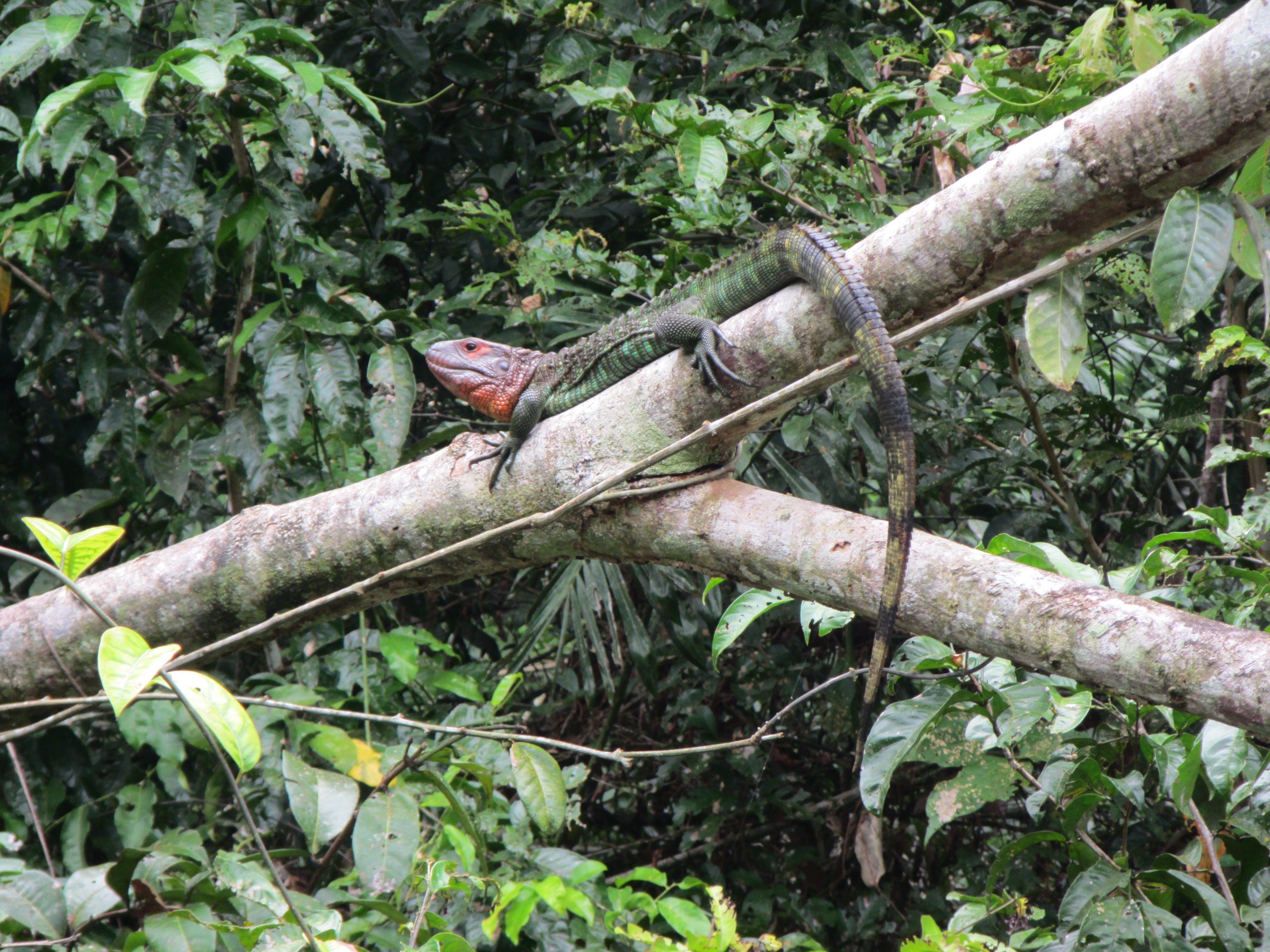
We also saw big iguanas on this day, as well as squirrel monkeys and a special type of ant whose nickname is the “balls-seeker.”

That night, we stayed at Poza Gloria, the nicest of the cabanas. We had a treat – another tourist was there! I will call him Kindergarten Cop, because he is a former kindergarten teacher who is traveling before he begins the police academy. A German man, he did not speak much English, but we all made the effort for a while.

Another woman at the cabana had heart trouble that night, so Señora gave her one of her own heart pills. It helped, and we all turned in. It was our last night in the jungle.

– The Private Eye


Day 6 in La Selva, March 21

At 3 am on the dot, I awoke to the sound of the radio playing a tinny AM station so romantically, I was briefly transported to a time I think more recognizable to my father, or even grandfather. Why not grandmother, you might ask? Sadly, when I think of old-fashioned radios and AM stations, I only think of men.

The stars were dim in the misty night, but visible. We drank coffee, loaded up the canoe, and began the long morning’s journey.

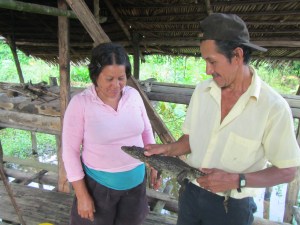
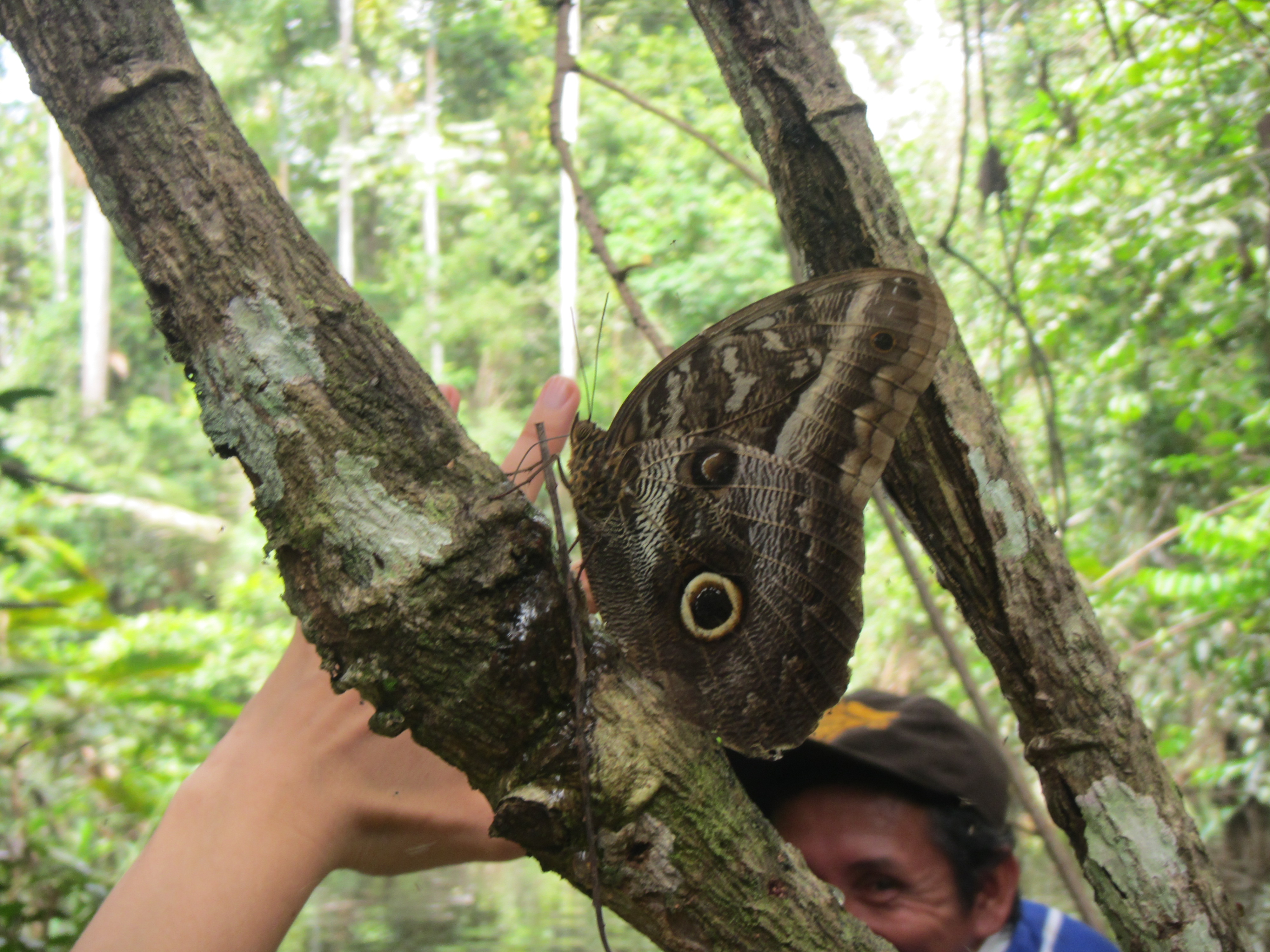
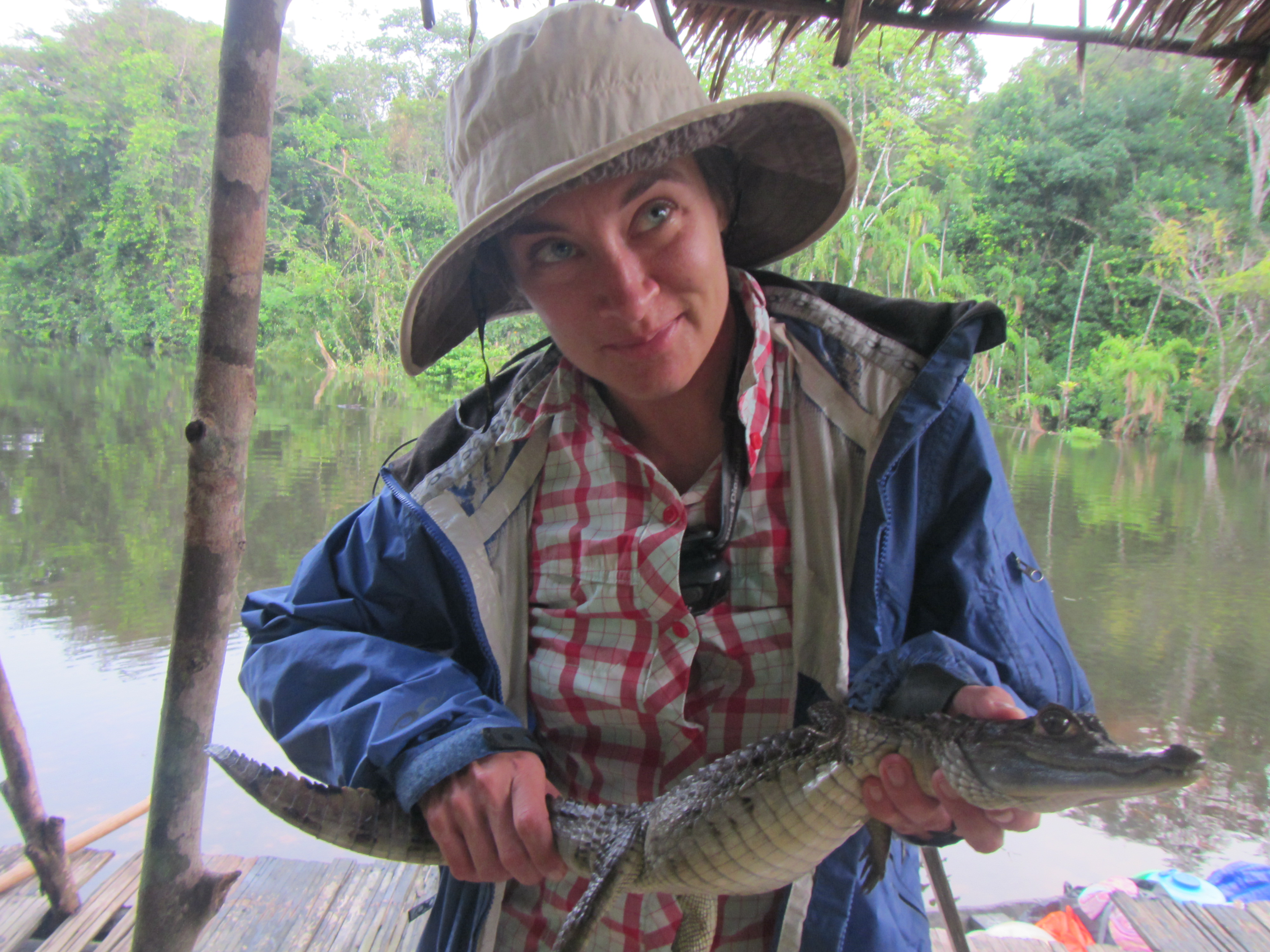
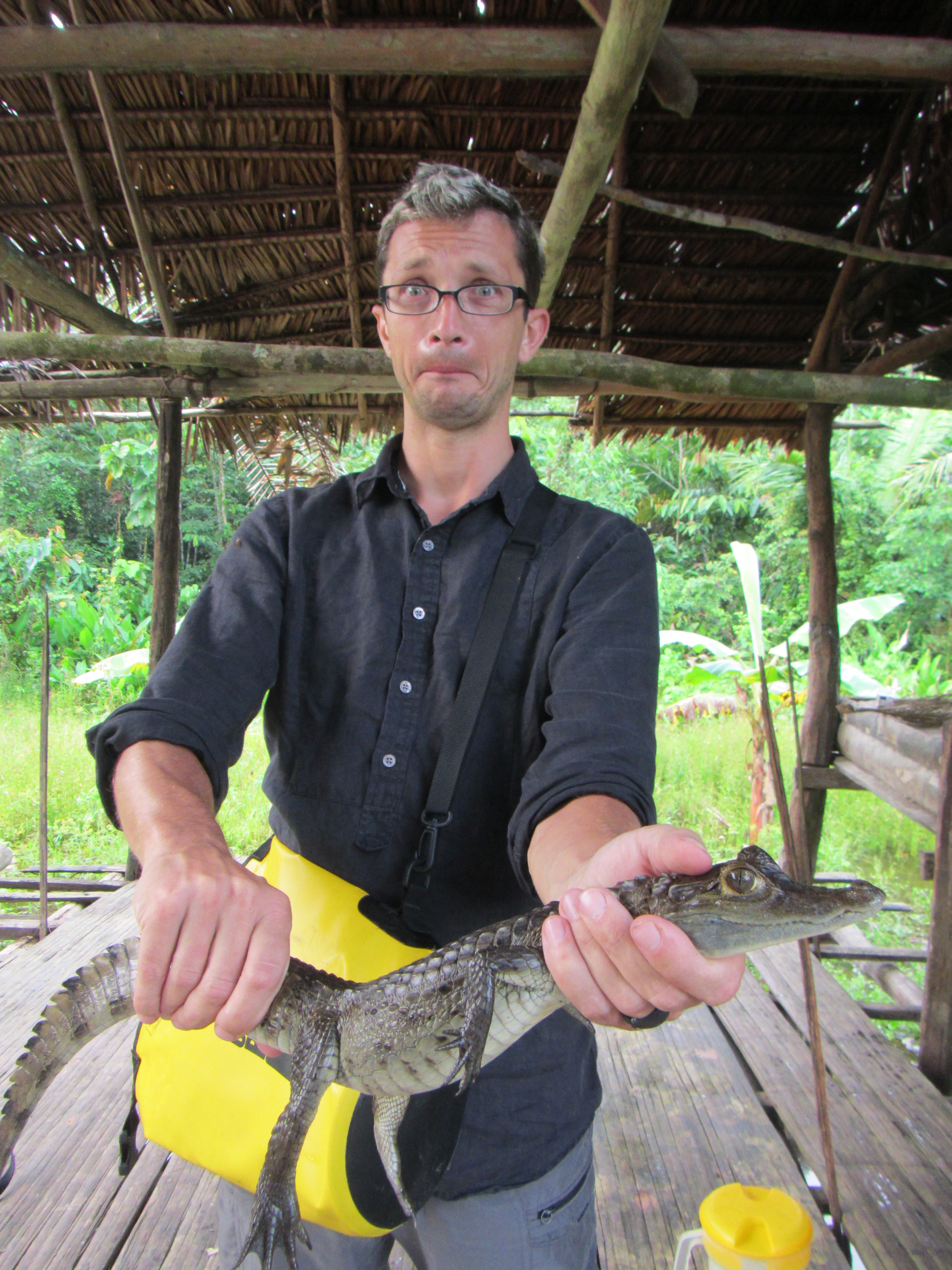
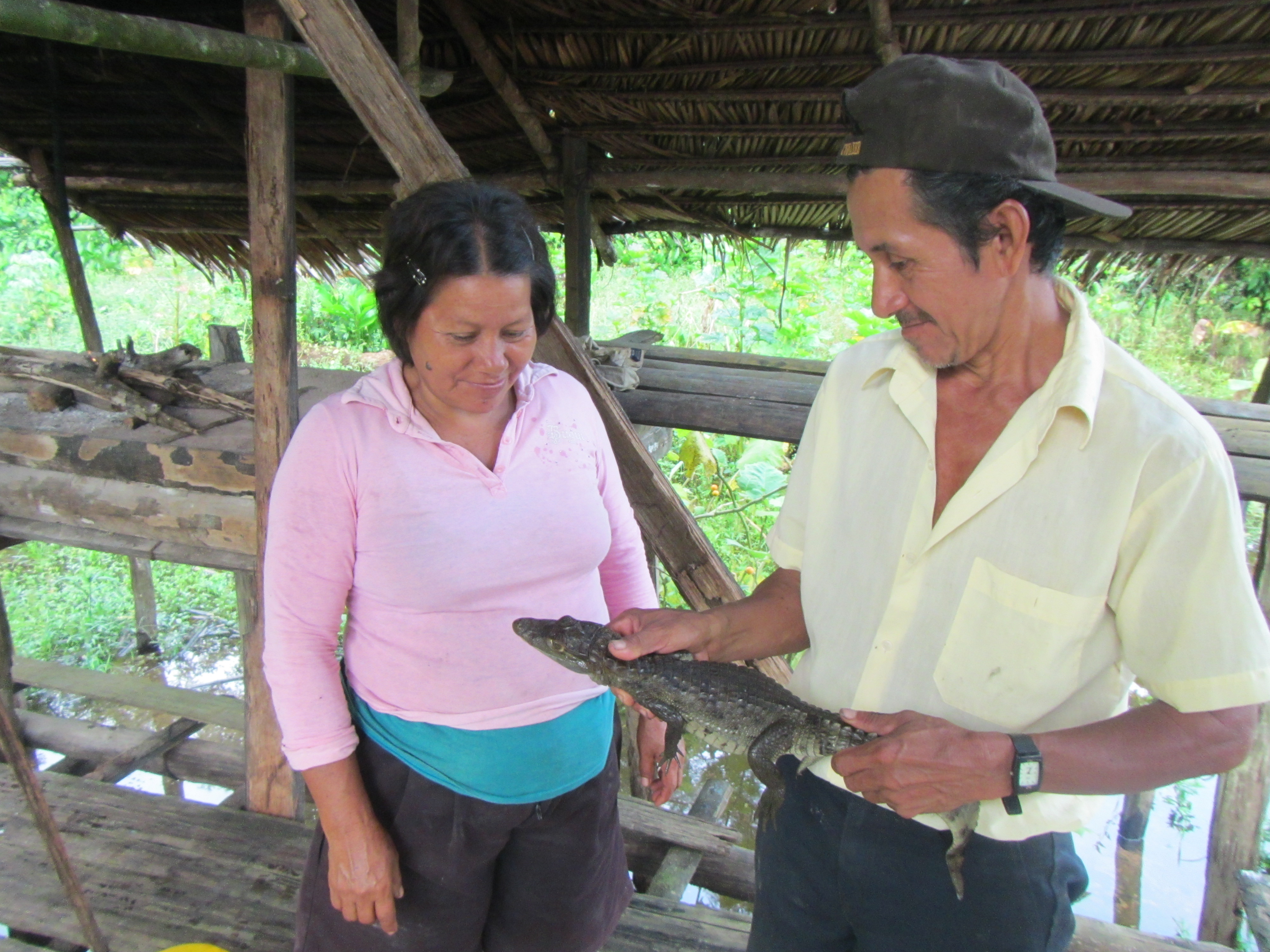
Shortly after beginning, Señor pulled our boat to the side of the river. He pointed out to us a very small crocodilian creature, I think a caiman. It was only a year old, and its eyes shone just above the water in the torchlight. Señor picked it up, and put it in a big shopping bag. We came across a second one, but let it go. We tried to make our best time, cutting out bends in the river by going straight through the flooded forest, which left me with a small lizard on my head. I have not mentioned them, but these lizards were abundant. Señor called them iguanas, but I will need to look up their English name at home.
IMG_3185

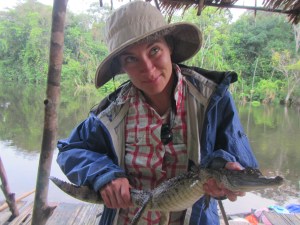
When we arrived at the little ruined cabana for breakfast, Señor pulled the caiman from its bag. He let each of us pet its pleasantly firm, ridged back, and showed us how to hold the beast. We each got to hold it, and then we let it go in the river. It stood in the bottom of the shallow water for a few minutes, and then crawled away into the waterlogged plants. We commented that we had just made the bathroom a bit dangerous, as I went wading in my rubber boots into the forest to answer the call of nature.
IMG_3190IMG_3195 IMG_3188

As we were eating breakfast, the sky darkened. We piled our things quickly into the boat, knowing that the cabana was in danger of collapse in a major storm. We covered everything with tarps. I put on my raincoat and the Professor’s rain pants, which he did not want, because they were hot and he would be rowing. Señor and Señora had made it clear that the larger boat required of this journey was a real bitch to row upstream, and the effort was hard on their older bones.

I was not feeling great either – I had slept on my back in a bad way the night before, and found myself unable to move my torso without a great spike of pain in my left hip. There we only a few positions I could take in the boat that were not painful, and none were comfortable. The Professor was not in pain, but had slept badly and was exhausted. We were none of us at our best.

We paddled off into the river. The sky opened in a terrific rainstorm. At first, I felt nonchalant about it, and enjoyed being in a real rainshower in a real rainforest. But soon, I began to feel like my wrists were wet. That’s odd, I thought, I am wearing a good raincoat, an old reliable that has kept me dry for years.

But I felt inside my sleeves, and sure enough, I was wet. My shirt felt damp too. As the rain poured on, I quickly discovered that my raincoat was failing me. Later, upon removing it, I saw that through heat in the backpack or simple wear, the waterproofing of the fabric had rubbed off along the seams in my shoulders, upper back, and hood.

In very little time, water was coursing down my chest. My legs, in brand-new rain pants, remained dry for longer, but soon the rivulets across my body flowed into a lake in the seat and underthighs of the pants. Being waterproof, they of course held the water excellently, just like a balloon.

Trying to adjust my position for the sake of my back, the back of my hands were briefly on the outside of the boat. The boat brushed into a section of palm tree poking out through the water. It was covered with spines. They embedded themselves in my knuckles. We paused a few minutes to work out the splinters.

Señor and Señora were working their hearts out, with the Professor speeding us along in high-current areas. I was distressed: in pain, soaking, and very very worried that Señor would throw out his back, or that Senora’s heart would burst. She had told us over breakfast that she took medication for her heart. There was nothing practical I could do besides keep my mouth shut and stay out of the way.

There was no sightseeing of animals, of course. Every single time Señor could cut off a meander by crossing the flooded forest, he did so. Sometimes, this made us pause as he stood in the front of the canoe, machete in hand, cutting us a path in the pouring rain. Once or twice, the big canoe got stuck between two saplings, or on submerged wood. At the most difficult one, Señor hopped out of the boat onto a log blocking our way. The log collapsed a few feet under the water, leaving him thigh deep in the wet stuff, but letting the boat go forward a little further.

It was still wedged between trees too close to each other. At the front of the boat, Señor pushed one half-submerged broken sapling aside. Señora stood on the collapsed log at the back of the boat, pushing. The Professor grabbed a tree to his right and a sapling to his left and mantled as though he was pushing himself above two rocks. The boat inched forward. It inched forward again. Finally, we were free. Señora got back in the boat, Señor hacked through some trivial brush like a swordsman among green opponents, and we finally gained the main body of the river. We crossed it and entered the forest again.

Señor had said it would be three o’clock by the time we got to the ranger station, but with all the shortcuts and The Professor’s help, we were there by noon. We were so happy to be somewhere dry. We all hung out our wet clothes, changed into dry ones, and ate pasta for lunch. We did our best not to bother Señor and Señora, so they could rest. I read a booklet from the ranger office about conservation of the lobos del rio, or giant river otter. We didn’t see any, but Señor had told me they had returned to being numerous in the region.

For dinner, we ate grilled goat with starches and salad. I asked Señor again about the man who had been sick back at the cabana.

He clarified things for me. In the heart of the forest, he said, lives a second kind of anaconda – the black anaconda. Everyone knows the yellow anaconda, he said, but the black one has never been in any book. Once, his own father was hunting for tapir, and he came across one, and tried to attack it. It ran as well as it could, but not far – it already had a young black anaconda wrapped around one of its legs. The little beast could not subdue the tapir, but it began calling for its mother, who could and did appreciate the giant meal.

The sick man had come across one of these black anaconda, Señor said. The man was struck by terror of the snake. The fear made him sick.

I asked Señor if he had any questions about the United States. He asked when boys and girls first get boyfriends and girlfriends. I told him usually between 13 and 17, though of course there are early and late bloomers. He said it was much the same locally, and told us that the (apparently 20something) ranger’s girlfriend, who was living with him at the station, was 15 years old and pregnant.

I was quick to say that we don’t generally want our people to start their families so early, and that teenagers often use birth control. He asked if we use the three-month shots, and I told him that we use those, and the pill, and also condoms and IUDs and implants. He was surprised at how long the latter two last. I felt a bit like an alien. He said he does not trust the pill because he has seen a case where a woman got pregnant while taking it, and the child was not normal.

He also was surprised that we neuter our cats and dogs. And I could understand why. After all our travels, I have come to the view that our pets are far more domesticated and controlled in the USA than in perhaps anywhere else in the world. I approve, but it is remarkable how unique it is.

– The Private Eye


The Second Story of Señor

Once upon a time, there was a monkey who was starving. He looked in all the trees, but couldn’t find any fruit or eggs, not even any insects that were safe to eat.

Eventually, he exhausted himself in his search. Sitting in a tree on yet another empty branch, he sighed in despair, because he did not have the energy to search any further.

But then suddenly, he had an idea.

Very carefully, he stuck his finger up his own butt and worked it around for a bit, since it had been so long since he had eaten. Then, he raised it up into the air. After a minute, he impatiently checked it – nothing. So he put his finger back in his butt and then, removing it, raised it into the air again. This time, he left it aloft for five minutes.

Sure enough, when he lowered his hand this time, there were flies on it. Lunchtime for the monkey!

In this way, he was able to sustain himself until he found more fruit.

THE END

– The Private Eye


Day 5 in La Selva, March 20

“Buenos dias!” called Señor from just outside the mosquito net. “Mira!”

We obediently raised the mosquito net and I put on my glasses. It was 7 a.m. Propping myself on my elbows, I could see an armadillo about a foot from our noses. It was an interesting naked little fellow with a few wiry hairs. It was also dead, with a gunshot to its neck just behind the ear.

Señor said Señora would be cooking it for breakfast; did we want any?

We said we would try it, then swiftly consulted the Neotropical Companion, our useful book on the flora, fauna and ecology of the New World tropics. Armadillos are incredibly common, as it turns out. So the Professor and I each ate a quarter of the beast with no problems. It was delicious, very much like good pork, and Señora served it with sautéed red onions, which marries well with both pork and armadillo. It was a nice change from fish, though I never was unhappy to eat fish.

(We hadn’t only eaten fish. Once or twice we ate pasta tossed in a light tomato-onion-chicken bouillon sauce and served with boiled eggs. Señora apologized for this, as she did for every meal that did not involve fresh meat and three kinds of starch, but The Professor was so happy.)

After breakfast, Señor, the Professor and I all boarded our canoe. Leaving Señora behind at camp, we returned to our trail of the previous night. We hiked through the rainforest to a tapir salt lick – a place where tapirs come to eat dirt. We had come there last night hoping to see tapirs, but had not. It was by an uprooted tree, and very muddy. Señor told us that people who hunt tapirs will sometimes re-salt a salt lick by peeing on it; I think I have mentioned that their diet is very salty. We did see some tapir tracks. It appears to be a large animal, but I have not seen one in the wild.

As we were walking, Señor cut a length of vine. It bled with a white juice, which he motioned to me to put over my mouth. “For your insides,” he said in Spanish; I had told him about the worms. I let the vine drip into my mouth for a few seconds, and it had a cool and mild taste. I asked him if I should have more, and he said no. The Professor tried a drop, thinking that dentro referred to teeth rather than insides.

I felt a bit funny for about 10 minutes after that, but it could easily have been the heat. I am happy to report, however, that the medicine appears to have worked, although of course I will see my doctor for a checkup after I return to San Francisco.

We returned to the cabana, and Señora prepared us fried fish, salad, yuca, rice and lemonade for lunch. Delicious. We were supposed to head back to the ramshackle cabana for another night after lunch, but there was a dark storm on the horizon. We should wait out the rain, Señor said.

We napped in our hammocks. Later, I opened up the Neotropical Companion, and Señor taught me the Spanish words for animals in the photos. I, in turn, taught him some English. He had a sheet of practical sentences in English written out, but he wanted to know more.

The storm was a long time coming. After a while, Señor asked us what we thought of waiting out the storm, sleeping in the same place, and getting up at 3 am. We could boat to the old cabana, have breakfast, and then continue on to the ranger station for the night. As The Professor observed, Señor and Señora seemed very happy to be in this nicer cabana, with a few of their good fisherman friends, a solid roof and happy memories of when they had lived here. So we were happy to oblige Señor on his plan, especially since getting rained on in the cabana of the vultures was not especially appealing.

We ate fried eggs and popcorn for dinner, and turned in early. As I was preparing for bed, I took out my contact lenses and washed them with solution. This was the first time I had done so in public, and Señora asked me if they were for my vision. She had never seen contact lenses before, so I showed them to her. She told me she is a little nearsighted, which is astonishing to me given how many animals she personally spotted high in branches. The Professor told her he prefers his glasses.

I should mention that the Professor came to this adventure without any Spanish at all, though he had some Italian and French, which are similar. I think this did not impress our hosts, but they – and I – became impressed with how quickly he picked up some of the language.

– The Private Eye


Day 4 in La Selva, March 19

I slept poorly on our first night of camping out of doors, kept awake by the desire to not wear earplugs in a strange and possibly dangerous place, with no walls to keep out animal or man. There was a great cacophony of sound, pleasant but complicated and intellectually stimulating, bad for sleep. One sound in particular haunted me, a mammal call (I later learned) similar to the rattling of bones.

Eventually the night ended, and we arose, ate delicious fried fish, potatoes and bananas with coffee. It was our first breakfast without any friends of Señor and Señora present, and we talked about some quite personal matters. I felt like we understood each other better, and that we did not seem as strange to our hosts as they learned that we have the same sort of human problems as they.

I did make an unpleasant discovery shortly after breakfast, which was that I had contracted worms. However, since i did not feel bad, i did not let it bother me much, and I did gain a certain amount of excitement when Señor promised to make me a traditional plant remedy.

Soon, we continued on our way – our last day moving forward into the wilderness before we began our return. We saw red howler monkeys quite clearly in some trees near the riverbank as we began, including a mother and child, followed by a whole troop of little squirrel monkeys, with adorable little faces and large eyes. Señor imitated their calls and they came even further out over the river on their branches to investigate.

We also saw several ring-necked kingfishers, a common bird we had seen before and which I admired for its handsome mallard-green body and striking black and white heads. Señor calls these birds martins pescadors. Strangely, it is St. Peter and not St. Martin who is the patron saint of fishermen.

We were not traveling so far this day, so we stopped en route to a location of dry(ish) land and took a walk through the jungle, with Señor making our way with his machete. It was hot, and buggy, and we were glad of our mosquito repellent clothing, but it was wonderful to see the stilt-root trees and the buttressed-root trees up close. We also came across a man with a rifle, and Señor told us that this was ok, because the man was hunting within the legal limit to feed himself and his family.

IMG_3149 IMG_3165 IMG_3147

Continuing on, we reached another cabana, this one in far better repair than the first. Some laundry and a backpack told us that we would not be alone on this night. Señor informed us that he and señora had lived there for a year and had put a lot of work into the cabana. However, he said, now many people used it to sleep in, but they did not upkeep the gardens or improve the structure in any way. Nevertheless, the floor was solid and so was the roof, and there were sturdy posts where we promptly tied our hammocks.

IMG_3181

Several fishermen returned, one of them obviously very ill. There was a tense conversation, with some significant glances in our direction, but I could not understand all the talk. Eventually, Señor explained to me that the sick man had a terrible headache. I, of course, offered ibuprofen, and then the Professor and I talked about how best to help, not being doctors. The man was already resting, and the Professor said fluids were the next most important thing, so I asked the other fisherman, through Señor, if the sick man had been drinking. His fellow replied nothing to eat or drink for three days! We had already noted, during the trip, that the people here drink very little – just a handful of river water on occasion, and lemonade from the local limons at lunch, much less than I would expect for hard workers like themselves. They do, however, eat a good deal of salt, and fish and yucca in broth.

I told them that the ibuprofen should be taken with lots of water. They did not look at me as if I were a pretentious ass for advising them on how to take Advil. The previous day’s adventure, this day’s experience, and further adventures instilled in me new appreciation for the medicine of richer countries. Ibuprofen is a precious rarity here where people are poor and all goods are brought in by slow boat. At home I buy generic bottles of 1,000 pills at Target.

I asked how the man became ill, and was told a story that beggars belief, and I still do not know if Señor told me this because he believes it to be true, or because he thought it was a good story, or because the truth is bad for tourist to know and he knew his tale would leave me speechless. It was this: three days prior, when the man was out seeking food for his family in the forest, he came across a young snake, which he tried to kill. He failed to do so, and the little beast called for its mother, who then gave the man the evil eye! The serpent can spit venom, but did not, in this case – merely gazed upon him.

It is possible that I have misunderstood the details of this story, but I asked several times about the gist and the answer was the same – the old snake eyes got to him.

He also had a fever. I put a cool washcloth on his head and refreshed it a few times. I did not get the washcloth back, but I didn’t want it anyway.

Two bufeo dolphins passed us on the river.

While we lolled in hammocks and did some laundry in the river, and Senora cooked for us, señor carved us a walking path in the jungle with his machete. That night, we viewed it in the darkness, with the moonlight illuminating small blue windows of foliage. We saw a tarantula, and tapir tracks.

– The Private Eye