When we departed for Southeast Asia, we had very few entries on our must-do list. There’s a trade off here. If you prepare a lot and figure out exactly what you’re going to do and you are unlikely to waste much time. But you’re also unlikely to take advantage of opportunities or discoveries as they arise. In our usual travel schedule, which for practical reasons is typically is 5-6 days, we try to follow the guideline that each person has one MUST, something we will so or do come hell or high water. For example, when we went to Paris, for The Professor it was the catacombs, for The Private Eye it was the unicorn tapestries at the Cluny. Of course there are lots of things we would like to do, but it’s OK if we don’t get to all of them, while missing a must is a calamity. Given the length of this trip, we gave ourselves a bit more flexibility than just one must each, but tried to keep the list short.
Angkor Wat was near or at the top of the list. Everyone who has traveled to the region and visited it almost always names it first. The Secretly American Englishman told us stories; The Professor’s Traveling Teacher Cousin recommended several days; almost every backpacker we’ve met has either been there or has it on the itinerary.
Our original thought had been to go early in the trip, perhaps after Laos. But the chilliness of Luang Prabang led us to yearn for beaches, and so we headed to Ko Tao and resolved to make Angkor Wat a bookend towards the end of the trip. And so, after the culture of Bali, the beaches of the Gilis, and the fast-paced modernity of Singapore and Kuala Lumpur, we flew to Siem Reap, Cambodia, the city a few kilometers from Angkor Wat and the center of its tourism industry.
The change from the metropoli of Singapore and Kuala Lumpur was wonderful. Here in Siem Reap, we are back in backpacker country, where a restaurant meal is $3, a beer on tap is 50 cents, and street food is typically $1. Our room, with daily cleaning and a fan (but no AC) is $8. Our daily budget is $80 for the both of us, thirty of which is for culture (museum tickets, passes to the temples, etc.).
So what is Angkor Wat? If you don’t know, don’t worry – neither did The Professor until his Traveling Teacher Cousin mentioned it. Angkor Wat itself is an enormous temple, built in the 12th and 13th centuries at the height of the Khmer Empire. It is the largest religious structure in the world. But Angkor Wat is not alone. Around it are a multitude of other holy sites and temples of tremendous scale and intricacy, from the holy city of Angkor Thom to the lake temple of Preah Neak Poan. To give an idea of the scale: the lake temple is one of the minor sites, consisting of an artificial lake that is 900 meters long and 3.8 kilometers wide. That’s approximately 3.5 square kilometers of earth that was dug to a depth of several meters, in the twelfth century, so by manual labor. The Pyramids are enormous in their scale: now imagine if they were covered on every surface with intricate carvings of religious and mythological scenes. Some of the sites, such as Angkor Thom, cover square kilometers. These aren’t places you can view on foot – you either hire a tuk-tuk or use bicycles.
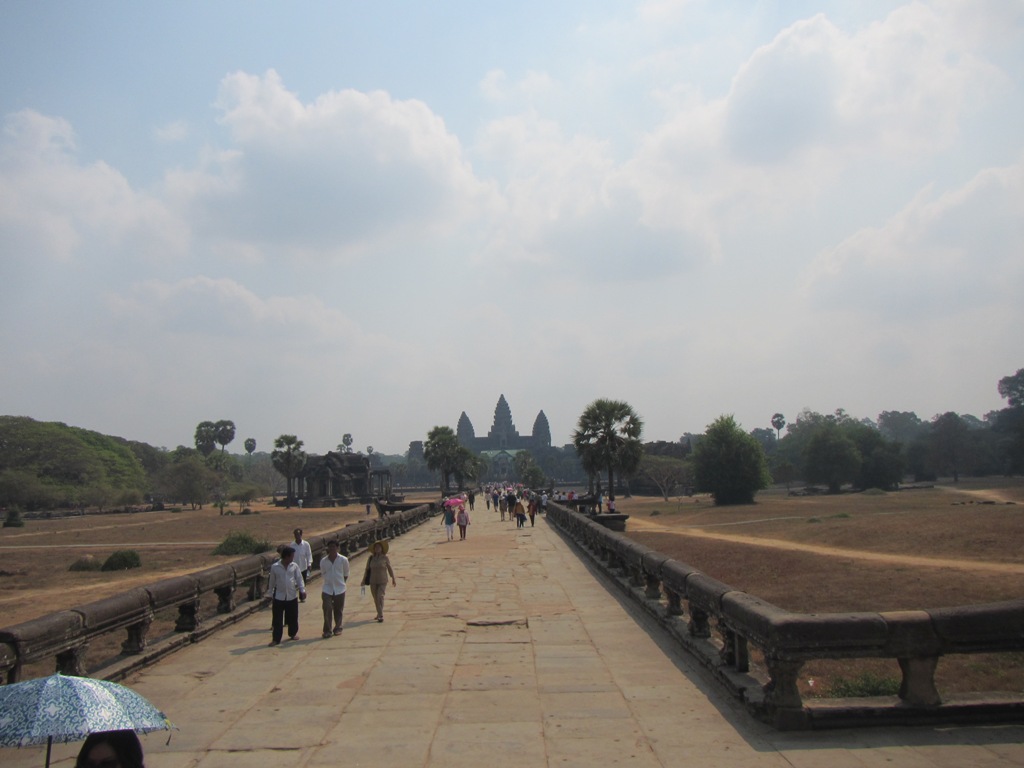
Our first day, an early flight out of Kuala Lumpur meant we were quite exhausted. So we found a place to stay, searched for good bicycles (knowing we would be on them a lot) for $1 a day, and explored Siem Reap a bit. It seemed like a really pleasant place, insofar as the people are friendly but much less pushy, selling-wise, than in some other places we have been.They’ll try to convince you to buy, but also appreciate when you joke about why you can’t ( “No tuk-tuk, we are already here!”) and will sometimes make jokes of their own (“best price, $1000 for you!). There is a river park running through the middle of town, and while the town isn’t fancy it seemed quite comfortable.
In short, a great place from which to go on marvel-viewing excursions. We have done three days of temple gazing. We took one day off in the middle to go to the National Museum, to get a helpful dose of knowledge to inform our second and third days.
The temples were built during a time of religious transition from Hinduism to Buddhism. Angkor Wat itself was build as a monument to the Hindu preserver of the universe Vishnu, but was converted to Buddhist use and remains a religious site. This means that there are monks who come to visit and take pictures, just like regular tourists! It also means that, unlike all the other temples with their spotless park-run toilets, you have to pay to use the bathroom at Angkor Wat.
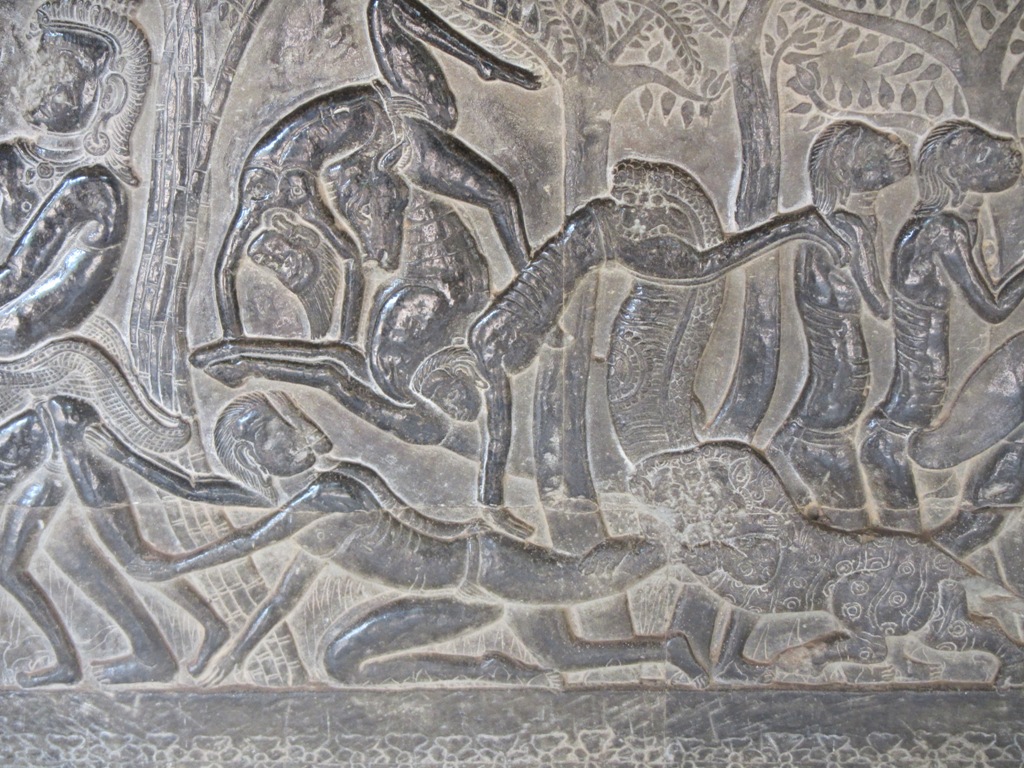
Not that that matters, of course. The building itself was awe-inspiring, a flaming mountain of stone covered with reliefs depicting stories ranging from the Ramayana to the Churning of the Ocean of Milk, a story as to how the gods and demons working together created the elixir of immortality. Additionally, there are endless reliefs of apsaras, beautiful dancing nymphs. We visited it twice, once at dawn when we watched the predawn light from a small, quiet structure with just a few other folks, and once in the late afternoon, when we climbed to the highest level and then descended and watched the clouds turn clear yellow over the walls from the eastern gate.

Atmospheric animal of the dawn: the white horse sleeping in the field near our mini-temple vantage, who would shake his neck with a jingle of bells every few minutes.
Educational animal of the dusk: the big monkey who robbed the Private Eye of her half-full large water bottle. Having faced off with a monkey for shoes in Luang Prabang, she found herself unwilling to risk a bite over a water bottle – thus encouraging the animal to rob more tourists, as The Professor has accurately pointed out. The monkey promptly opened and drank the contents of his robbery.
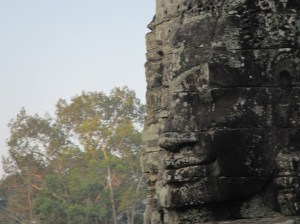
In contrast to the Hindu Angkor Wat, Angkor Thom is actually a walled city, with a central temple Bayon, which is covered with giant reliefs of Buddha’s face (said to strongly resemble the king). We explored the Bayon and the rest of the city after watching the sun rise over Angkor Wat. Only the stone structures remain, and a dry and flower-scented forest has grown up where houses and shops and even the wooden palace used to be. Being as it was 7 am, we had some of the smaller temples to ourselves, or almost. At one, a police officer was waiting. Assuming him to be on duty, we asked if we could climb the pyramidal structure. He said yes, and began ascending with us, and then The Private Eye remembered that this could be a scam that a guidebook had warned about. So we got off of the little temple, declined to light some incense with him, and got out as quickly and politely as we could.

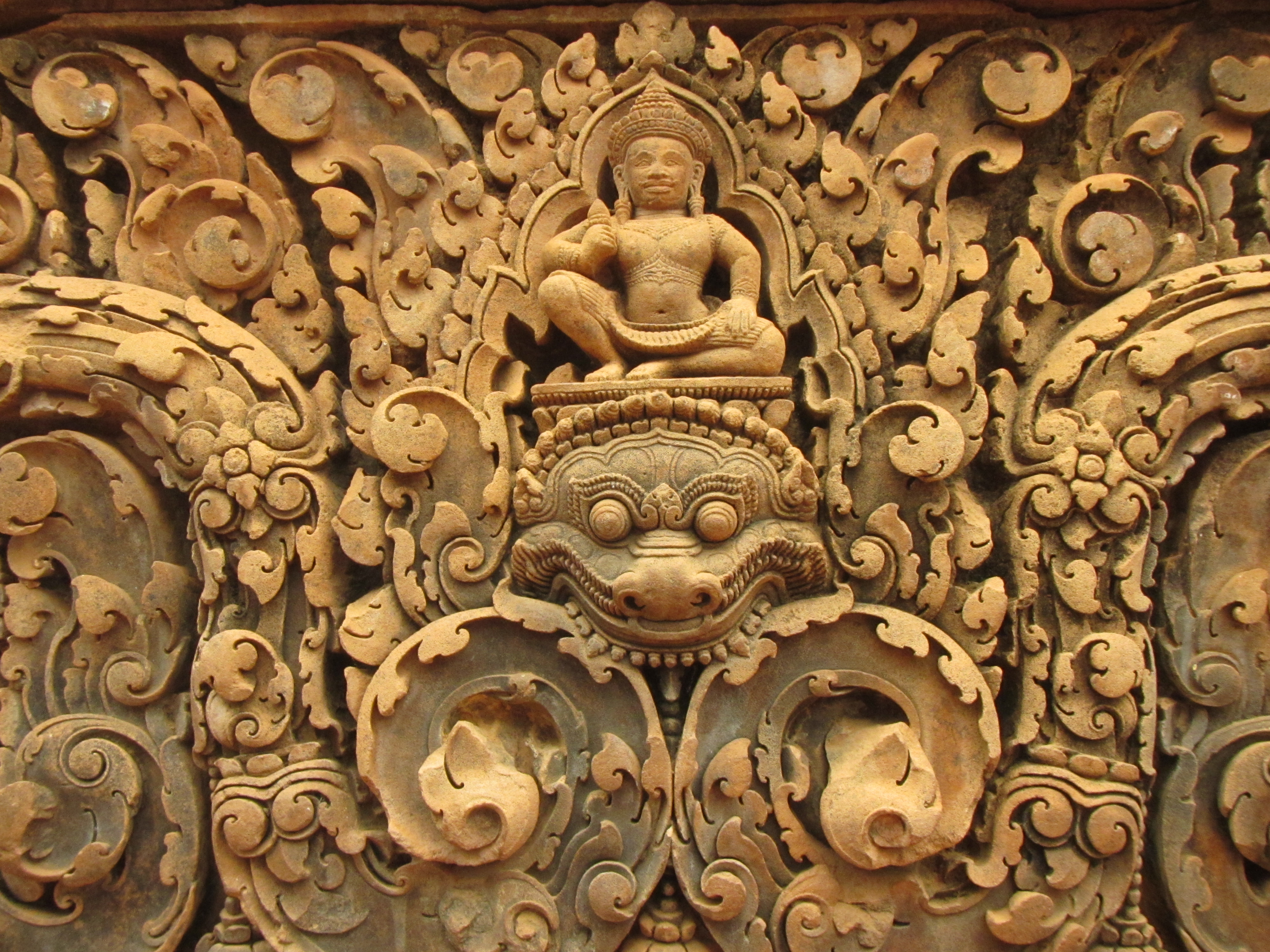
Yesterday, breaking from our usual habit of bicycling everywhere, we hired a tuk-tuk to take us to Banteay Srei, a Hindu temple carved of beautiful pink in sandstone In very intricate reliefs. Though a smaller temple, it was very much worth the trip. Each doorway featured a different scene from the Hindu religion, and they were NOT all the Ramayana. The flowers, the garlands, the apsaras, the monster faces, everything was just beautiful. And though it probably was not actually “built by ladies, no man’s hands could do that work”, we liked that it is presently called the Lady Temple anyway. It was not commissioned by the king, unlike the other temples – it was instead commissioned by an educated man, an advisor to the king, who clearly had wonderful taste. Apparently that particular pink sandstone is also better for carving than other stone.

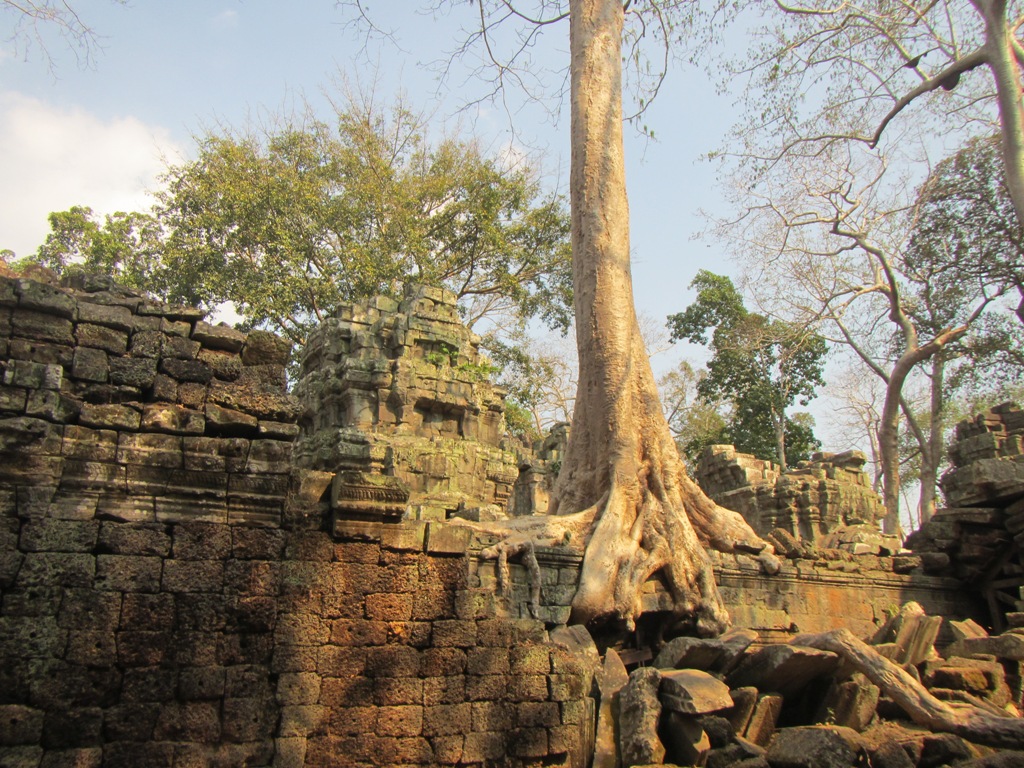
The Professor’s favorite temple: Ta Phrom, eerie in how it is overgrown not by vines, but by enormous trees that grew over decades or centuries:
What’s amazing about all of these temples, in their scale and number, is that the civilization that built them collapsed and abandoned most of them, much like the Maya abandonment of Tikal. We have read some claims that Angkor was the largest pre-industrial city in the world, larger than Rome. But unlike Rome, we know so little about it. Besides the carvings on its stone temples and the narratives of Chinese traders and diplomats, no written records survive. Why does Angkor Wat face west? When was it completed (we know approximately but not exactly)? We don’t know exactly why the Khmer Empire collapsed, though we know some of the historical factors concurrent to that time, such as the rise of the Thai empires, the Black Plague, and other events that must have impacted what had been the largest empire of Southeast Asia. Some of these temples, which must have taken thousands of people working for years, were completely lost and forgotten. Imagine living in a country that was once the greatest empire in Southeast Asia, but that being part of your identity is near impossible because nothing is known about it. So tourists come to wander these ruins, whose intricate carvings tell Hindu and Buddhist stories, and the only way to connect with them is in the present and the now, since the past is closed off.
– the professor and the private eye, tag team
 The Professor and the Private Eye: Adventures Abroad