We’ve seen dances in three different cultures: Java, Bali, and Cambodia. Rather than discuss the differences, I thought I’d just give examples. These are from Bali:
Java (sorry it is sideways):
Cambodia:
— The Professor
We’ve seen dances in three different cultures: Java, Bali, and Cambodia. Rather than discuss the differences, I thought I’d just give examples. These are from Bali:
Java (sorry it is sideways):
Cambodia:
— The Professor
Our last full day in Yogyakarta was an educational one. First, we went to the Benten Vredeburg museum in the downtown. This is an old Dutch fort that was converted to a history museum of Indonesian independence and early national struggles. I really enjoyed the dioramas, which were high quality and probably took someone a long time to make. The stories they depicted bore a heavy stamp of “official history”, but as I was unfamiliar with a lot of the history and appreciated any education, this did not bother me all that much. It is amusing, though, how many were devoted to meetings, a dry subject when taken without the gloss of myth making.

Of course, for the many high-school history students there, we were part of the attraction. We starred in a lot of cell phone photos and made friends with their teacher.
We then got lost for a bit attempting to find the bus to Kaliurang. But eventually, we boarded a scrofulous foam-entrailed minibus which took us to the right village, and we chatted with an pleasant small scale businessman on the way. From Kaliurang, we attempted to board another minibus to the Ullen Sentalu museum. It was going there, but we were going to have to wait another hour for its regularly scheduled departure. Instead, we gave the driver an equivalent $3 to drive there right away.
I really liked Ullen Sentalu. It was up the slopes of the volcano, so the weather was cool. It has beautiful buildings on beautiful grounds, and is a gracious and personal museum of four sultan families of central Java, created and kept by one of those families. Especially charming was the room with many letters to a princess, encouraging her to keep up her strength and happy nature after her parents denied her marriage to her beau. They all had poetic phrases and photos of the sender; the girl’s parents eventually relented.
There is also a great collection of portraits both painted and photographed, an in-depth look at batik, and other quiet treasures. You have to have a museum guide to tour Ullen Sentalu, and ours, Tammy, was a real pleasure to talk to.

Afterward, we caught a cab home and went out for jackfruit curry. I liked the curry just fine, and the fruity pressed tofu quite a lot, but I couldn’t handle the solid fist of organ meat that came with it. Oh well, I just got more tofu.
On the following day, we flew to Singapore. I really like the Yogyakarta airport, which
is a startlingly good place to buy souvenirs. It was much better than Jakarta, where we had a layover.
Singapore began for us with meeting up with our friend Life Is Too Short, who we’d met in Luang Prabang. It was 8:30 pm by the time we were settled and ready for action, so we walked to the nearest hawker stall food court, the Lavender Street one about a block away. I ordered dumpling soup with greens, a plate of bao, and a juice from a fruit I had never heard of before. I sat down with The Professor and our friend, took a bite, and fell in love with Singapore. The fastest way to my heart really is through my stomach, I guess.
– The Private Eye
I will admit that for a couple of days, I actively disliked Ubud.
How can this be, you might wonder? This is, after all, a city where art reigns supreme, where mask-carver, batik-maker and painter are viable day jobs. Further, this is the city of love in Eat, Pray, Love. But I didn’t love it to start, though i came to like it very much, and I hope the reasons why may be of use to other travelers.
First: my greatest regret about our preparations for this trip is that neither of us learned to ride a scooter. Despite the fact that one of our dear friends is nothing less than the Scooter-Preneur of San Francisco, and another of our dear friends owns and rides a scooter, in our presence, all the time — we just never learned. In Asia, we soon came to understand, this is the equivalent of deciding not to learn to drive a car in America. You can do fine in major cities, but in the country or in a place without strong transit infrastructure, like Bali, you will be hiring a car and driver, which was a largely unexpected and unwelcome expense. Self-driving car rental here is thin on the ground. Locals tell you about all the tourists who die every year learning to ride scooters here. Fellow travelers who didn’t heed the warning invariably show you some scrape or another from a more minor accident.
This being the case, we decided to base ourselves in the center of Ubud, so we could walk quickly to many of the main attractions, rather than basing ourselves in some blissed-out rice paddy twenty minutes by foot from town proper. This turned out to be a fine decision for many practical reasons, and I really liked our guesthouse, but the center of Ubud is now well and truly touristed. Picture being at Pier 39, but every shop is filled with interesting things, and has a kind-looking woman out front urging you to buy. Every street corner has a man asking if you if you want taxi, transport. It’s great for shopping, but a bit overwhelming for me – I tend to notice everything, and everyone, and feel drawn to connect based on very minimal contact. This is a great quality for my work, but a lousy one for navigating a new bazaar in a new country where I feel unsure of myself. Point being, our particular location meant that we could not walk anywhere without being subject to 10 minutes or more of this.
Add to this the 90+ degree heat and humidity that turns my face into a 12 hour wellspring of sweat every day, and I was having trouble enjoying all that is amazing about this place.
But what a difference a new friend makes! The day after we met the Art Teacher (the expat from Canada who lives in Turkey and was here on vacation), we did not see her. She was doing her batik class, and we were making our rings, which I loved as it was both quiet and fully engrossing. Afterwards I had a tougher time enjoying myself, though The Professor and I did a nice sunset walk on the Campuan Ridge (rice paddies, towering pastel cloud views, charming local teens smoking and flirting in quiet corners of a thatch-field atop the ridge), and saw the Kecak and Fire Dance.

Both are very worth seeing, by the way. The former features a cast of shirtless men who chant monkey-like chitterings as the only musical accompaniment to a drama of a portion of the Ramayana; the section stars Hanuman the monkey king, of course. The latter features a man, supposedly entranced, who is “riding” a hobby-horse over a bed of hot coconut husk coals barefoot, each charge of knight and steed resulting in a beautiful and shocking shower of embers directly at somebody’s face, but never touching them. Attendants swept the coals back into a pile after each pass, until the man astride the magic gallops through them again. Eventually he collapses from exertion and is revived by the priest. I know this is an old ritual tarted up for tourists, but it remains powerful.

And yet despite the wonder I remained discontent! But that all changed the next day when we met up with the Art Teacher at the Threads of Life textile center for a lecture. It’s a worthy organization with an approach both practical and academic to preserving Indonesian weaving traditions throughout the archipelago. And the Art Teacher was so enthusiastic and knowledgable about it, and about Bali/Ubud in general. She is very smart, and tells good stories, and it was a pleasure to talk with her. Suddenly, I could appreciate the quiet lanes off the main roads more, and feel a bit less affected by the pleading on the busier streets.
The lecture was followed by a lunch of delicious suckling pig in a nearby warung, where we relaxed despite future daily specials squealing on a balcony one floor below us. Then, following the clue that our laundress had been all dressed up that morning, we went to the temple of the dead. We missed the ritual, but enjoyed seeing the architecture and banyan trees, and just sat around on a shady platform talking. Then we got the bright idea to go to the Setia Darma Museum of Masks and Puppets in the village of Mas, which was exceptional – and was another great place to sit and talk when we weren’t appreciating remarkable art.


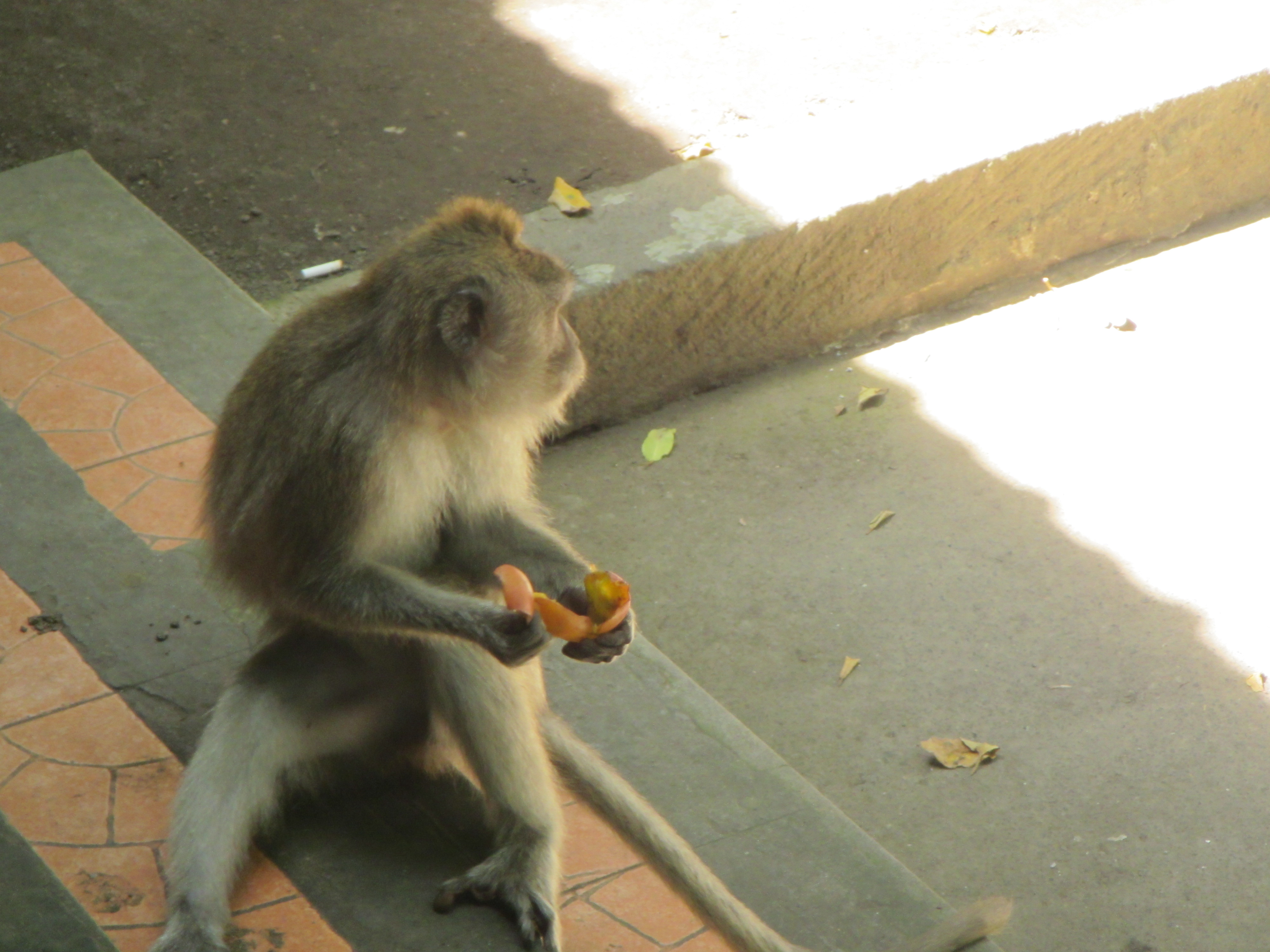
When we got back, we separated near the Art Teacher’s part of town, which is still busy but less frantic, near the Monkey Forest. We parted, and the Professor and I decided to find the studio of the artists we had met in the gallery on Hanuman Street. It turned out that the studio lay directly behind the sacred monkey forest, and that there is a “bike path” (scooter route) that leads there which follows the exterior fence of the forest. We saw plenty of monkeys on our walk, including a baby monkey that was so tiny, it had trouble managing its rambutan fruit.And we didn’t have to pay to go into the forest! And here are full-grown ones:

Behind the forest, past a woodcarver’s house, lay the studio. It was open walled, cement floored and tin roofed, and the artist I had spoken with for a long time at the gallery was the only one at home. There were stacks and stacks of paintings in racks along the edge of the space, and suitable seating for such a place, such as old car seats and a large sculptural high chair, and some cheap plastic stools near a home-made table. The artist welcomed us, and we shared our mangosteens, and talked until the sun set about Indonesia and America and his art and the yoga-people who come to Bali — both the good and the over-the-top ridiculous: “yoga blah blah blah”. Also hilarious: his explanations about why Balinese men get a lot of action from female tourists, though our host did not relate that he had had any such adventures. I admire a man with discretion.


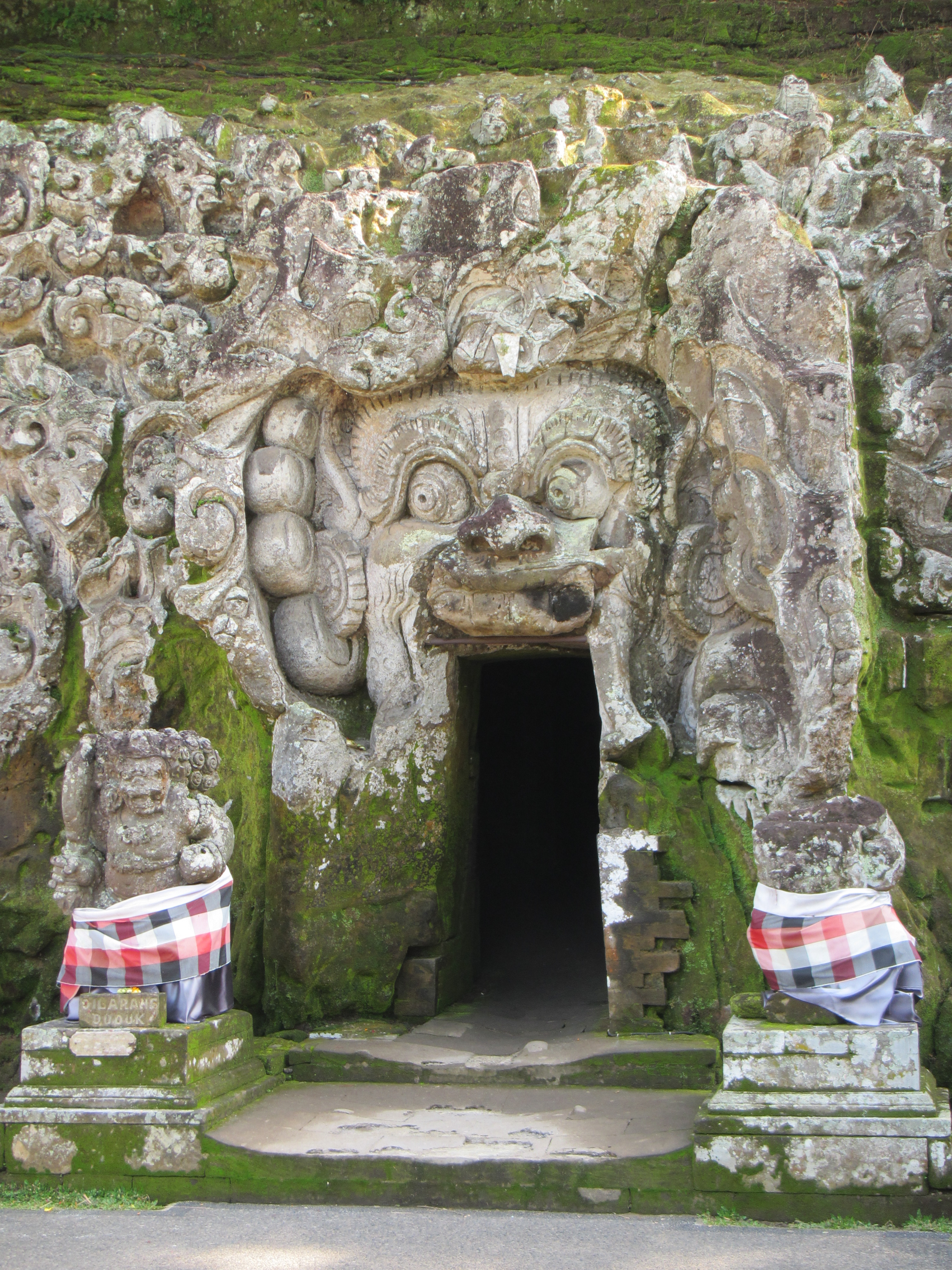
We bid him farewell and had a nice duck dinner, and then went to bed. On the next day, the Art Teacher, the Professor and I walked to Goa Gajah, a cave whose opening is carved in a monstrous face. We then went to Gunung Kawi, a site of old ruins in niches of a rock face. We retired to our homestay for the heat of the day, where I spent my time learning Bahasa Indonesian words from our host’s children, while teaching them English words for things. It was fun; I also tried to teach the oldest tic-tac-toe, but I fear I am a poor teacher and we turned it into a counting game.
Later, we went back to the palace and enjoyed a much more exciting Legong dance than our first one, the dancers seemed much more passionate. We also saw the Barong dance, in which a large, shaggy embodiment of good does some onstage comedy with a monkey, and later fights a demon. Predictably, I love the Barong. So do children everywhere!
Barong: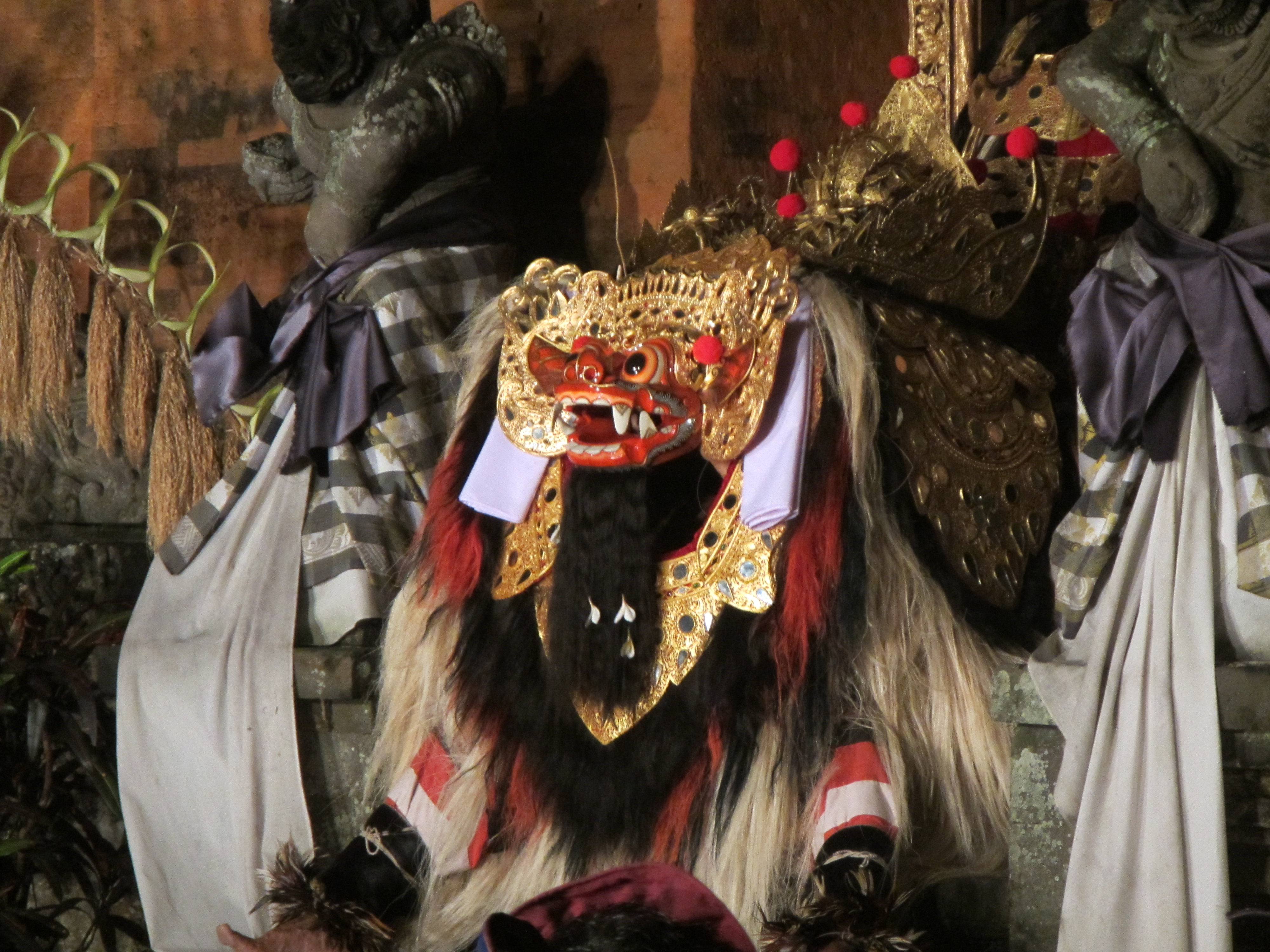
Demon: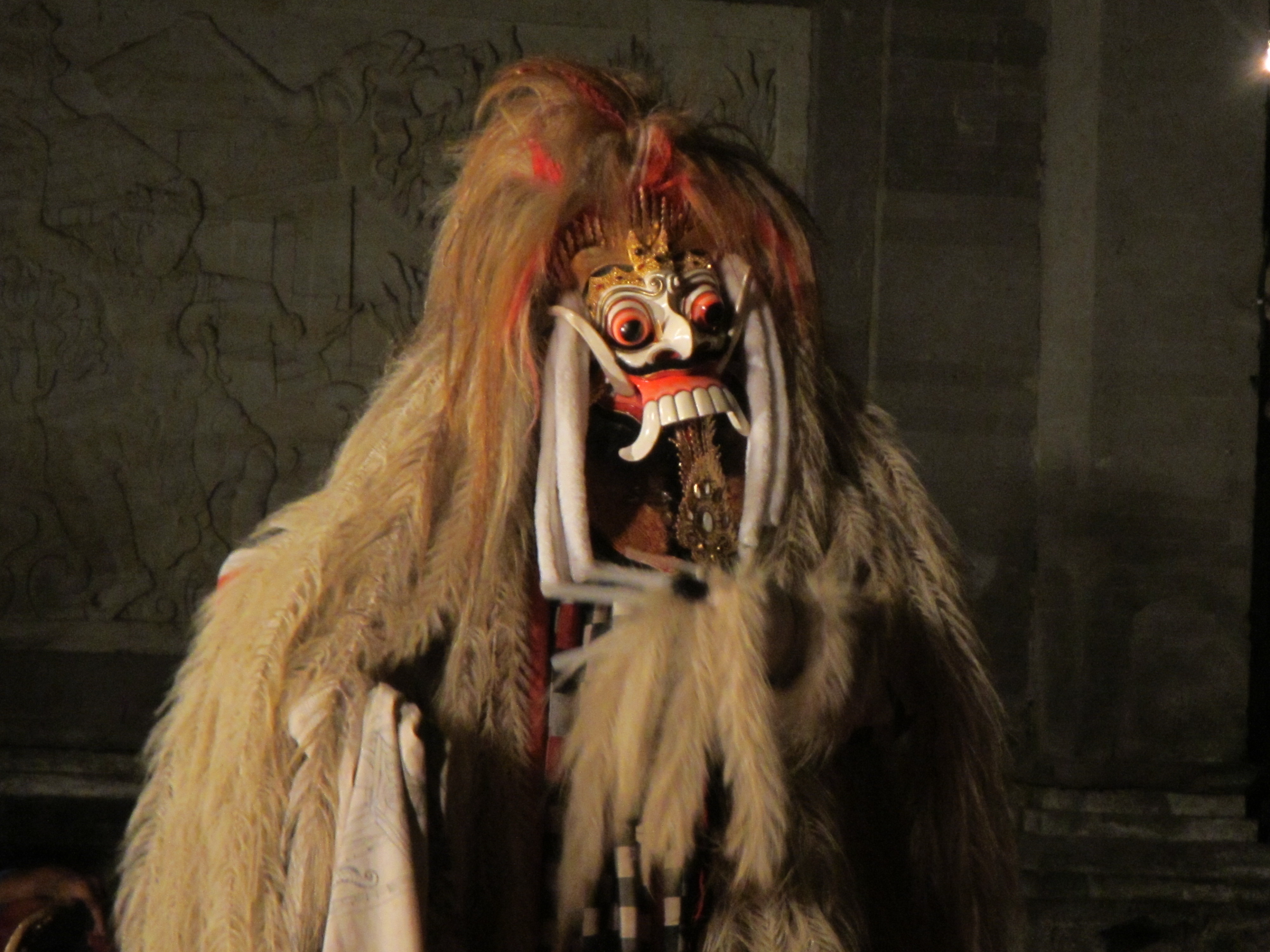
It was a great performance.
Today, we head on to Amed on the east coast to dive the wreck of the USS Liberty. I am looking forward to less humid weather, but I have come to appreciate Ubud more, thanks to our hosts, their children, the artist and the Art Teacher. It is amazing how much kindness and conversation can turn your whole view around.
– The Private Eye
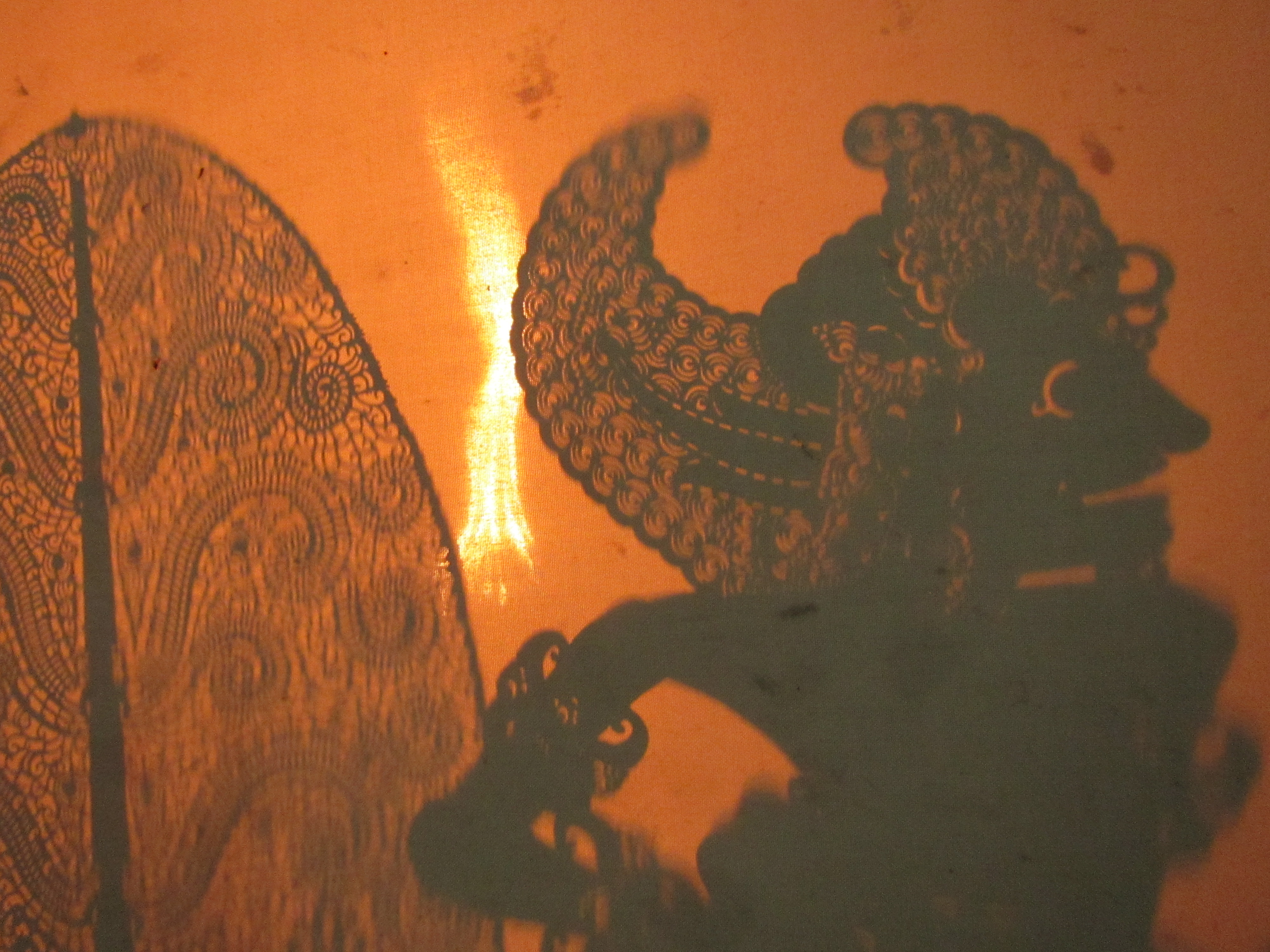
There’s a long list of artistic and cultural places we want to go and things we want to do here in Ubud: art classes, dance performances, museums, and more. The Private Eye has, since her making a large parade-style puppet last year, been very interested in puppetry. Shadow puppetry is an art form here, called Wayang Kulit, so we made Sunday night’s venture to go to a show. There was a simple sheet, with a torch behind it. You could see where, over decades, the torch has sooted the ceiling black and eroded the plaster a bit. The puppetmaster was 80 years old, and had several assistants. The show we saw told the story of the Sacrifice of Bima, where Bima offers himself as a sacrifice to a demon to appease it and save a kingdom, then defeats it in battle.
We met an expat art teacher (from British Columbia, now teaches in Turkey) who comes to Bali every few years to learn some new arts. We chatted for a bit and might meet up tomorrow for a walk around the city.
On Monday, 2/4, we woke up and made our way to the small private library that is seemingly becoming our base of operations. We’d scheduled a silversmithing class for 10AM: 3 hours cost R200k/person ($25), including up to 3 grams of silver, you pay for the extra silver if you want to use more. After a bit of discussion, we decided to make rings, similar in shape (both ringed bands with designs within), but different in style. Our teacher, Anna, has been a silversmith all her life, and her entire family are silversmiths.
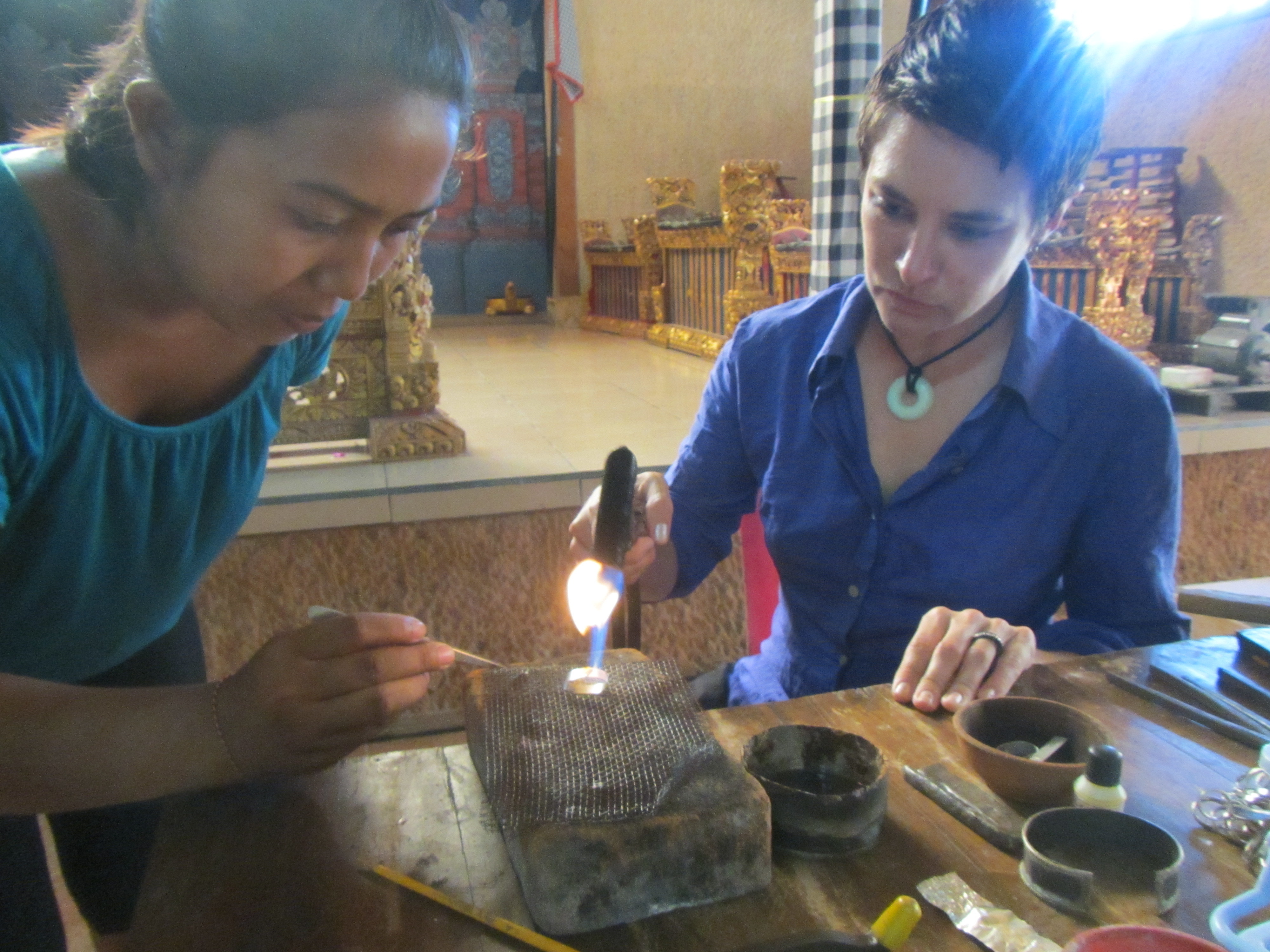
First, you decide how big a ring, and cut a piece of silver (92.5% silver, 7.5% copper) plate of the right width and length. You then solder (with silver solder) the two ends together, and shape it into a circle. You then add the wires that form the rings on the edges of the band, and solder them on. At this point, you have two simple silver rings, and you need to add the decoration.
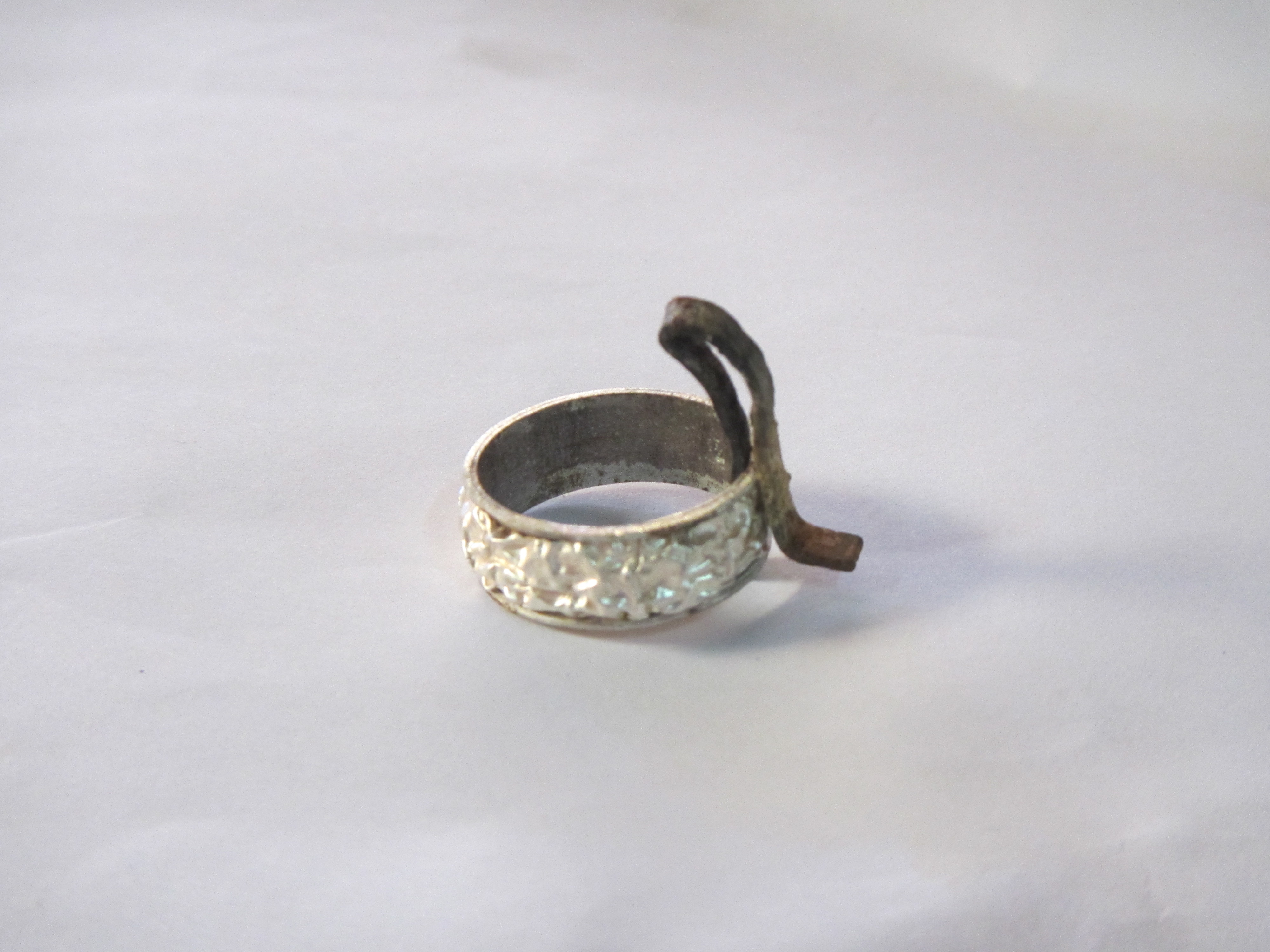
I chose a design that I’d never seen before, but in my typical style is much easier to do than it looks. You take a thin piece of silver plate and crinkle it up, heat it, and crinkle it up again. You cut the plate to the right length and width to fit between the rings, and solder it in.
The Private Eye chose a beaded design with curls. To do this design, you take thin silver wire and bend it into the desired curls, then glue them to the face of the ring. Using tiny bits of glue, you then affix tiny silver beads; she also affixed some small disks.
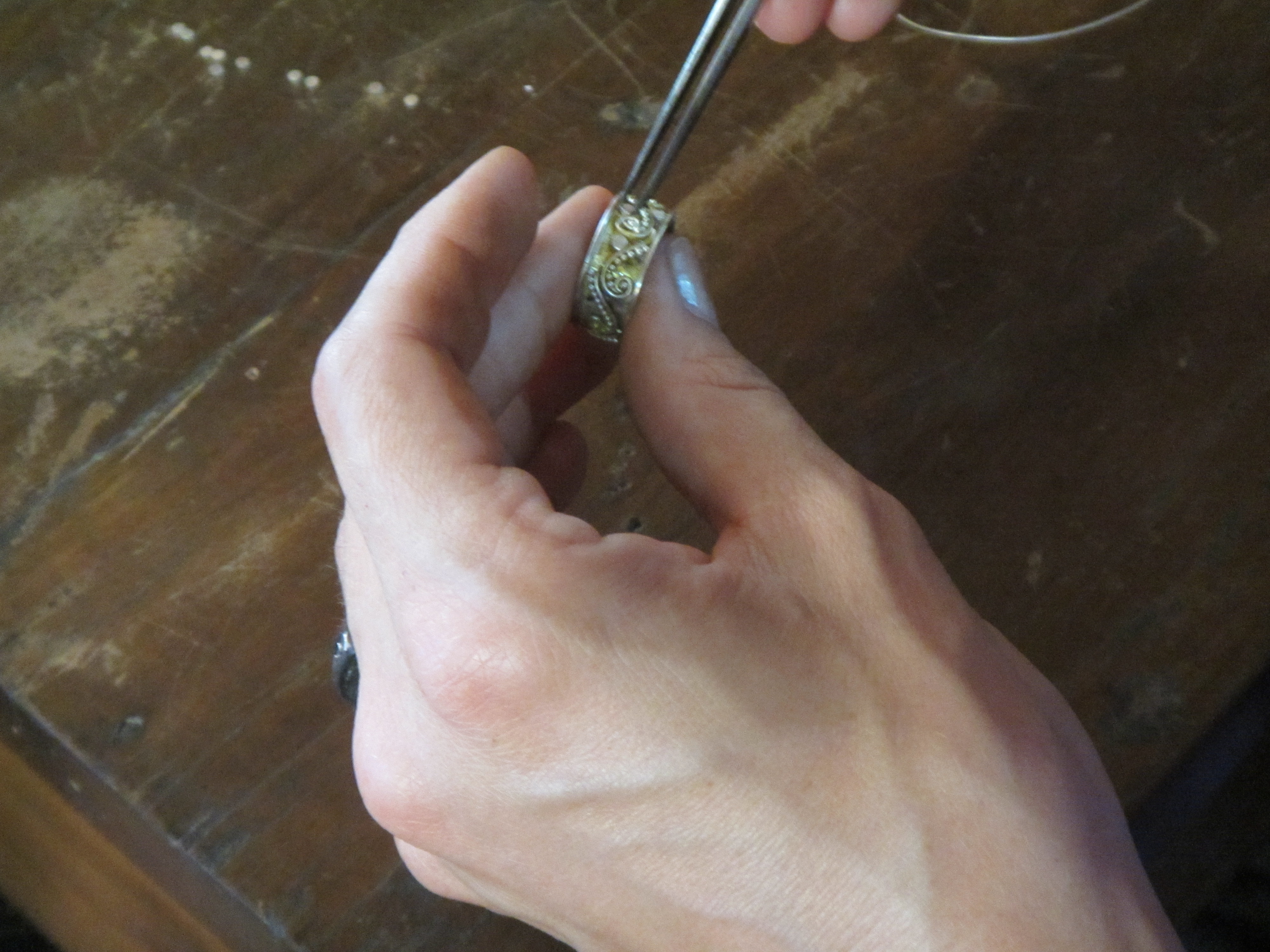
You then dab some solder around the pieces and heat the ring, replacing the glue with metal. To heat the rings, Anna had a foot pumped propane torch. Very simple, but it works!
After the rings have cooled, you polish them, inside and out. We used an oxidizing solution to darken recessions in our designs, then polished again to make the raised regions shiny. Two hours later, we had silver rings made by our own hands.
We are trying to keep to a R500k/day ($60) budget, which would be easy except for all of these artistic ventures. To attend a Kecak dance tonight we’re going to cheat and borrow from tomorrow’s finances. Food isn’t too hard — you can get a tasty meal of noodls or fried rice with vegetables for R15k. Of course there are also super-fancy places here with R60k desserts, but we’d rather spend our money on art and save for diving and other adventures.
We haven’t quite figured out our schedule yet. It turns out that Life is Too Short (whom we met in Luang Prabang) has been distracted by Myanmar, so might not make it to Bali until the 16th. We definitely have a few more days in Ubud, but don’t know how many. I don’t know if we are going to try Kuta (the Bali foreigner party city) at all, or just avoid its western stuff and skip directly to Gili Air.
(this post is a bit brief and choppy because I’m trying to finish it quickly before The Private Eye returns from the spa!)
— The Professor
Well before we arrived in Ubud, we were struck by the immediacy of Balinese art. The goggle-eyed faces peering out at us around Denpasar evoked both fear and laughter, as though every face was a laughing face lit by firelight from below. Scary. Funny. Somehow part of some full-bellied, cosmic joke. Even the sculptural decoration of columns and walls seemed so aggressively three-dimensional as to be extra-dimensional.

So when we saw a dance performance at the palace last night, all that imagery came to life for us. The Professor and I disagreed about the performance quality – I found it solid but not brilliant, in part due to a lackluster audience; he found some of the performers amazing – we did not disagree about the strong performances among the troupe and the transfixing nature of the dance period.
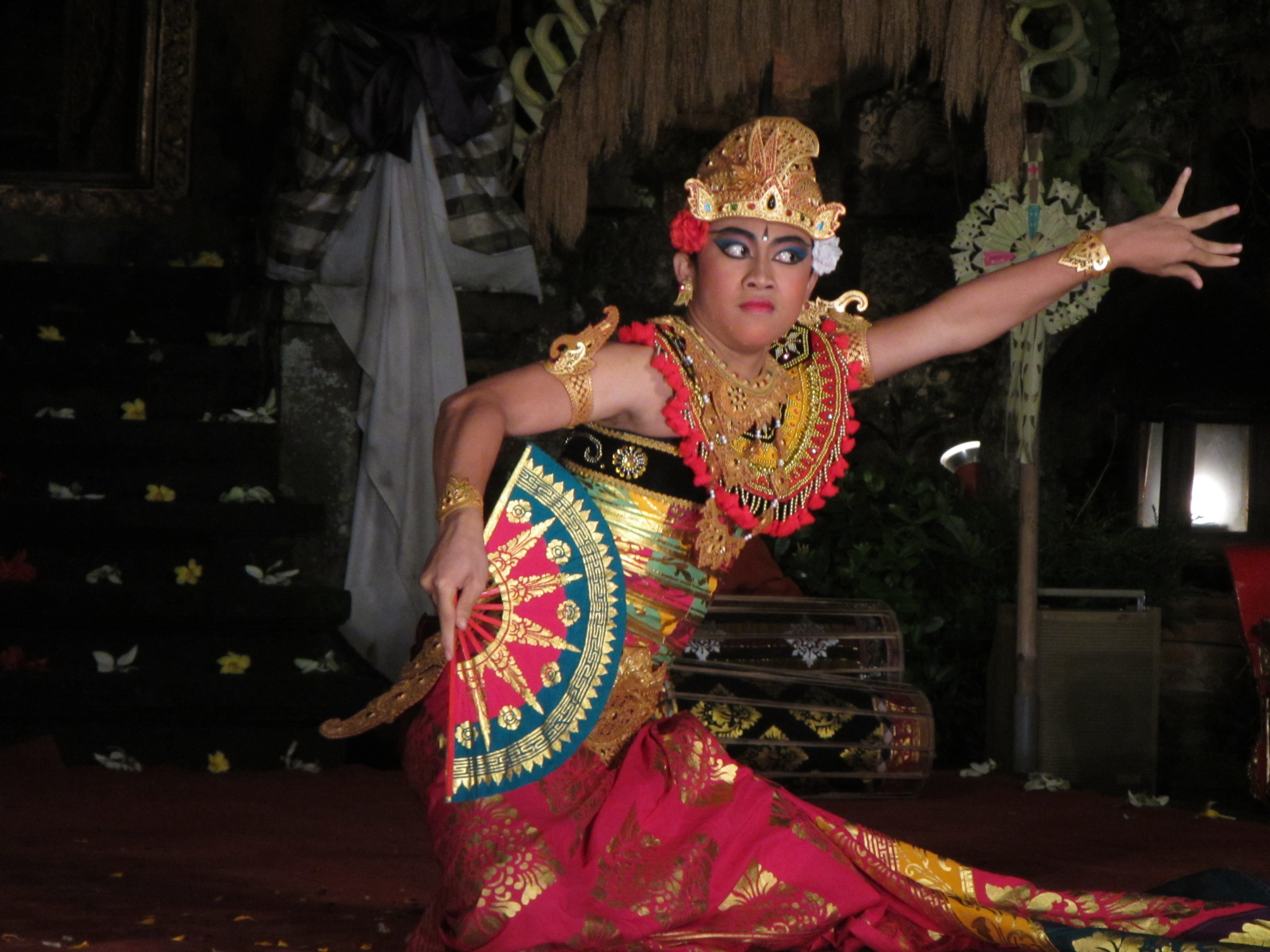
The evening featured an assortment of traditional dances. I liked the Kebyar Dudak, which “depicts the infancy and adolescence in the life of a young prince”, which featured a young, heavily made-up man with very sharp and precise movements, as well as a confident sneer and a great eye roll.
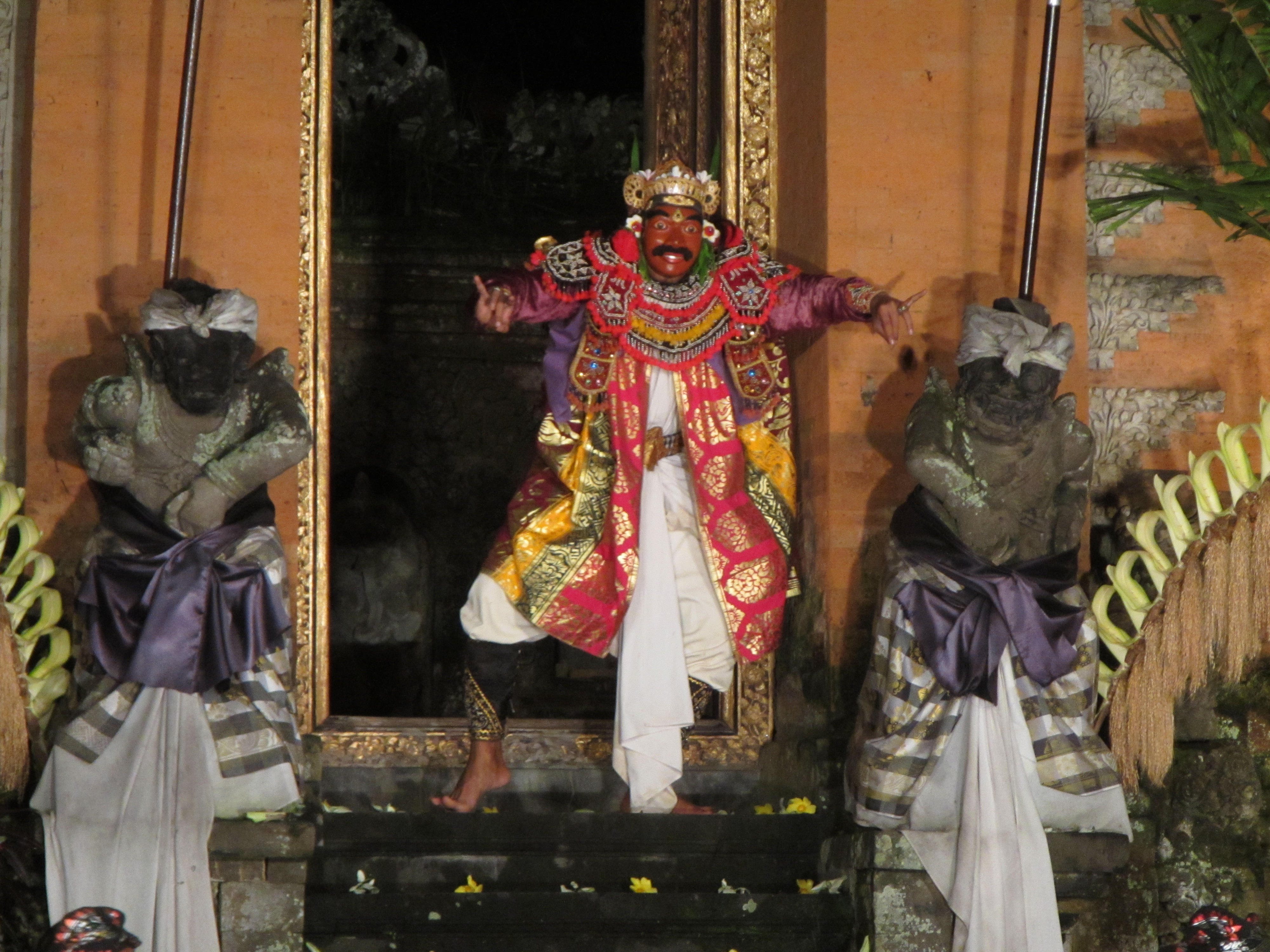
I also enjoyed the Topeng Keras mask dance, which featured a tough, red-faced man who moved like a video game villain from a late-80s Nintendo game, all sideways menace and sudden movements after periods of quiet.
Like gymnastics, this dance performance mostly featured mature men and tiny little girls. The girls did a butterfly dance that I quite liked, but I couldn’t get into the more traditional Legong dance. I did like the Puspa Wresti dance, which was performed by women and led by a woman in her 30s or 40s who had the most astonishing facial expressions. I don’t know if her eyelids ever touched her irises, she was that wide-eyed.

Afterwards, we went out on the town looking for action, which is apparently hard to come by in Ubud. At my insistence, we went to a jazz bar for dessert, but got there just as the band was packing up, and soon realized that the place was full of other couples, most of whom seemed older than us by a good deal, which was not important, but all of whom seemed uninterested in meeting new people, which was an issue.
We left and started walking down the street, and passed by an art gallery in which six or eight 20-something longhairs guys were sitting around a low table, drinking beer and smoking clove cigarettes. One of them called out, “hey, come in!” and after a quick huddle the Professor and I did so.
I’ll confess now – I smoked a few cloves with the guys, breaking my new year’s resolution for an evening. Two of the guys were the gallery’s artists, and their art wasn’t like anything around, not Balinese-iana at all. It featured scary/funny faces (that thing again), girls, text, objects from a bar, local dogs, and pure abstraction. Vigorous young-man stuff. One of them explained to me that he grew up in Sumatra, and had studied art in Jakarta, but had come to Ubud because artists can make a living here, even artists who don’t make the stuff tourists expect to buy.
Not that things weren’t thin for them as they are for young artists everywhere. One guy, an artist and a former boxer who dropped fighting after being put in a coma, explained that he grows his hair into long dreadlocks to sell once they reach a certain length.
We talked about living far away from home, the phenomenon of short hair on women and long hair on men, politics, economics and art. They shared their beer with the Professor.
So today, after touring a big and gorgeous museum, we bought them a big beer in return, and they invited us to come see their studio. We might see it tomorrow, after taking a silver-smithing class or touring the ARMA museum and the monkey forest.
– The Private Eye
One thing is different about Bali for sure: people here are much more aggressive in trying to sell you things. As soon as you exit customs, men start approaching you. “Taxi? Cheap cheap,” accompanied by a gesture of hands outstretched like on a steering wheel. Most of them aren’t really taxis (well, taksis), just people with cars who will charge you an arm and a leg. There is one reputable taxi company in Bali, Bluebird, who actually have meters and charge reasonable rates. To get one, you have to walk through the airport parking lot to an actual street. We flagged one down. The driver was from Tabanan, a town to the north and west of Denpasar. We talked about how he has had a long day, starting work at 6:30 AM. His shift is supposed to end at 12:30, but since he’s already reached his target for the day, he’s going to quit early, after only 13 hours. The ride costs R77,000, or about 10 dollars. We tip him R8k, which is generous, because he has to drive back through the traffic to drop off the taxi before riding his motorbike home, and he was very nice and conversational.
Denpasar is not a big tourist destination, which is why we thought spending a night in it would be nice. It takes us 20 minutes to find our homestay, which thankfully has space. Here in Bali, families don’t live in individual homes. Instead, a family has a plot of land that has multiple buildings within its walls. So many of the cheaper places to stay, rather than separate guest house buildings, are homestays, or rooms in a building in the family compound. We drop off our things and head to Pasar Barung, the largest market in Denpasar, for dinner.
But markets here are different. In Thailand, day markets are a mix of groceries and street food, while night markets are often mostly street food and sometimes some trinkets. Here, it’s all produce, meat and spices. The Private Eye starts to lose confidence we will find anything to eat and suggests we just go to a warung (street food vendor) outside the market, pointing a direction. Of course, it happens to be at that particular exit there is an elderly woman serving some kind of soup and a few fried vegetables. We have no idea what it is, but sit down and have some. It’s different than anything I’ve eaten before, a thin, slightly sweet coconut soup with lentils and a few small balls of sticky rice that she adds. The vegetables are some kind of sweet potato and we think cassava. She’s also making some kind of coffee drink with fresh egg, which the locals seem to like. In our half hour in the market, and since getting out of the taxi, we have seen two other white people. Three bowls of soup (The Private Eye had seconds), two bottles of water, and four fried bites is R31k, or about 4 dollars. We wander back to the homestay, rinse off the sweat (sitting in front of a soup pot in the tropics is hot!), and sleep, thankful that tomorrow is the first day in a while that we don’t need an alarm.
We sleep in and have a simple breakfast in the public area. I’m up first, so over my toast and coffee I have a long discussion with a woman from England about whether western culture is destroying Bali. I mention Ubud and she says she was disappointed. “It has a Starbucks. And a Polo store,” she says. We talk about why this might be bad (or not), finding common ground that if only tourists go to the stores then that’s problematic, as they indicate making a place less challenging and more comfortable as well as less unique. I argue that if locals want a Starbucks, though, they should be able to have it. We veer off into consumerism, capitalism, and other ills. She doesn’t agree with me, but also doesn’t disagree.
We decide to get a SIM card for our phone and to go to the nearby museum of Balinese art. On our way, we pass by a grimy concrete structure that says “Art Market” outside. Inside, it’s basically large, open concrete floors with men and women selling wood carvings. Since business is slow most of them are working on new ones to pass the time. Demon faces, Komodo dragons, Buddhas, monkeys in lewd poses, dragons, chess sets, and boxes dominate. We haven’t even been in Bali for 24 hours so shy from buying anything at first, but then The Private Eye finds a unique carving, a very simple, unfinished one of a rabbit. The woman seems surprised that we like it. She looks at the bottom and names her price: R50k. I bargain her down to 30 (~$3.75), which she accepts pretty easily but seems reasonable to me. After, we look at the bottom and it says 25; we paid a little more than we could have, but still a fair price. The woman stains it for us and wraps it in newspaper.
After the market, we head to the museum, which we have to ourselves. The most interesting exhibit is on Balinese dance, showing some costumes and describing the different forms of dance.
It looks like rain, so we catch a bluebird taksi back to the homestay, pick up our bags, and ride to the terminal where bemos to Ubud leave from. We debated back and forth about whether to take a taksi or a bemo. A taksi would probably be R160k, while a public bemo would be 30. Bemos are basically vans that run certain routes. They are small and kind of cramped. Foreigners don’t ride them much – one issue or complaint many travelers raise with Bali is its lack of a transportation infrastructure. But I figure we should ride one once, and this one is a major route.
Once we get to the terminal, there’s a bunch of discussion with people there. The long and the short of it is that we don’t catch a public bemo. Instead, a grizzled old man with a very beat up van agrees to take us to Ubud for R70k ($10). He won’t go lower. I figure since it’s a charter with no other stops, and it won’t be crowded, it’s worth it.
When we arrive, and I try to pay him, I realize I think I did the right thing. I don’t have correct change: we have only 50k notes and then 19k in other notes. So I give him 100k and ask for change. He looks at the bills, and pulls out a wad of bills from his pocket. He looks at them, leafs through them, and stops. They are mostly small bills. I realize that he probably can’t add them up in his head – he can’t make change. Generally speaking, nobody does arithmetic in their head here, it’s always with a calculator. I offer to make the change for him and realize he doesn’t have 30k – he has only about $3 on him. So I give him the 69k we can give him, counting it very slowly so he can see we are not cheating him. The look of relief and happiness on his face when I give him the money gives me a glimmer of how much harder his life is than mine and how valuable this money is to him. The idea of bargaining for a price you are both happy with does make more sense when there are such disparities.
We get out of the bemo outside the palace in Ubud, find a bookstore/library and a place to stay. I’ll leave our nighttime adventure involving Balinese dances, a jazz bar, and sharing beer with a half dozen artists in their studio for another post.
— The Professor
 The Professor and the Private Eye: Adventures Abroad