We’ve seen dances in three different cultures: Java, Bali, and Cambodia. Rather than discuss the differences, I thought I’d just give examples. These are from Bali:
Java (sorry it is sideways):
Cambodia:
— The Professor
We’ve seen dances in three different cultures: Java, Bali, and Cambodia. Rather than discuss the differences, I thought I’d just give examples. These are from Bali:
Java (sorry it is sideways):
Cambodia:
— The Professor
Our last full day on Gili Trawagnan was Thursday the 14th. Over breakfast at Bale Sasak, we met The Wine Label Designer, who lives in Napa. After a bit of chit-chat, we agreed to have lunch together. He had just arrived on the island, so we gave him a bit of information on how to get around and fun things to do. We then parted ways: we watched an episode of Homeland in the height of the afternoon heat, while he went paddle boarding. After watching the sunset at Exile one last time, where we had an interesting conversation with a local who helped start one of the three major bars on the island. He talked about island politics and some of the recent legal issues as well as methanol poisoning. We met up with The Wine Label Designer again for a drink at Surf Bar, whose young proprietors were actually a bit obnoxious. But they let us play our own music so we all listened to The Black Keys for a bit before The Private Eye and I decided to turn in.
Denpasar airport is actually much closer to Kuta than Denpasar. Since we have a 6:05AM flight to Yogyakarta, we thought spending one night, a Friday night, in the famous/infamous Kuta was a good idea. Kuta is kilometers of beautiful beach that’s pretty good for surfing: it’s where Bali tourism and vacationing began. These days, it’s a long strip of clubs, minimarts, tourist-friendly restaurants, bars, and little stores hawking touristy wares. People traveling to Bali for its culture avoid it like the plague; people traveling to Bali to dance, lounge on the beach, and party love it.
After a 90 minute boat ride from Gili Trawagnan and a 2 hour van ride, we arrived in Kuta and booked a room. We had a nice conversation with a Londoner who was traveling with two of her girlfriends. She had a lot of interesting travel stories, but the conversation was also a little sad. She found out that there had been a bunch of layoffs (redundancies, in British parlance) at her work while she was away and didn’t know whether she was one of them. Based on a conversation she had with her boss before she left (“While you’re traveling, think about what you might want to do next…”) it seemed pretty clear she probably was, but she hadn’t connected the dots. We both stayed mum on our independently reached conclusions.
I had scraped my foot on a rock in the surf when snorkeling on Wednesday, and a torrential downpour had left large standing pools of water in many of the side roads on Gili Trawagnan on Thursday night. I ended up having to step in a few of them, and despite using iodine and alcohol before bed, I woke up Friday morning with the scrape a bit red and tender. So as soon as we arrived in Kuta and had a room, I headed to a clinic to have the scrape cleaned and dressed as well as receive some antibiotics. Once that was complete, we wandered the alleys a bit for dinner, followed by watching the sunset on Kuta beach. Walking back to our room, we came aross a restaurant with fire dancing to thumping techno and so stopped for dessert, then finally made a few sprints between covered alcoves when the downpour momentarily receded.
So where to go for some music? We surveyed the options and decided on first walking to Kuta’s main drag to hear if there was anything good. If not, then we’d try a place called Deejay Club that would be a very short cab ride away. If none of those panned out, we’d head to Seminyak (a much longer cab ride), the upscale version of Kuta, where The Wine Label Designer said he thought we might like.
Kuta’s strip (Jl. Legian) was a bit boring and crass – The Private Eye actually saw a guy grab a drunk girl and grope her (unwillingly); she broke it up. After that, we walked much more closely together, listened for a bit at the one place that sounded promising, and decided to move on to Deejay. After fending off an irate taxi (but not Taksi) driver who claimed nobody uses meters on Friday night (hint: if they become angry they are probably lying), we found a respectable taksi, arrived at Deejay around 12:30, and found out it didn’t open until 1. Later that night, taking with a woman with excellent English, we found out Deejay is where people go after the regular clubs, because it’s open until 11AM.
But our taksi to the airport was at 4:30AM, so we didn’t want to hang out for half an hour in a kinda dirty and quiet alley for the late club to open, given we wouldn’t be able to stay for when it would get going. So one more taksi, this time to Mint in Seminyak.
But oh, what San Francisco fools we are. You see, these are the upscale clubs. You know, the ones that successful people in their thirties go to. That means they have a dress code. Psylo shorts and a tank top don’t make the cut – sleeves at least, collars preferred, leather shoes appreciated. So we wandered around a bit, realizing the intersection of good music and would let me in was the null set. Especially frustrating given I could have worn appropriate clothes but didn’t know. After weighing our options – three more taksis to go home to change, come back, then head home, seemed like too much. And so, we San Francisco noobs, to whom dress codes are completely foreign, utterly failed to dance.
And so, 90 minutes of sleep later, now we are on the flight to Yogyakarta, which was momentarily in danger of being rerouted to Eastern Java due to fog but is now starting its descent. The guidebook says the greatest danger in Yogyakarta is slick batik salesmen who rip you off; if that’s the seamy underbelly of this town, it sounds adorable.
— The Professor
We have decided on our next destination: Yogyakarta on the island of Java, with Kuta in Bali as a one night stopover on our way back to Denpasar airport. Our flight is Saturday at 6:05 AM – at that time, we could get two tickets, with meals of our choice, for $130. So we will take a boat to Kuta on Friday, maybe try finding some dancing there on Friday night, then wake up dreadfully early to fly to Java.
Yogyakarta sounds a lot like the Chiang Mai of Indonesia: university town, lots of arts, some fantastic religious sites. But unlike Chiang Mai, it has a sultan.
So we are here on Gili Trawagnan for two more nights. We considered a day trip to Komodo, but once you add everything up it’s a bit expensive. We also considered climbing Rinjani on Lombok or Gunung Agung on Bali, but since it’s the rainy season floods, landslides and such make them questionable endeavors. So we’ve decided to head back west. After Yogyakarta, we hope to go to a bustling metropolis (either Singapore or Kuala Lumpur), then we will have time for one more destination before we start our endgame with Angkor Wat. Until then, we’ll do a bit more snorkeling:
— The Professor
Our last day in Ubud, February 7th, was hectic.
While down near the Monkey Forest, visiting Andy in his studio, we came across a tailor/leatherworker. Hanging in his shop was a leather jacket I thought The Private Eye might like. Back in college (a decade and a half ago), she bought a light leather jacket at The Gap. It became one of her most worn coats, due to its combination of useful features: a lining warm enough for a cool but not cold night, a hood, side pockets without zippers that scratch your wrists, and an inside pocket for a wallet and phone. The jacket has been slowly falling apart, and so for the past year or two I’ve been looking for a replacement. This jacket seemed perfect. Heavy goat leather, so it can take the beatings of everyday use, a hood, an excellent cut, her size, and a beautiful teal lining. The day before we left, I showed her the coat and in a prearranged dance of signals so the shop owner would not know her degree of interest, she tried it on and said she loved it. There was one catch: to make a new coat would take 2-3 days, and we were leaving tomorrow. So perhaps he could sell us this one? And add side pockets? Without zippers? And an inside pocket? And repair/replace the lining because it’s a little worn from show? The answer to all of these questions was yes, and at a fantastic price. The one catch: it would not be ready until 3.
And just in case it sounds like I always bargain low prices, I don’t. When the shopkeeper quickly agrees, then smiles, and touches the money to similar items for good luck, then you know it could have been cheaper. Like the Barong mask I bought at Gunung Kawi.
So we planned to leave Ubud at 3 or so. We took care of all of our last tasks (a carved wooden mask for Cleverpig, register for Burning Man ticket sale, a gift for furrybluehouse, some Internet banking, returning our library books, a waxing for The Private Eye), and arrived at the Monkey Forest parking lot at 2.
You see, by this point we had several bags of stuff for our real lives – presents for friends, a few souvenirs (Barong mask for my lab!), two pairs of pants from a cool but cheap designer, and now a leather jacket. Our taxi agreed to leave for Ubud at 3, but could not do much later. So once I picked up the jacket, I hired a scooter (R10k) to take me to the post office to mail this all home. With one hand I held onto the diver, with the other I held the four bags. Sending it all by sea (2-3 months) and packing cost about $80. So then hop on a scooter back (driven by an old man who drove a harder bargain, R14k), and call Made, the driver, to tell him we are ready.
And what a good driver Made (mah-DAY) is! We would recommend him to everyone. He drove us to the puppet and mask museum in Ubud and when we discussed Amed, he gave us a price that later research showed to be very fair (R350k, or $40) for a 2 hour drive. We had a wonderful conversation during the drive. We talked about Bali, his children (two daughters, learning Balinese dance), America, the permanency of residences and families in Bali, village life, immigrating to Bali (village head gives you rules to follow…), and Indonesia. In March and April he works for an American company that organizes a bicycle ride in Bali, the rest of the year is for hire. If you are ever in Bali and want a good driver, ask and we can give you his information. It can be hard to find a good driver and just meeting people on the street is hit or miss.
The drive began as Ubud traffic, but towards the end became beautiful. Roads high above terraced rice fields, huge banyan trees, and the ever-increasingly looming power of Gunung Agung, whose top was shrouded by a single, lonely cloud.
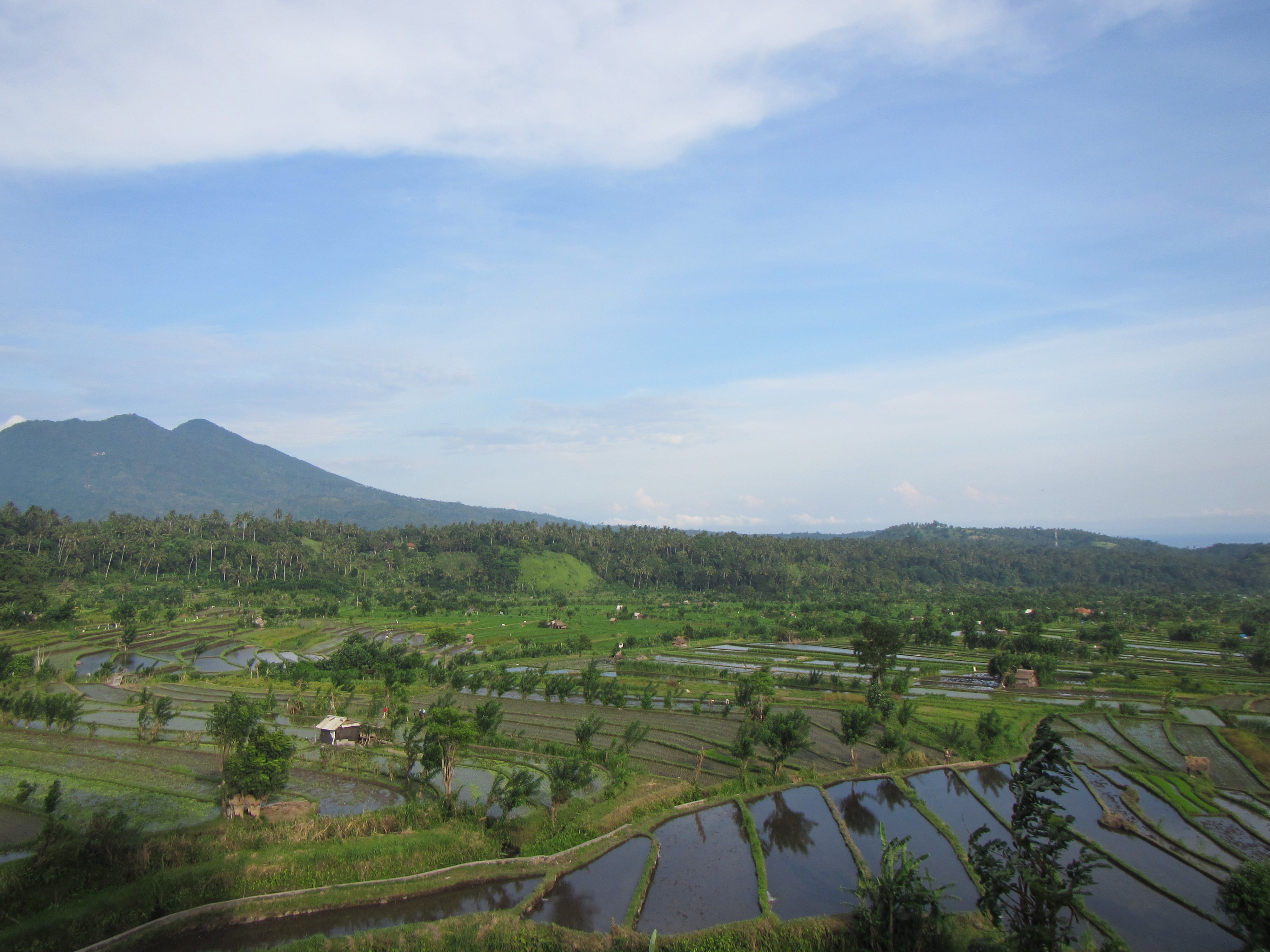
It’s the low season in Bali. Ubud still has a good number of visitors, travelers, and tourists, but Amed is very quiet. It’s a line of bungalows, warungs, and dive shops along the road parallel to the beach. In the low season, the local industries are fishing and salt making. The Liberty dive is off the shore from Tulamben, which is a 10-15 minute drive northwest; we chose to stay in Amed because the beach is tiny black pebbles rather than big black rocks and the town has more to it than just diving.
We picked Eco Divers because they have a reputation for being environmentally conscious. Seemed a reasonable distinguishing feature. We arranged to dive the next day, they helped us find a bungalow (which we chose to not spend a second night in – while nice looking and clean its architecture is such that it stays hot at night, our second night, tonight, is in a bungalow run by our dive guide, on the beach, cooler, nice, and an even better price), and arrange for a boat to the Gilis. The dive price was high; I’m willing to negotiate for goods and sleeping, but diving doesn’t seem like something to drive a price on, and a great dive is so much better than a good one.
After Sail Rock, we weren’t sure how many days we would like to dive. We figured that if conditions were poor, we’d hang around and wait to dive until they were excellent. This was a little frustrating to Eco Divers (How many nights? Not sure. How many days of diving? Not sure?), but we didn’t want to commit to many days hanging out on a beach and also didn’t want to leaves before a great dive.
And what a dive it was. The Liberty was a transport ship in World War II, fitted with two guns for self defense. The ship was 120 meters from bow to stern. In 1942 it was hit by a Japanese torpedo and limped to Bali, where it was grounded and sat on the beach until 1963. When Gunung Agung erupted, the ship rolled off the beach and settled to the sea floor about 30 meters from the shore, where it has been since. The stern is the highest point, about 8 meters below the surface. The bow is down at 26 meters (hence our deep dive training!). I wish I could have taken pictures, but renting cameras is expensive and our point and shoot can only go to 10 meters. Here are some pictures I found on the web:
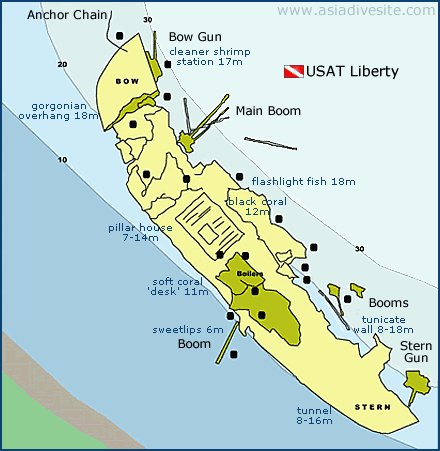

So it’s an enormous ship. Even with the 50 meter visibility (!!!!), you can’t see the ship end to end. Many supporting structures and internals have broken free, leading to side towers of life and a whole metropolitan area of coral and fish. We saw a pair of 4 foot long yellowfin tuna, a 5 foot long sea turtle, schools of tens of different kinds of fish, an enormous grouper, coral of all colors of the rainbow, scorpionfish, and so much more. In Ko Tao, there were what I thought to be large plate coral, maybe 3 feet in radius. On and around the Liberty, there were coral with a radius of 5 feet or more.
For our first dive, we were practically alone; we arrived first and only saw other divers as we left the wreck. Even on the second dive, there were only a few other groups.
On the first dive, we approached at the stern and took a path alongside the ship on the side facing away from shore, until we reached the bow. We then entered the body of the ship and swam between girders to see all of the life within it. Because the Liberty is so large, this wasn’t tight swimming. On the second dive, we reversed our path, taking a different route through the ship. We entered the ship at the stern, swam through it, then returned along the side facing away from the shore. Swimming alongside and within this enormous steel structure, covered and swarmed with life darting to and fro, this private helicopter tour of the aquatic Manhattan, well, it was as good as everyone had promised.
The water was so calm, the visibility so good, and we saw so many rare things (Tuna! Turtle!) that I thought diving again tomorrow would likely just be a disappointment. So we decided to leave tomorrow for the Gili Islands and booked a fast boat with Eco Divers. We found a better bungalow and spent a good part of the afternoon snorkeling just outside it. The snorkeling was similarly magical – while there were no turtles like in Hawaii, we saw many of the same fish we saw on our dive, but this time could linger as long as we wanted to watch them. Also, the coral were outstanding, splashes of color in all kinds of shapes, so much healthier than in Ko Tao. While Ko Tao has one clownfish, named Nemo, carefully protected by a ring of stones, we saw at least half a dozen just snorkeling along the shore.
After snorkeling, we rinsed off and had a wonderful and simple dinner (grilled fish for me, fried prawns for The Private Eye, vegetables, and rice) at our dive master’s restaurant, cooked by his wife, who also makes a mean lemon pancake. I tried arak, the palm sugar wine: it tastes similar to sake. And that leaves us here and now, sitting on the beach, looking at the stars, which look so different!
— The Professor
I will admit that for a couple of days, I actively disliked Ubud.
How can this be, you might wonder? This is, after all, a city where art reigns supreme, where mask-carver, batik-maker and painter are viable day jobs. Further, this is the city of love in Eat, Pray, Love. But I didn’t love it to start, though i came to like it very much, and I hope the reasons why may be of use to other travelers.
First: my greatest regret about our preparations for this trip is that neither of us learned to ride a scooter. Despite the fact that one of our dear friends is nothing less than the Scooter-Preneur of San Francisco, and another of our dear friends owns and rides a scooter, in our presence, all the time — we just never learned. In Asia, we soon came to understand, this is the equivalent of deciding not to learn to drive a car in America. You can do fine in major cities, but in the country or in a place without strong transit infrastructure, like Bali, you will be hiring a car and driver, which was a largely unexpected and unwelcome expense. Self-driving car rental here is thin on the ground. Locals tell you about all the tourists who die every year learning to ride scooters here. Fellow travelers who didn’t heed the warning invariably show you some scrape or another from a more minor accident.
This being the case, we decided to base ourselves in the center of Ubud, so we could walk quickly to many of the main attractions, rather than basing ourselves in some blissed-out rice paddy twenty minutes by foot from town proper. This turned out to be a fine decision for many practical reasons, and I really liked our guesthouse, but the center of Ubud is now well and truly touristed. Picture being at Pier 39, but every shop is filled with interesting things, and has a kind-looking woman out front urging you to buy. Every street corner has a man asking if you if you want taxi, transport. It’s great for shopping, but a bit overwhelming for me – I tend to notice everything, and everyone, and feel drawn to connect based on very minimal contact. This is a great quality for my work, but a lousy one for navigating a new bazaar in a new country where I feel unsure of myself. Point being, our particular location meant that we could not walk anywhere without being subject to 10 minutes or more of this.
Add to this the 90+ degree heat and humidity that turns my face into a 12 hour wellspring of sweat every day, and I was having trouble enjoying all that is amazing about this place.
But what a difference a new friend makes! The day after we met the Art Teacher (the expat from Canada who lives in Turkey and was here on vacation), we did not see her. She was doing her batik class, and we were making our rings, which I loved as it was both quiet and fully engrossing. Afterwards I had a tougher time enjoying myself, though The Professor and I did a nice sunset walk on the Campuan Ridge (rice paddies, towering pastel cloud views, charming local teens smoking and flirting in quiet corners of a thatch-field atop the ridge), and saw the Kecak and Fire Dance.

Both are very worth seeing, by the way. The former features a cast of shirtless men who chant monkey-like chitterings as the only musical accompaniment to a drama of a portion of the Ramayana; the section stars Hanuman the monkey king, of course. The latter features a man, supposedly entranced, who is “riding” a hobby-horse over a bed of hot coconut husk coals barefoot, each charge of knight and steed resulting in a beautiful and shocking shower of embers directly at somebody’s face, but never touching them. Attendants swept the coals back into a pile after each pass, until the man astride the magic gallops through them again. Eventually he collapses from exertion and is revived by the priest. I know this is an old ritual tarted up for tourists, but it remains powerful.

And yet despite the wonder I remained discontent! But that all changed the next day when we met up with the Art Teacher at the Threads of Life textile center for a lecture. It’s a worthy organization with an approach both practical and academic to preserving Indonesian weaving traditions throughout the archipelago. And the Art Teacher was so enthusiastic and knowledgable about it, and about Bali/Ubud in general. She is very smart, and tells good stories, and it was a pleasure to talk with her. Suddenly, I could appreciate the quiet lanes off the main roads more, and feel a bit less affected by the pleading on the busier streets.
The lecture was followed by a lunch of delicious suckling pig in a nearby warung, where we relaxed despite future daily specials squealing on a balcony one floor below us. Then, following the clue that our laundress had been all dressed up that morning, we went to the temple of the dead. We missed the ritual, but enjoyed seeing the architecture and banyan trees, and just sat around on a shady platform talking. Then we got the bright idea to go to the Setia Darma Museum of Masks and Puppets in the village of Mas, which was exceptional – and was another great place to sit and talk when we weren’t appreciating remarkable art.


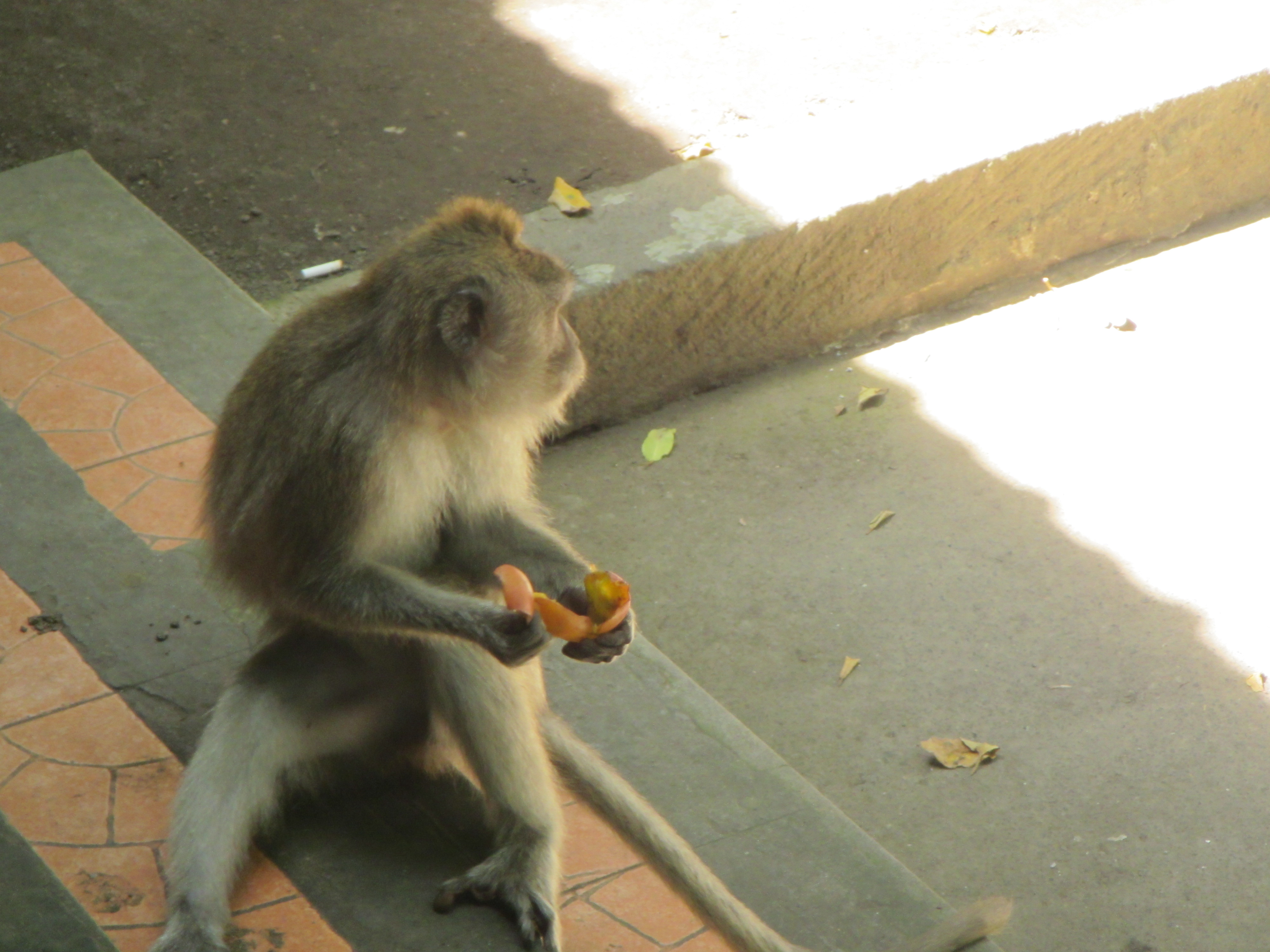
When we got back, we separated near the Art Teacher’s part of town, which is still busy but less frantic, near the Monkey Forest. We parted, and the Professor and I decided to find the studio of the artists we had met in the gallery on Hanuman Street. It turned out that the studio lay directly behind the sacred monkey forest, and that there is a “bike path” (scooter route) that leads there which follows the exterior fence of the forest. We saw plenty of monkeys on our walk, including a baby monkey that was so tiny, it had trouble managing its rambutan fruit.And we didn’t have to pay to go into the forest! And here are full-grown ones:

Behind the forest, past a woodcarver’s house, lay the studio. It was open walled, cement floored and tin roofed, and the artist I had spoken with for a long time at the gallery was the only one at home. There were stacks and stacks of paintings in racks along the edge of the space, and suitable seating for such a place, such as old car seats and a large sculptural high chair, and some cheap plastic stools near a home-made table. The artist welcomed us, and we shared our mangosteens, and talked until the sun set about Indonesia and America and his art and the yoga-people who come to Bali — both the good and the over-the-top ridiculous: “yoga blah blah blah”. Also hilarious: his explanations about why Balinese men get a lot of action from female tourists, though our host did not relate that he had had any such adventures. I admire a man with discretion.


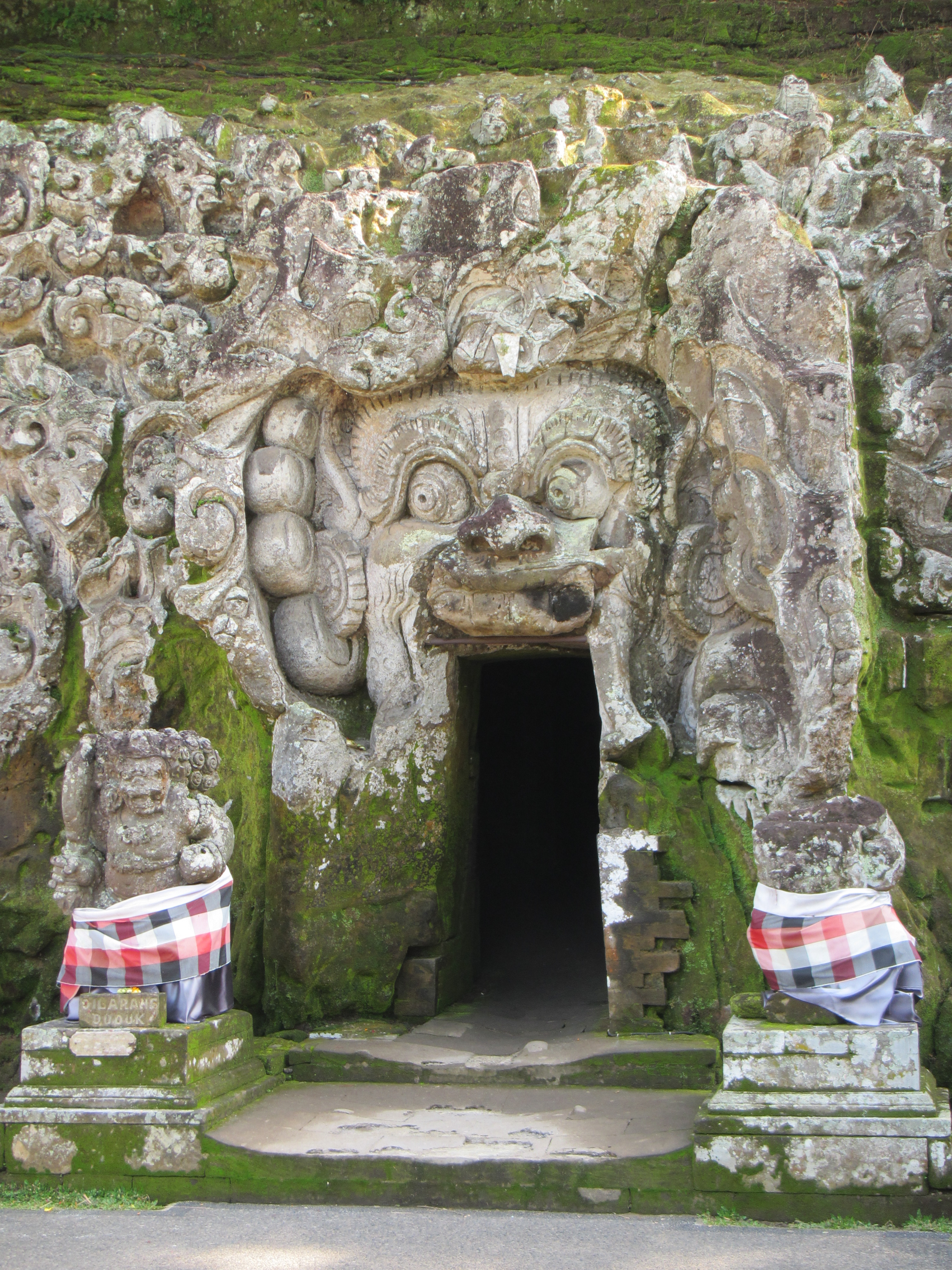
We bid him farewell and had a nice duck dinner, and then went to bed. On the next day, the Art Teacher, the Professor and I walked to Goa Gajah, a cave whose opening is carved in a monstrous face. We then went to Gunung Kawi, a site of old ruins in niches of a rock face. We retired to our homestay for the heat of the day, where I spent my time learning Bahasa Indonesian words from our host’s children, while teaching them English words for things. It was fun; I also tried to teach the oldest tic-tac-toe, but I fear I am a poor teacher and we turned it into a counting game.
Later, we went back to the palace and enjoyed a much more exciting Legong dance than our first one, the dancers seemed much more passionate. We also saw the Barong dance, in which a large, shaggy embodiment of good does some onstage comedy with a monkey, and later fights a demon. Predictably, I love the Barong. So do children everywhere!
Barong: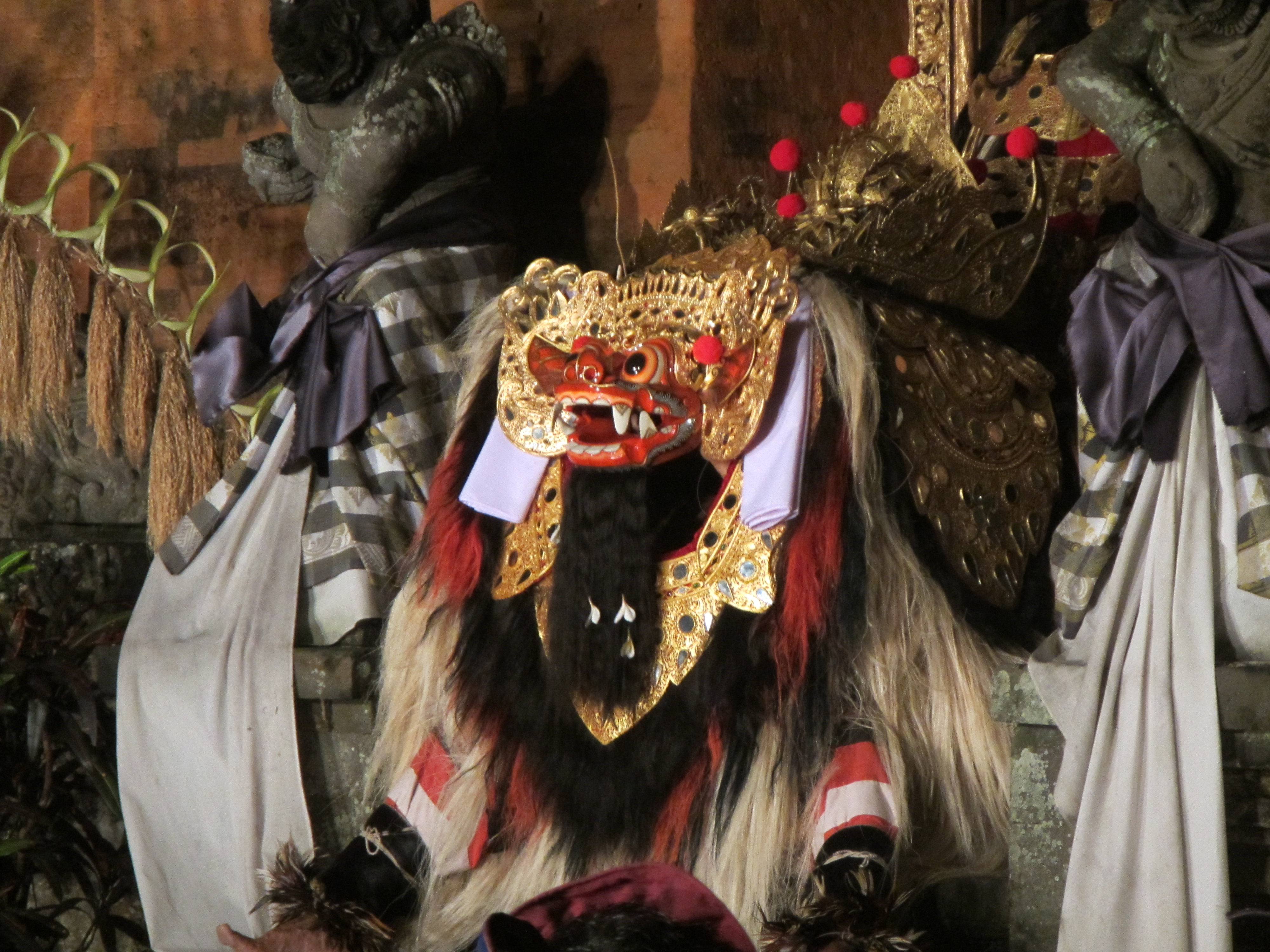
Demon: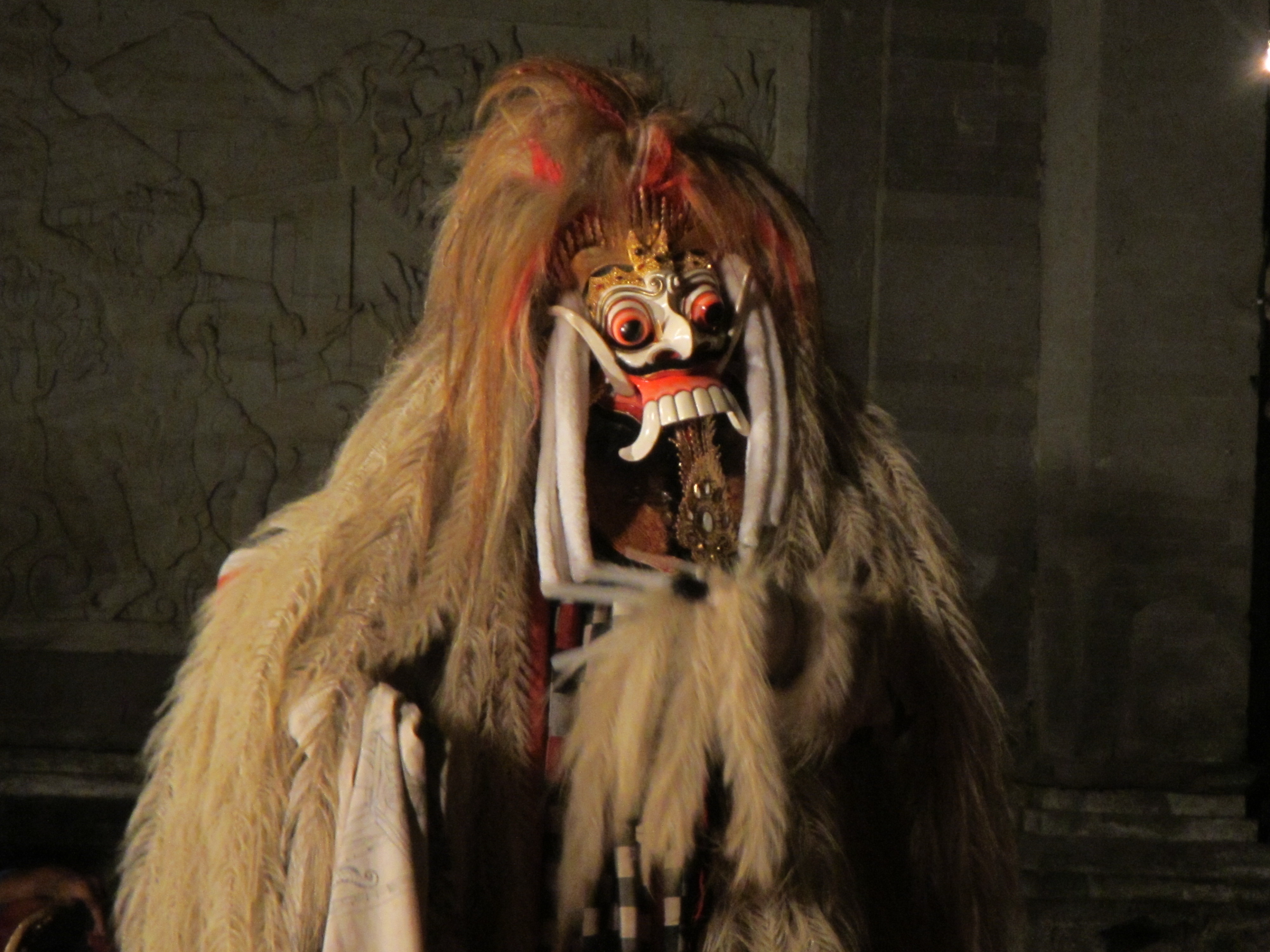
It was a great performance.
Today, we head on to Amed on the east coast to dive the wreck of the USS Liberty. I am looking forward to less humid weather, but I have come to appreciate Ubud more, thanks to our hosts, their children, the artist and the Art Teacher. It is amazing how much kindness and conversation can turn your whole view around.
– The Private Eye
There’s a long list of artistic and cultural places we want to go and things we want to do here in Ubud: art classes, dance performances, museums, and more. The Private Eye has, since her making a large parade-style puppet last year, been very interested in puppetry. Shadow puppetry is an art form here, called Wayang Kulit, so we made Sunday night’s venture to go to a show. There was a simple sheet, with a torch behind it. You could see where, over decades, the torch has sooted the ceiling black and eroded the plaster a bit. The puppetmaster was 80 years old, and had several assistants. The show we saw told the story of the Sacrifice of Bima, where Bima offers himself as a sacrifice to a demon to appease it and save a kingdom, then defeats it in battle.
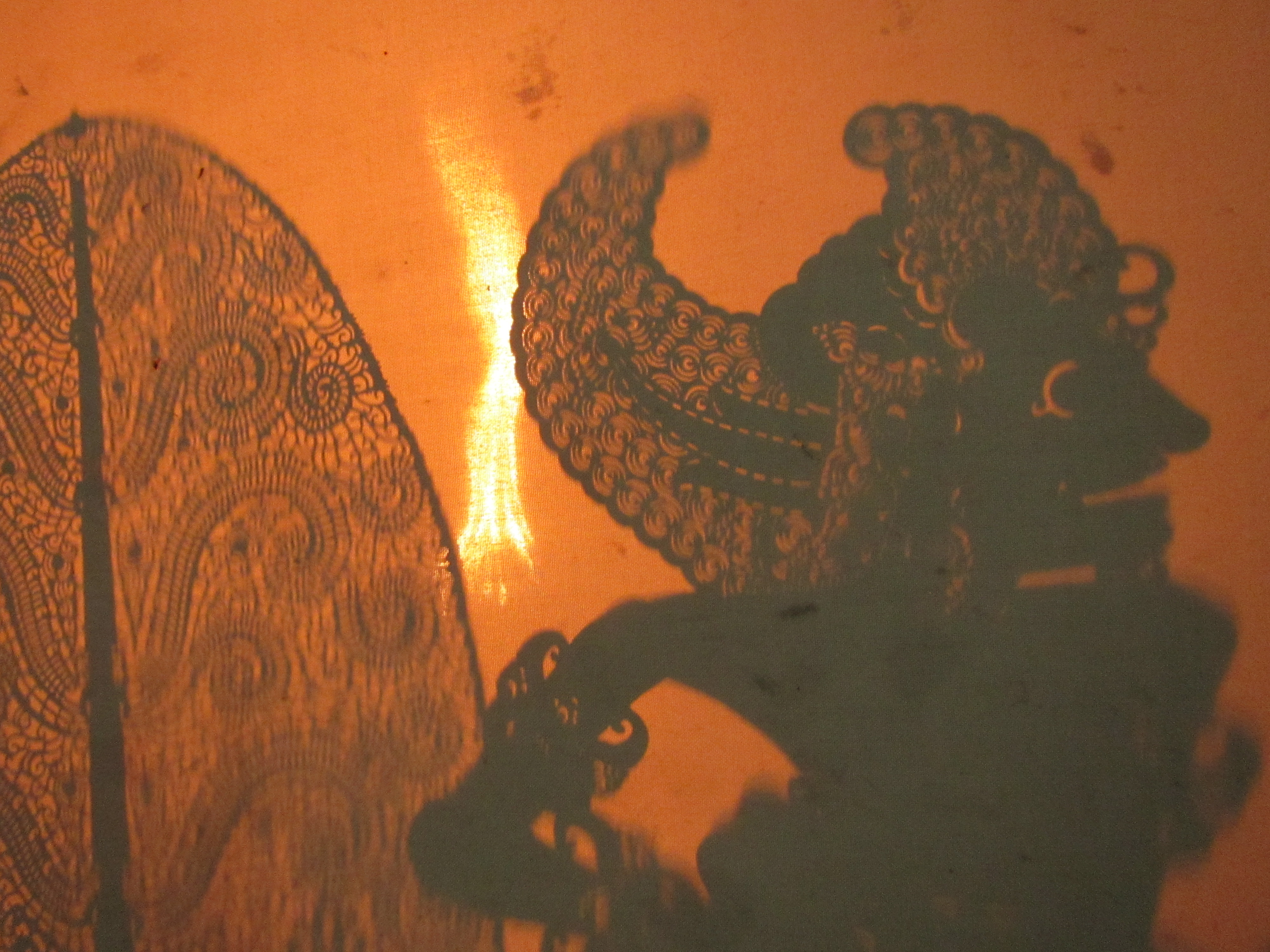
We met an expat art teacher (from British Columbia, now teaches in Turkey) who comes to Bali every few years to learn some new arts. We chatted for a bit and might meet up tomorrow for a walk around the city.
On Monday, 2/4, we woke up and made our way to the small private library that is seemingly becoming our base of operations. We’d scheduled a silversmithing class for 10AM: 3 hours cost R200k/person ($25), including up to 3 grams of silver, you pay for the extra silver if you want to use more. After a bit of discussion, we decided to make rings, similar in shape (both ringed bands with designs within), but different in style. Our teacher, Anna, has been a silversmith all her life, and her entire family are silversmiths.
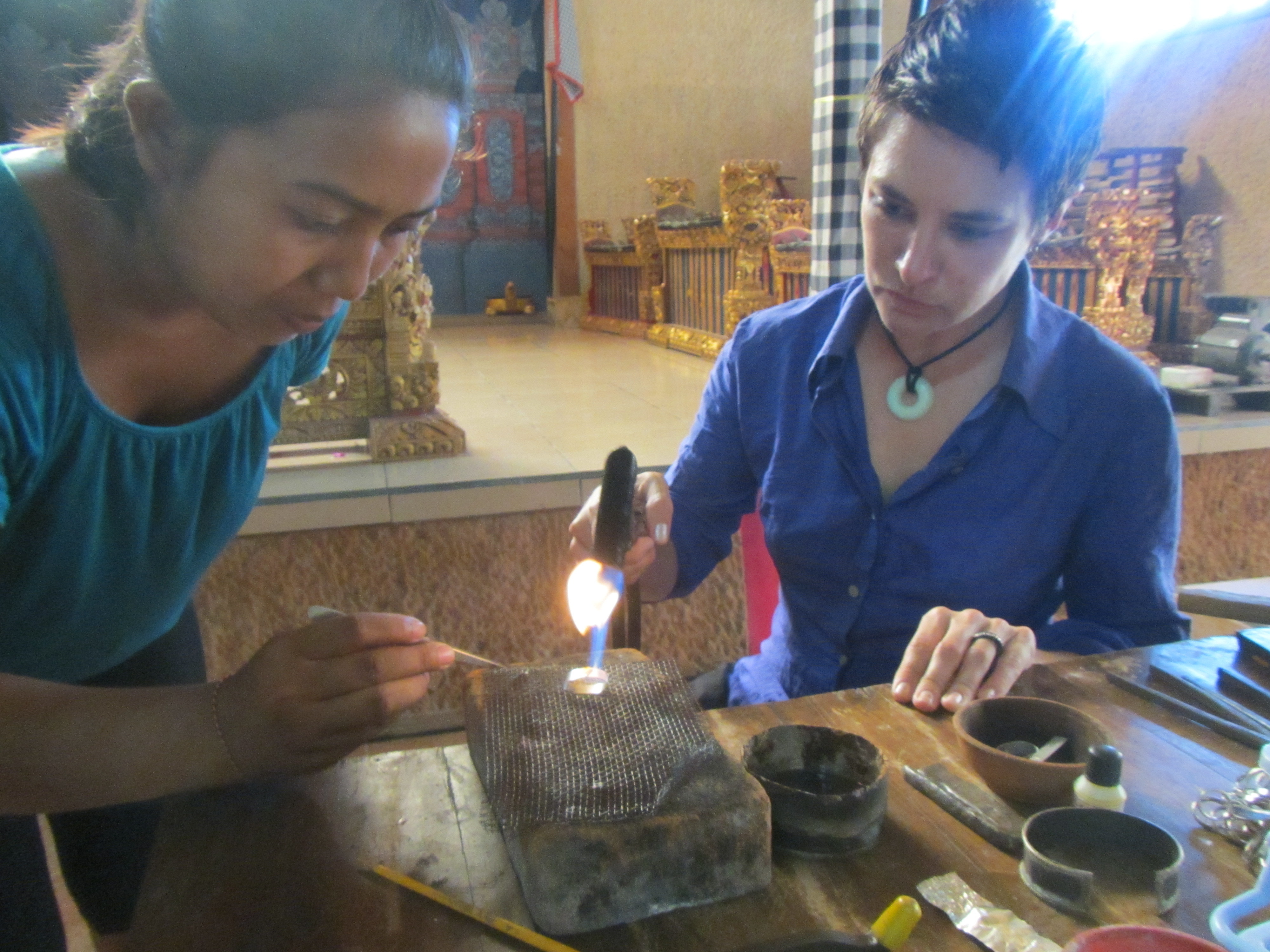
First, you decide how big a ring, and cut a piece of silver (92.5% silver, 7.5% copper) plate of the right width and length. You then solder (with silver solder) the two ends together, and shape it into a circle. You then add the wires that form the rings on the edges of the band, and solder them on. At this point, you have two simple silver rings, and you need to add the decoration.
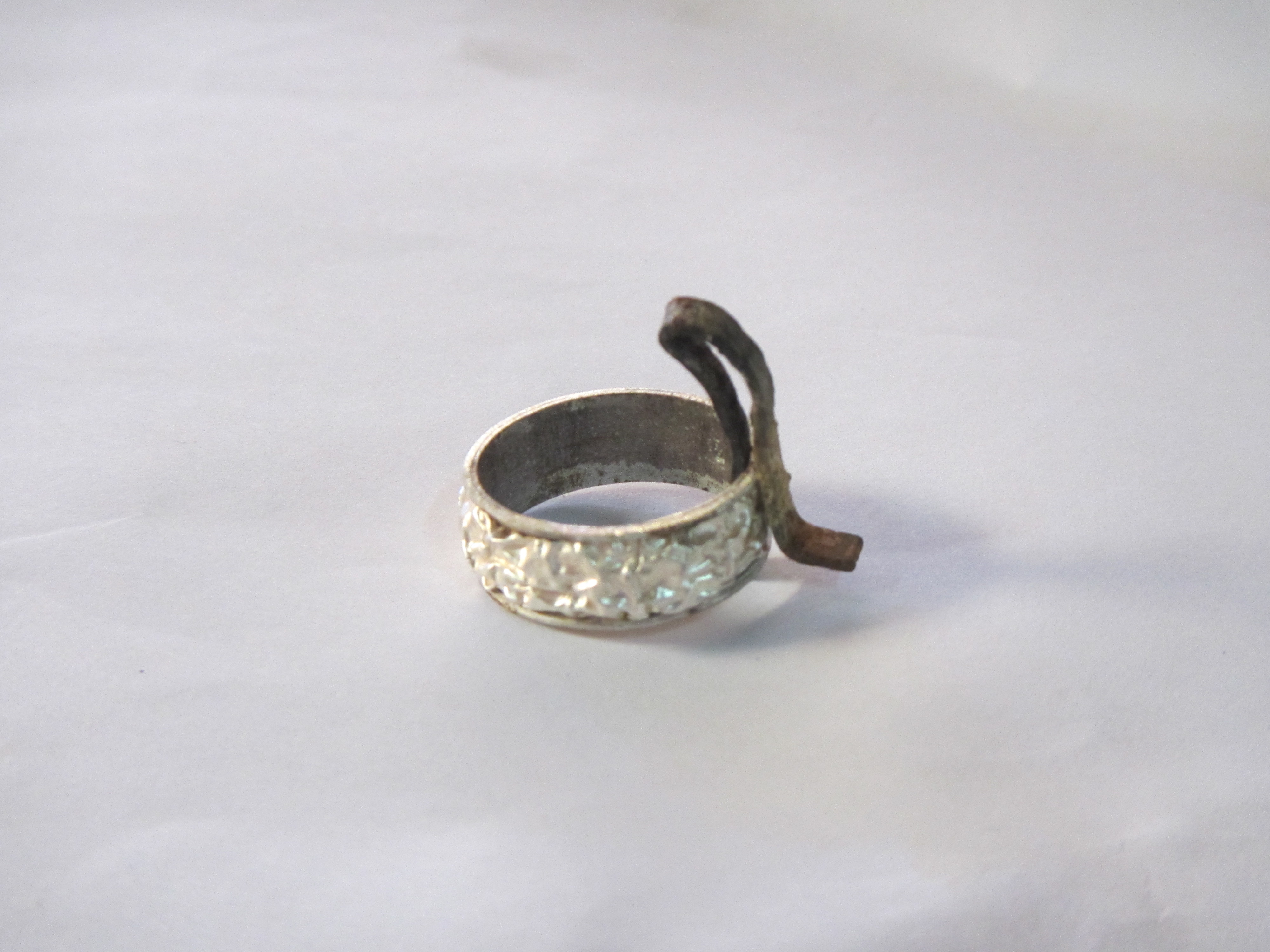
I chose a design that I’d never seen before, but in my typical style is much easier to do than it looks. You take a thin piece of silver plate and crinkle it up, heat it, and crinkle it up again. You cut the plate to the right length and width to fit between the rings, and solder it in.
The Private Eye chose a beaded design with curls. To do this design, you take thin silver wire and bend it into the desired curls, then glue them to the face of the ring. Using tiny bits of glue, you then affix tiny silver beads; she also affixed some small disks.
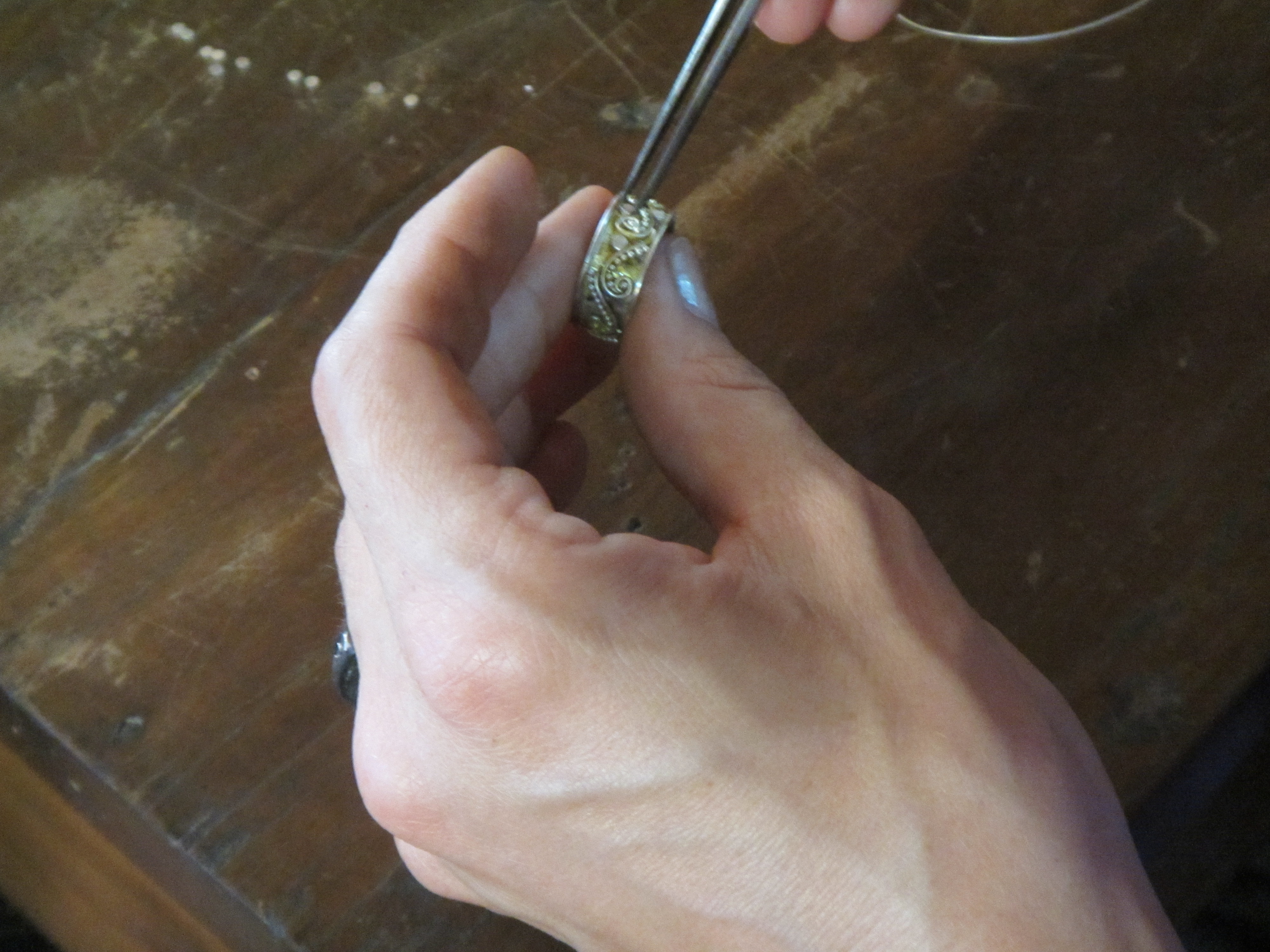
You then dab some solder around the pieces and heat the ring, replacing the glue with metal. To heat the rings, Anna had a foot pumped propane torch. Very simple, but it works!
After the rings have cooled, you polish them, inside and out. We used an oxidizing solution to darken recessions in our designs, then polished again to make the raised regions shiny. Two hours later, we had silver rings made by our own hands.
We are trying to keep to a R500k/day ($60) budget, which would be easy except for all of these artistic ventures. To attend a Kecak dance tonight we’re going to cheat and borrow from tomorrow’s finances. Food isn’t too hard — you can get a tasty meal of noodls or fried rice with vegetables for R15k. Of course there are also super-fancy places here with R60k desserts, but we’d rather spend our money on art and save for diving and other adventures.
We haven’t quite figured out our schedule yet. It turns out that Life is Too Short (whom we met in Luang Prabang) has been distracted by Myanmar, so might not make it to Bali until the 16th. We definitely have a few more days in Ubud, but don’t know how many. I don’t know if we are going to try Kuta (the Bali foreigner party city) at all, or just avoid its western stuff and skip directly to Gili Air.
(this post is a bit brief and choppy because I’m trying to finish it quickly before The Private Eye returns from the spa!)
— The Professor
Well before we arrived in Ubud, we were struck by the immediacy of Balinese art. The goggle-eyed faces peering out at us around Denpasar evoked both fear and laughter, as though every face was a laughing face lit by firelight from below. Scary. Funny. Somehow part of some full-bellied, cosmic joke. Even the sculptural decoration of columns and walls seemed so aggressively three-dimensional as to be extra-dimensional.

So when we saw a dance performance at the palace last night, all that imagery came to life for us. The Professor and I disagreed about the performance quality – I found it solid but not brilliant, in part due to a lackluster audience; he found some of the performers amazing – we did not disagree about the strong performances among the troupe and the transfixing nature of the dance period.
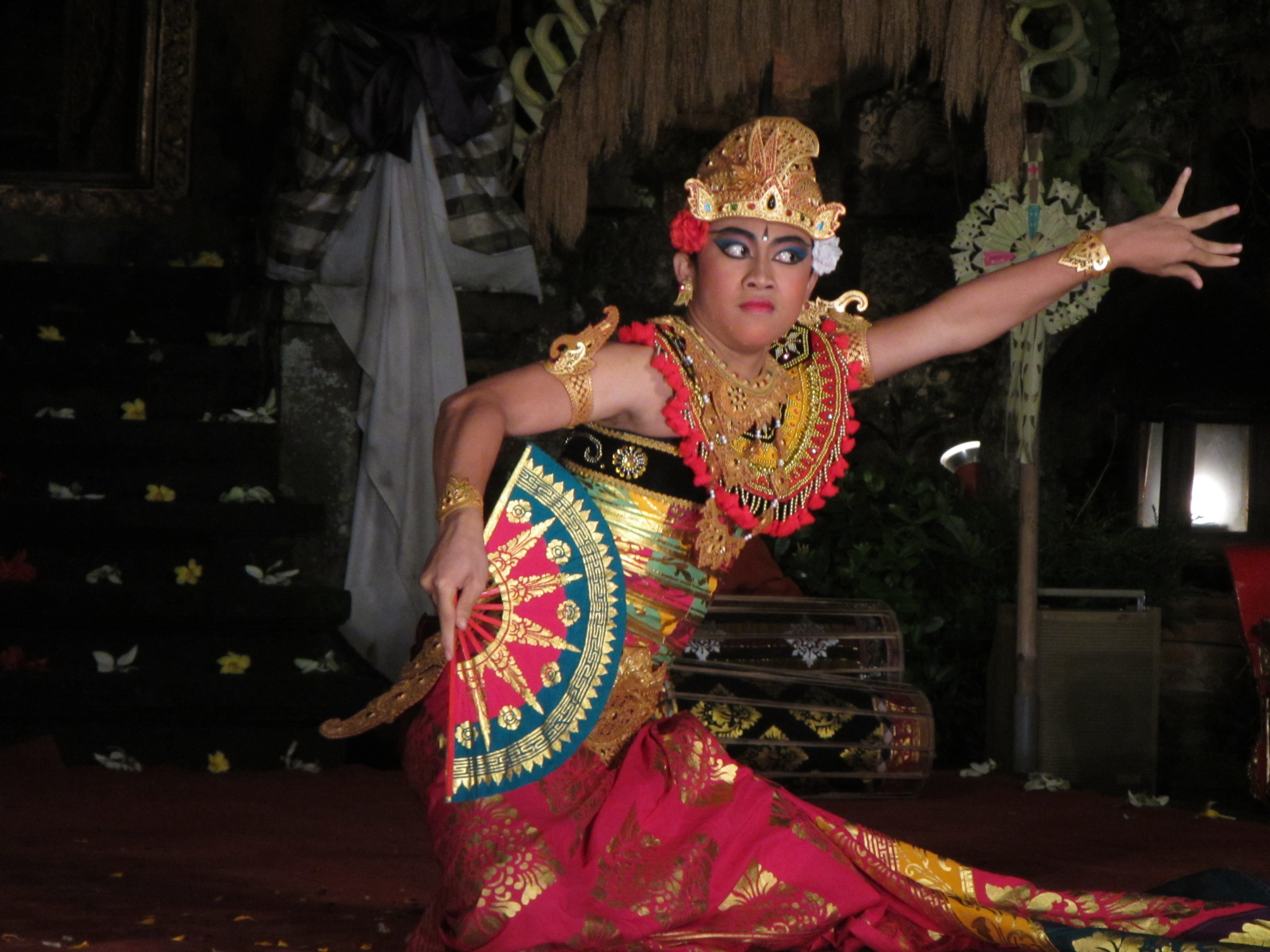
The evening featured an assortment of traditional dances. I liked the Kebyar Dudak, which “depicts the infancy and adolescence in the life of a young prince”, which featured a young, heavily made-up man with very sharp and precise movements, as well as a confident sneer and a great eye roll.
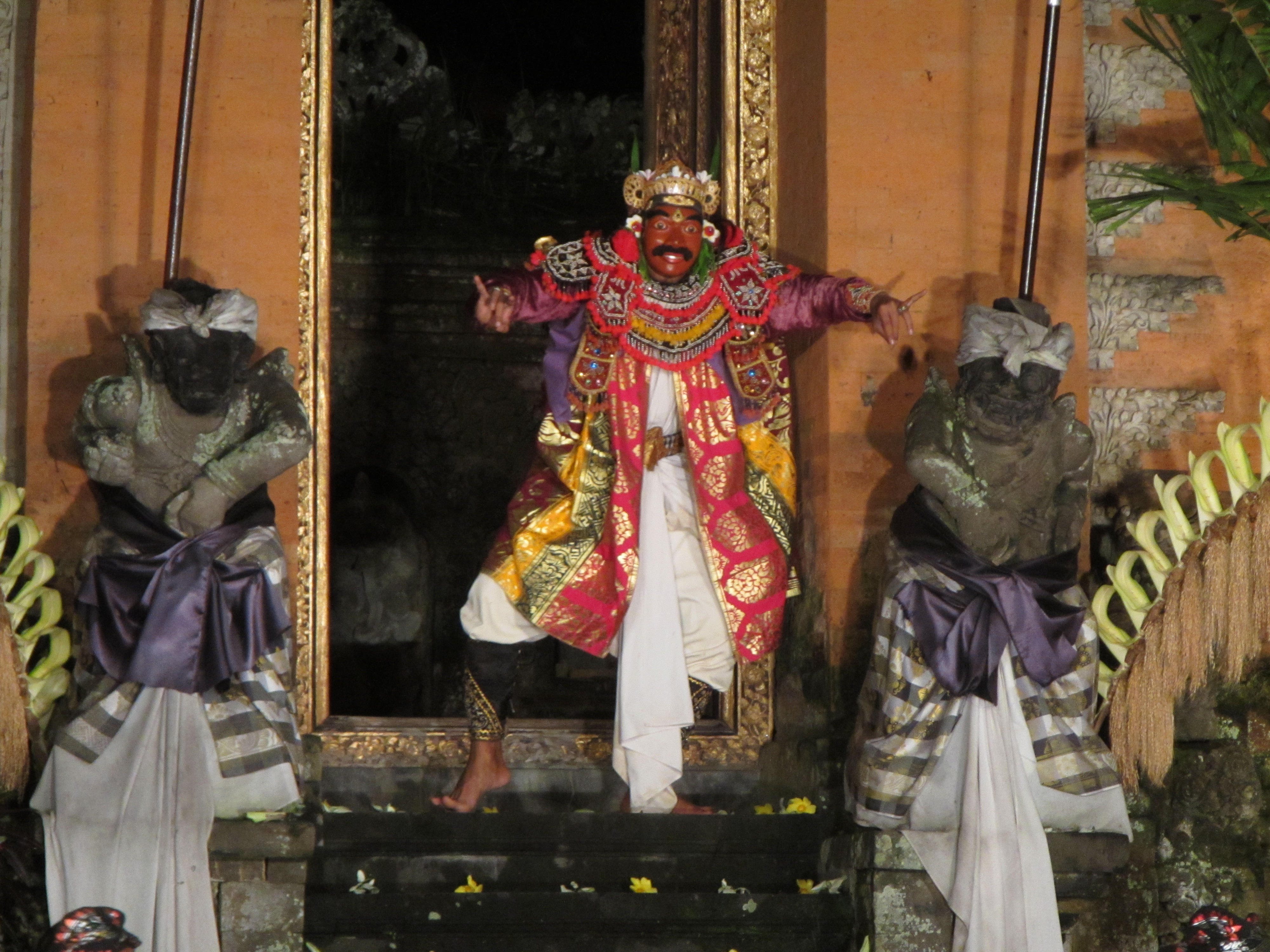
I also enjoyed the Topeng Keras mask dance, which featured a tough, red-faced man who moved like a video game villain from a late-80s Nintendo game, all sideways menace and sudden movements after periods of quiet.
Like gymnastics, this dance performance mostly featured mature men and tiny little girls. The girls did a butterfly dance that I quite liked, but I couldn’t get into the more traditional Legong dance. I did like the Puspa Wresti dance, which was performed by women and led by a woman in her 30s or 40s who had the most astonishing facial expressions. I don’t know if her eyelids ever touched her irises, she was that wide-eyed.

Afterwards, we went out on the town looking for action, which is apparently hard to come by in Ubud. At my insistence, we went to a jazz bar for dessert, but got there just as the band was packing up, and soon realized that the place was full of other couples, most of whom seemed older than us by a good deal, which was not important, but all of whom seemed uninterested in meeting new people, which was an issue.
We left and started walking down the street, and passed by an art gallery in which six or eight 20-something longhairs guys were sitting around a low table, drinking beer and smoking clove cigarettes. One of them called out, “hey, come in!” and after a quick huddle the Professor and I did so.
I’ll confess now – I smoked a few cloves with the guys, breaking my new year’s resolution for an evening. Two of the guys were the gallery’s artists, and their art wasn’t like anything around, not Balinese-iana at all. It featured scary/funny faces (that thing again), girls, text, objects from a bar, local dogs, and pure abstraction. Vigorous young-man stuff. One of them explained to me that he grew up in Sumatra, and had studied art in Jakarta, but had come to Ubud because artists can make a living here, even artists who don’t make the stuff tourists expect to buy.
Not that things weren’t thin for them as they are for young artists everywhere. One guy, an artist and a former boxer who dropped fighting after being put in a coma, explained that he grows his hair into long dreadlocks to sell once they reach a certain length.
We talked about living far away from home, the phenomenon of short hair on women and long hair on men, politics, economics and art. They shared their beer with the Professor.
So today, after touring a big and gorgeous museum, we bought them a big beer in return, and they invited us to come see their studio. We might see it tomorrow, after taking a silver-smithing class or touring the ARMA museum and the monkey forest.
– The Private Eye
One thing is different about Bali for sure: people here are much more aggressive in trying to sell you things. As soon as you exit customs, men start approaching you. “Taxi? Cheap cheap,” accompanied by a gesture of hands outstretched like on a steering wheel. Most of them aren’t really taxis (well, taksis), just people with cars who will charge you an arm and a leg. There is one reputable taxi company in Bali, Bluebird, who actually have meters and charge reasonable rates. To get one, you have to walk through the airport parking lot to an actual street. We flagged one down. The driver was from Tabanan, a town to the north and west of Denpasar. We talked about how he has had a long day, starting work at 6:30 AM. His shift is supposed to end at 12:30, but since he’s already reached his target for the day, he’s going to quit early, after only 13 hours. The ride costs R77,000, or about 10 dollars. We tip him R8k, which is generous, because he has to drive back through the traffic to drop off the taxi before riding his motorbike home, and he was very nice and conversational.
Denpasar is not a big tourist destination, which is why we thought spending a night in it would be nice. It takes us 20 minutes to find our homestay, which thankfully has space. Here in Bali, families don’t live in individual homes. Instead, a family has a plot of land that has multiple buildings within its walls. So many of the cheaper places to stay, rather than separate guest house buildings, are homestays, or rooms in a building in the family compound. We drop off our things and head to Pasar Barung, the largest market in Denpasar, for dinner.
But markets here are different. In Thailand, day markets are a mix of groceries and street food, while night markets are often mostly street food and sometimes some trinkets. Here, it’s all produce, meat and spices. The Private Eye starts to lose confidence we will find anything to eat and suggests we just go to a warung (street food vendor) outside the market, pointing a direction. Of course, it happens to be at that particular exit there is an elderly woman serving some kind of soup and a few fried vegetables. We have no idea what it is, but sit down and have some. It’s different than anything I’ve eaten before, a thin, slightly sweet coconut soup with lentils and a few small balls of sticky rice that she adds. The vegetables are some kind of sweet potato and we think cassava. She’s also making some kind of coffee drink with fresh egg, which the locals seem to like. In our half hour in the market, and since getting out of the taxi, we have seen two other white people. Three bowls of soup (The Private Eye had seconds), two bottles of water, and four fried bites is R31k, or about 4 dollars. We wander back to the homestay, rinse off the sweat (sitting in front of a soup pot in the tropics is hot!), and sleep, thankful that tomorrow is the first day in a while that we don’t need an alarm.
We sleep in and have a simple breakfast in the public area. I’m up first, so over my toast and coffee I have a long discussion with a woman from England about whether western culture is destroying Bali. I mention Ubud and she says she was disappointed. “It has a Starbucks. And a Polo store,” she says. We talk about why this might be bad (or not), finding common ground that if only tourists go to the stores then that’s problematic, as they indicate making a place less challenging and more comfortable as well as less unique. I argue that if locals want a Starbucks, though, they should be able to have it. We veer off into consumerism, capitalism, and other ills. She doesn’t agree with me, but also doesn’t disagree.
We decide to get a SIM card for our phone and to go to the nearby museum of Balinese art. On our way, we pass by a grimy concrete structure that says “Art Market” outside. Inside, it’s basically large, open concrete floors with men and women selling wood carvings. Since business is slow most of them are working on new ones to pass the time. Demon faces, Komodo dragons, Buddhas, monkeys in lewd poses, dragons, chess sets, and boxes dominate. We haven’t even been in Bali for 24 hours so shy from buying anything at first, but then The Private Eye finds a unique carving, a very simple, unfinished one of a rabbit. The woman seems surprised that we like it. She looks at the bottom and names her price: R50k. I bargain her down to 30 (~$3.75), which she accepts pretty easily but seems reasonable to me. After, we look at the bottom and it says 25; we paid a little more than we could have, but still a fair price. The woman stains it for us and wraps it in newspaper.
After the market, we head to the museum, which we have to ourselves. The most interesting exhibit is on Balinese dance, showing some costumes and describing the different forms of dance.
It looks like rain, so we catch a bluebird taksi back to the homestay, pick up our bags, and ride to the terminal where bemos to Ubud leave from. We debated back and forth about whether to take a taksi or a bemo. A taksi would probably be R160k, while a public bemo would be 30. Bemos are basically vans that run certain routes. They are small and kind of cramped. Foreigners don’t ride them much – one issue or complaint many travelers raise with Bali is its lack of a transportation infrastructure. But I figure we should ride one once, and this one is a major route.
Once we get to the terminal, there’s a bunch of discussion with people there. The long and the short of it is that we don’t catch a public bemo. Instead, a grizzled old man with a very beat up van agrees to take us to Ubud for R70k ($10). He won’t go lower. I figure since it’s a charter with no other stops, and it won’t be crowded, it’s worth it.
When we arrive, and I try to pay him, I realize I think I did the right thing. I don’t have correct change: we have only 50k notes and then 19k in other notes. So I give him 100k and ask for change. He looks at the bills, and pulls out a wad of bills from his pocket. He looks at them, leafs through them, and stops. They are mostly small bills. I realize that he probably can’t add them up in his head – he can’t make change. Generally speaking, nobody does arithmetic in their head here, it’s always with a calculator. I offer to make the change for him and realize he doesn’t have 30k – he has only about $3 on him. So I give him the 69k we can give him, counting it very slowly so he can see we are not cheating him. The look of relief and happiness on his face when I give him the money gives me a glimmer of how much harder his life is than mine and how valuable this money is to him. The idea of bargaining for a price you are both happy with does make more sense when there are such disparities.
We get out of the bemo outside the palace in Ubud, find a bookstore/library and a place to stay. I’ll leave our nighttime adventure involving Balinese dances, a jazz bar, and sharing beer with a half dozen artists in their studio for another post.
— The Professor
Our flight out from Phuket airport was at 10:30AM. There’s a taxi mafia in Phuket Town, who charge ridiculous prices, so we decided to take the B90 ($3) bus instead. The official schedule says the bus leaves at 7AM to arrive at 8:20, but a sheet of paper taped to the schedule claimed it wouldn’t arrive until 9 (120m), while all other departure times still only took 80 minutes. As the bus indeed arrived at 8:20, and many taxis tried to convince us they would only take 45 minutes, I think this was the taxi mafia at work trying to scare farang away from the bus.
We flew from Phuket to Kuala Lumpur, in Malaysia. Imagine a shiny, new, clean airport (e.g., the international terminal at SFO), filled with luxury goods, but the throngs of passengers are from corners of the world an American rarely sees. Women wearing everything from tank tops and shorts to Muslim women covered from head to toe in black, only their eyes visible, women wearing suggestive, tight, outfits in bright colors that leave no skin revealed and cover the hair, with bright makeup, like from an early Star Trek episode, a man wearing a fluffy white skirt that looks like a thick towel, reaching below his knees, with a bright green belt, and a shirt that reveals the bottom of his belly, cyber Japanese women in leather and huge sunglasses, and many more. It felt like the future, not just in terms of the architecture and shining metal of the building, but also culturally, given the recent and future rise of Asia.
We arrived with about an hour until our gate opened. Entry into Indonesia requires a $25 visa, exact change required. So we took a train to another part of the airport to change some baht into dollars. The visa is only for 30 days, something every guide book says is too short, given the size, scope, and diversity of a country spread across literally thousands of islands.
We found out that there’s a big dance party with music we like on Gili Air, a tiny idyllic island east of Bali, very close to Lombok (the next island over), tonight. We thought that landing and immediately heading to Gili Air for dancing sounded like a lot of fun, but given our flight arrives at 6:30 it doesn’t look feasible. We would have to make it about 50 miles from the airport to a north eastern coast town (e.g., Amed), then catch an expensive speed boat. The seas can be rough at this time of year, and making the trip at night given the warnings we’ve heard about boat safety seemed like a bit too much like danger rather than adventure.
So we are going to stick in Denpasar tonight, maybe head to Ubud tomorrow.
Right now we are on the plane from Kuala Lumpur to Denpasar, a 3 hour flight. The Private Eye is figuring out which part of town we want to look for a guest house, probably near one of the bemo (think bus) terminals and markets.
— The Professor
We have two more dives here in Ko Tao, our two wreck dives. One of them will be nitrox. Our instructor, Gemma, will be bringing a camera so we will have pictures of us diving a wreck! It seems silly that we’ve spent so many hours underwater and have no pictures to show for it.
We’re then catching a boat to Ko Phagnan on the 25th. The full moon party is the night of the 26th, we will dive Sail Rock on the 28th. We booked a flight (through Kuala Lampur) to Bali from Phuket (western side of southern Thailand) on Feb. 1st. . So between the 28th to 31st, we will choose between diving some more in Ko Phagnan, rock climbing near Krabi, or maybe even dive the Similans as a day dive. Or some combination of these options. We can’t dive on the 31st as we are flying on the 1st so I suspect we will rock climb or travel that day.
Met a wonderful couple yesterday, originally from Toronto, now living in Gold Coast. We all went out to dinner and mid-dinner they remembered it was their second anniversary! I’m glad we chose a nice Italian place, recommended by the scuba instructor from Milan.
Today we are going to finally walk around the island a bit, as we have no more afternoon class work. Meeting up with the SF burner for dinner.
I’m missing all of my friends back home! Hope they are all having a wonderful time. February is my favorite month in the Bay Area, I’m sad I’ll miss it. Well, only kinda sorta sad. 🙂
— The Professor
 The Professor and the Private Eye: Adventures Abroad