Oh, the batik salesmen of Yogyakarta. They seem so friendly, so hospitable. “My friend! What is your name? Where are you from? When did you arrive? Where from? For how long will you be in Yogya?” But once such pleasantries have wound down, they cast their line. “Oh, you arrived today? You are lucky, it is the last day of the student art exhibition, which has a lot of batik!” Because, you see, their eyes and posture tell you it is so sad, a veritable tragedy, how poor the batik is in your country, and so it’s really your duty to bring some home.
We’ve been trying to come up with a fun way to respond, to play along and pull their chain once it’s clear they’re trying to cheat you. The one I want to try involves reading up a lot about the art and then telling the person I’m a connoisseur, in fact a professor at a prestigious American university, an art professor who studies batik and so yes, can truly appreciate and discern a fine piece of batik. Of course, they might see this as raising the stakes – if I’m that, yet so clueless to talk to them, maybe they can make a HUGE sale… We will see. Either that, or be completely clueless on what batik is and then tell them that I don’t understand why you’d ever want cloth with patterns on it.
Our first day was a mix of reading in the guest house lobby waiting for our room to be ready, then venturing out to Jl. Malioboro (named after the Duke of Marlboro) to see the market.It had a lot of batik, of course, front and center. But in the back, there were also spice and food merchants, huge bags of cinnamon and turmeric, bins of star anise, cloves, and cardamom, all filling the rain-humid air with such wonderful smells. And, of course, head scarves:

The Private Eye commented that she’d like a guide: some of the foods, such as dried, thin disks of some starch that were everywhere, were foreign to us. And as she finished her first durian juice, her prayer was answered. A man named Aldi started chatting us up. He is a spice merchant, and started telling us about Sultan’s Tea, also called garbage drink, but not for its flavor, rather that when prepared the many spices floating in the tea make it look like flotsam and jetsam. As we walked back to his stall, we asked him about the different foods and he answered all of our questions. He then sold us two packets with which to prepare Sultan’s Tea, which include ginger, bay leaves, cinnamon, and a half dozen other spices. They were about 90c each; even if a total rip-off, I’d gladly have paid $2 for the time talking with him. We tried Sultan’s Tea tonight at dinner and it was great, sweet and spicy, so we will have to break open one of the packages sometime soon.
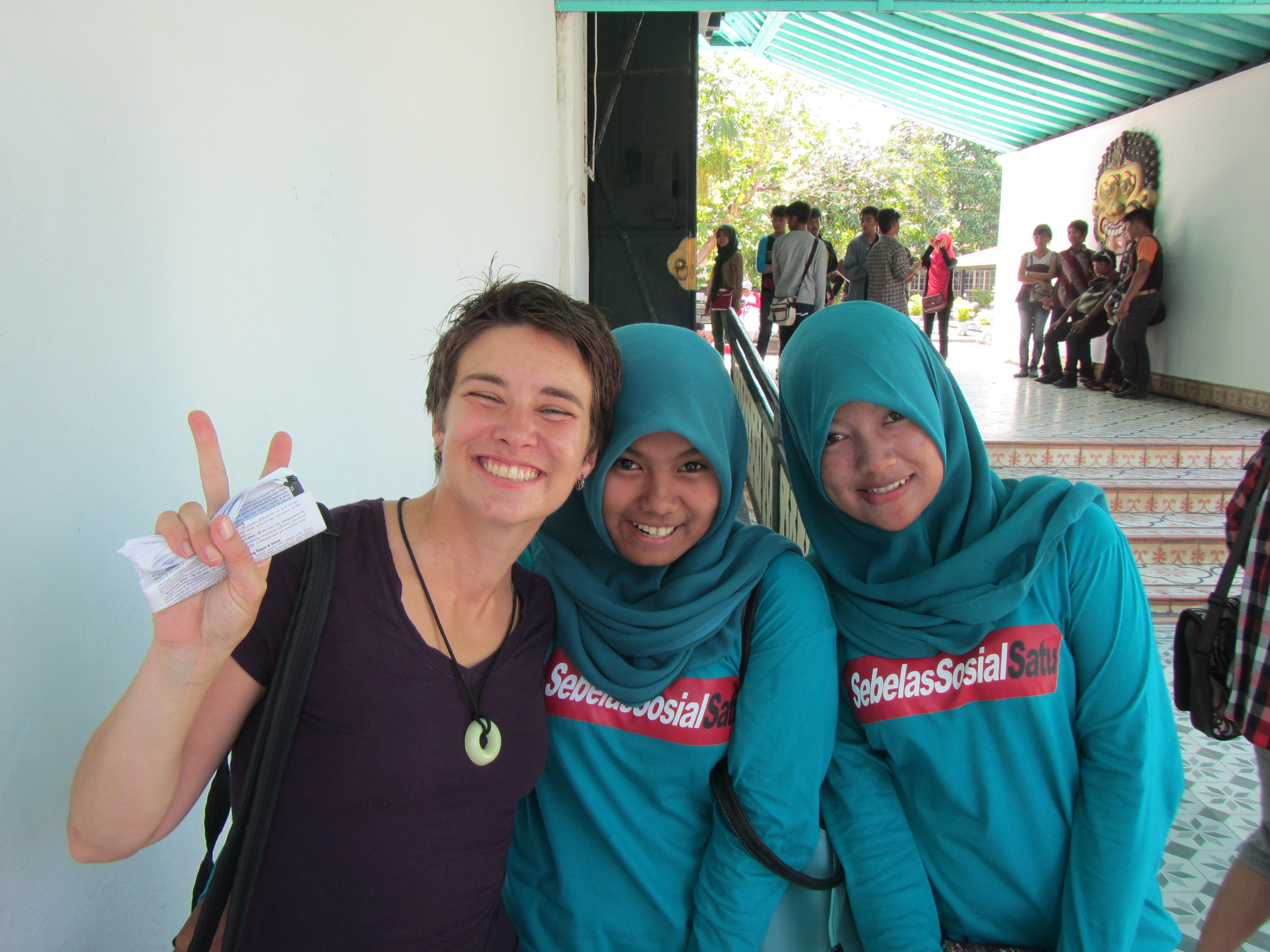
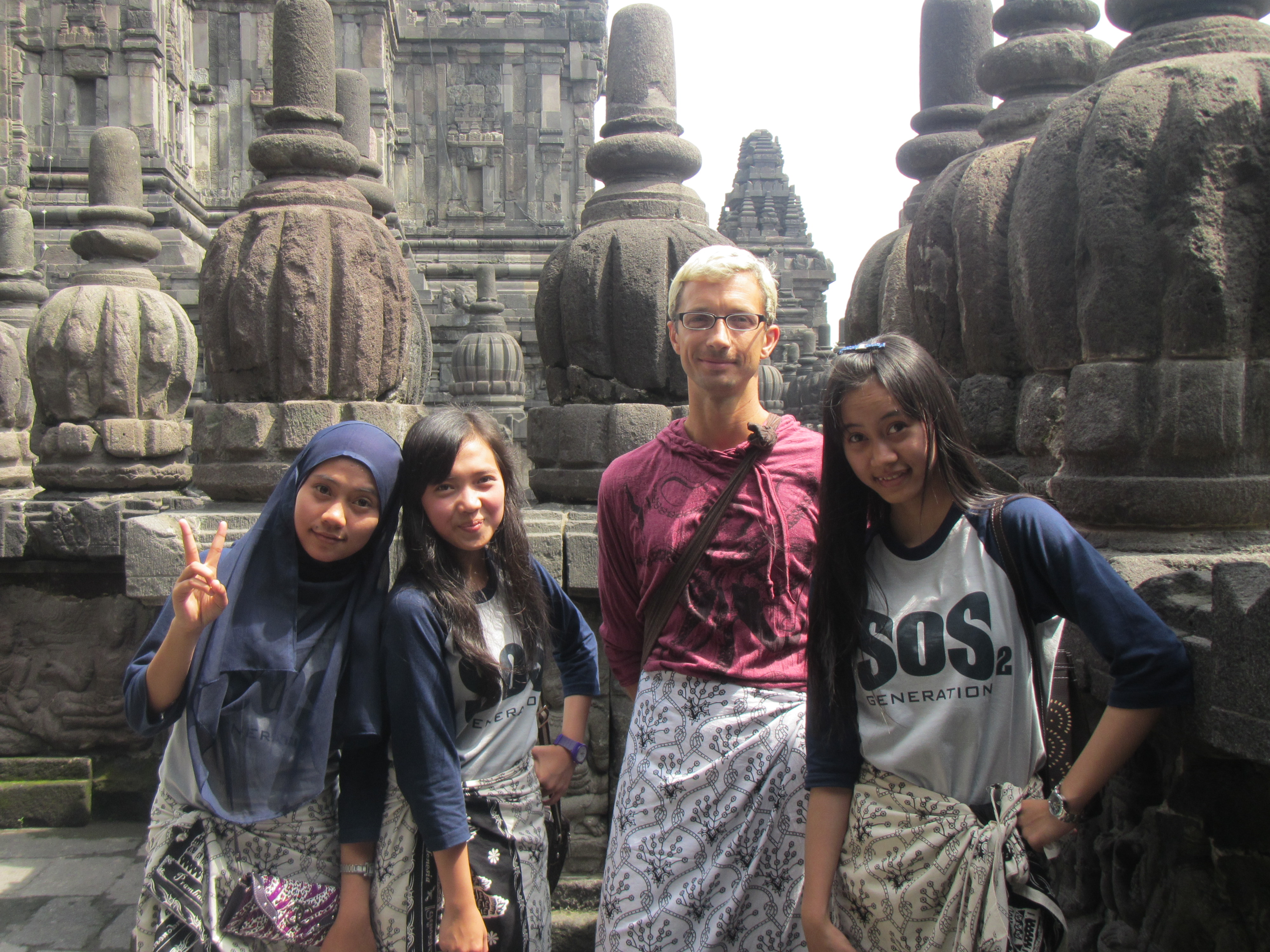
Today, we went to the kraton, the large walled complex that encompasses the Sultan’s palace. We also ventured to the silversmithing village/neighborhood a few kilometers away. At the kraton,we encountered a first, something which we’ve experienced at every tourist destination in Yogyakarta: we are one of the attractions! Teenagers, generally school groups, ask if they can have a picture with us. We usuallu say yes, except when there are so many (and have so many cameras they need to switch between so everyone gets a picture) that we don’t seem to be seeing the sights anymore. Sometimes we ask if we can have a picture too:

In all honesty, though, today was more about the transportation than the destinations. We rode in a becak, a two-person seat pushed by a bicycle, in our case ridden by old, gnarled and wiry men who could read the traffic so well that they never used brakes yet were always completely safe.

I liked the idea of transportation infrastructure that puts its providers in good shape. We rode the bus and, with the help of a man from Holland who used to live here but now just visits, figured out a transfer – no matter that our destination, the Affandi museum, was closed. Then the rain began, and we hid under a tiny tarp with three teenagers running a coffee cart, where we had two cups of coffee, two small bundles of rice and chicken, three egg rolls, and a few other fried goods, for R12,000 – around $1.50.
It’s hard to say much about Yogya just yet – while there is tourism here, it seems much more a working city, and so the culture is not as on display. It also means the division between tourist and local is much thinner, such as sitting in a donut shop that is a Starbucks clone, surrounded by Indonesian couples and friends chatting. Tomorrow we wake at 3:45 to go see Prambanan and Borobudur, enormous, beautiful Hindu and Buddhist temples. We have booked a flight Wednesday afternoon to Singapore, where hopefully we will connect with Life Is Too Short, as well as the Singaporean man we met on the bus to Chiang Rai from Tha Ton.
— The Professor
 The Professor and the Private Eye: Adventures Abroad