RSS

Category Archives: Cambodia

English Subtitles Most Wonderful

Our last night in Phnom Penh, we turned on the TV in our luxurious room (AC! Fridge! TV! Free laundry!) and encountered a kung fu movie involving a child monk, an old and wizened master, and a villain with spiky shoulder pads. The action sequences were not great, but the English subtitles were fantastic entertainment:

“The teacher empty senior the big defeats thief’s person greatly and courageously.”

“Higher than that thief’s person’s effort… That why would you be anti- to win. So a should have another to losing a teacher sad BE is not. However I still needed to give public recognition today empty. The is empty you beat today the very brave dozen have to be good.”

“The first teacher can teach me a to recruit extremely. The second teacher can give me adjust a bed. Master’s elder brother’s feet were too smelly.”

“This still doesn’t hurt that on the whole how just hurt on the whole. I have already dashed in to chase little LIN2 SI4 YI2 as flat ground.”

— The Professor


Dance in Bali, Java, and Cambodia

We’ve seen dances in three different cultures: Java, Bali, and Cambodia. Rather than discuss the differences, I thought I’d just give examples. These are from Bali:

Java (sorry it is sideways):

Cambodia:

— The Professor


Calamity and quibble

The calamity, of course, is the bloody reign of the Khmer Rouge. Yesterday we went to the Tuol Sleng museum, where the regime tortured its countrymen, and to the memorial park at Choeung Ek, where the regime then murdered them. Each is one of a series of such places in use in the late 1970s – today, the symbol for them all.

I feel inhibited writing much about history that I don’t know all that well, and from highly derivative sources at that. You can read about the Khmer Rouge elsewhere. I will just say that it killed more than a million – likely millions – of its own people as it took power, purged dissidents, and then turned in on itself with such viciousness that in 1978, 300 or more people a day were murdered in Choeung Ek, many of them the Khmer Rouge’s own officials or military. Those numbers included vast numbers of women and children, in a move designed to eliminate the possibility of family revenge – all of a targeted person’s family was destroyed.

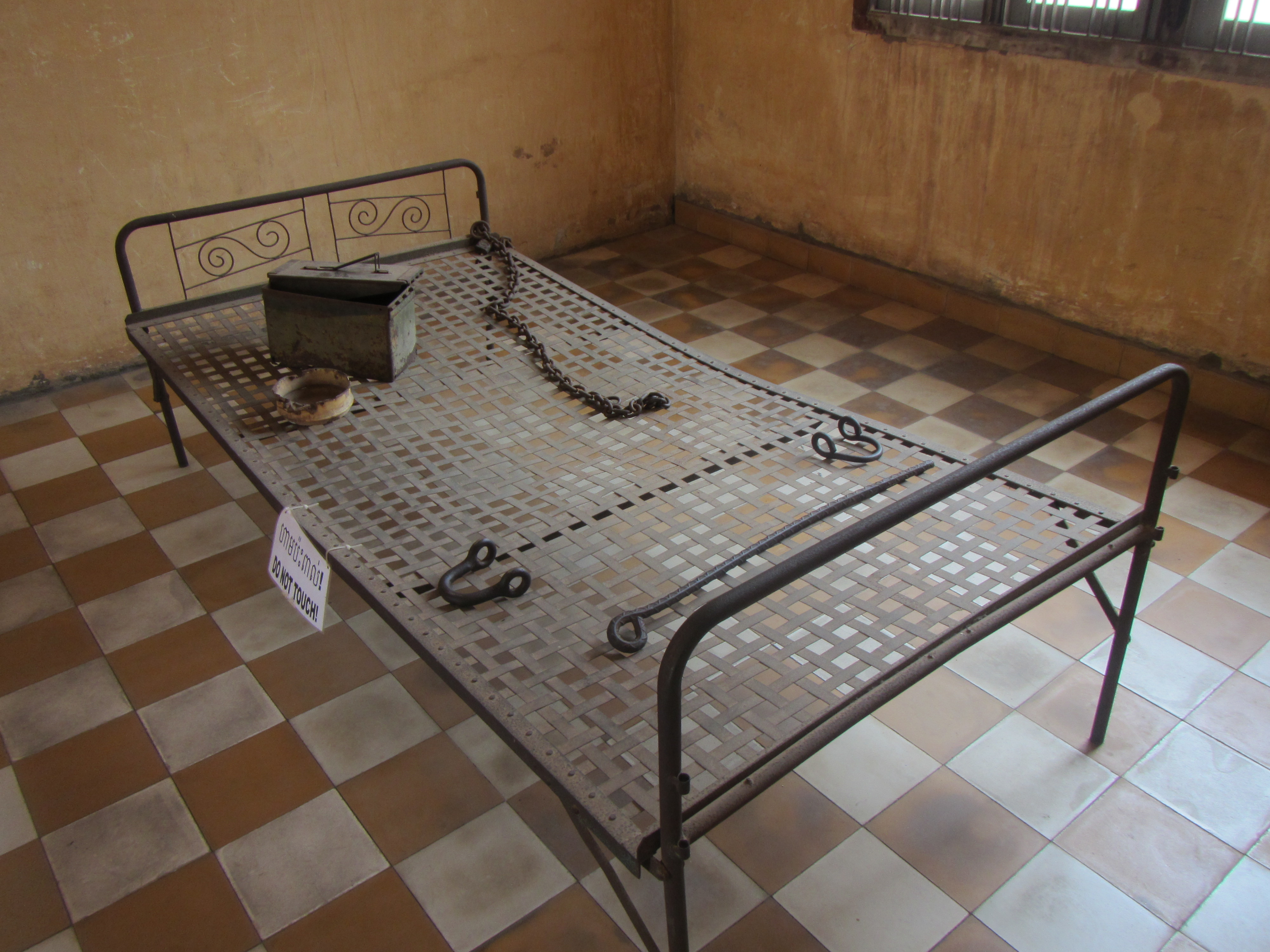
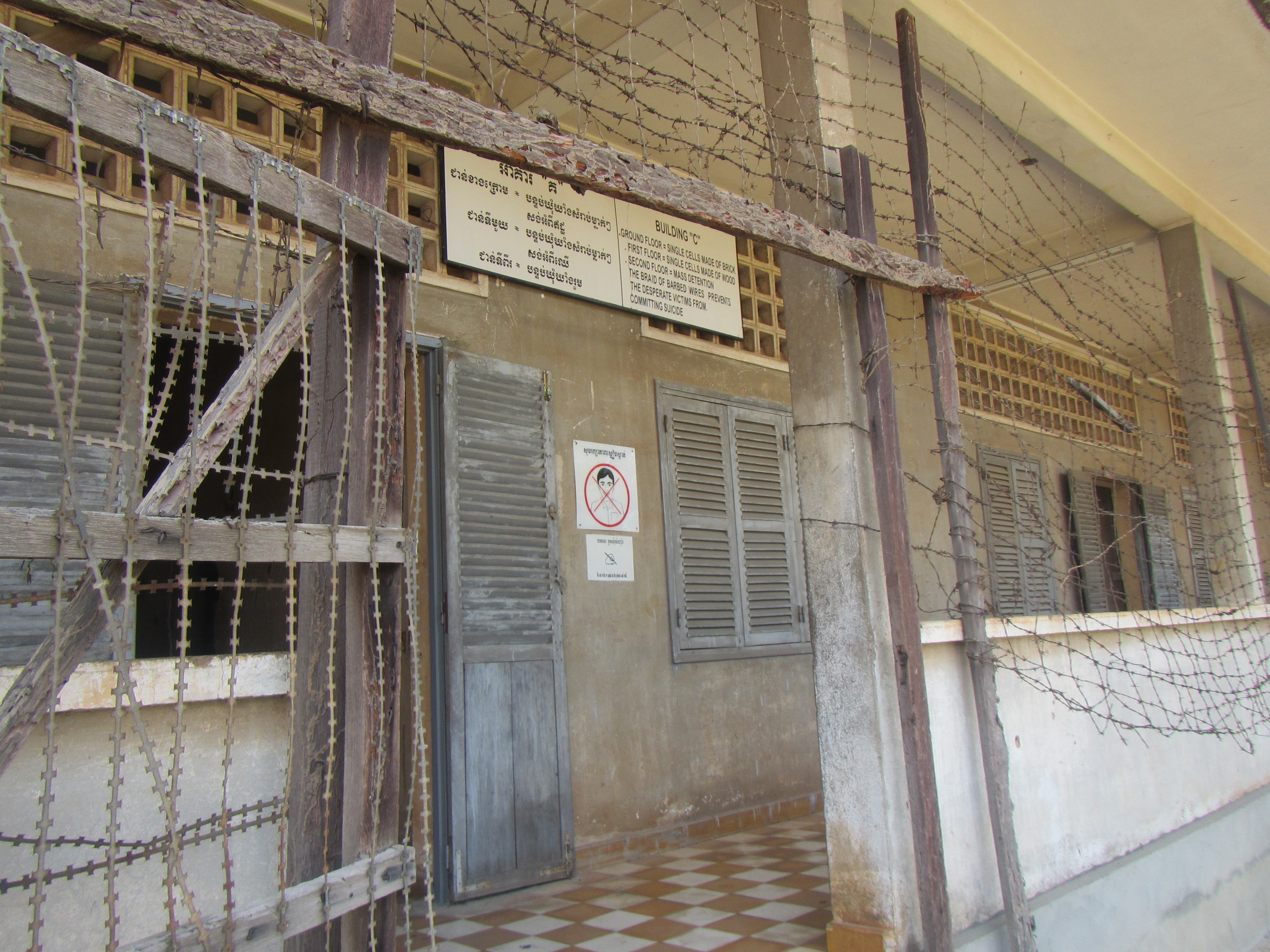
Tuol Sleng itself had been a school prior to its use as holding cells and torture chambers for supposed dissidents. It is easy to imagine eager pupils in the cool cream and terra cotta tiled classrooms, with the windows looking out on leafy streets and a courtyard. But the museum has left the metal beds there, and the shackles made of rebar, and the empty munitions boxes. On some of the walls are photos of the last 14 corpses found in and around those beds when the place was liberated. There are bars on the windows, and when I saw a sparrow fly in and around the room, I wondered how many birds the prisoners had seen, and if their unhampered flight brought comfort or despair. I am guessing the latter, because the prisoner were underfed and shackled to their beds, and probably couldn’t reach the sparrows to eat them.

IMG_2786IMG_2754

Some of the classrooms were built out into dozens of little brick cells, each basically long enough for a man to lie down in, and a chain sunk into cement on the floor.

IMG_2790

The most powerful part, of course, was the hundreds of photos in some of the rooms. Numbered prisoners, men, women, and children. Bright faced young children conscripted for the cause, turned into child soldiers, prison guards and murderers, in fear of their own lives if they didn’t cooperate.

I love people. I love listening to their stories. It’s why I am a private eye. Looking at the faces, I could imagine so many personalities – that smart young man who has trouble with his temper. That girl with the lazy, confident smile of a hippie chick. That woman, my age, with my haircut, but with a more aged face, probably a grandmother, with a whiff of good sense about her. The honest man who has finally gotten mad and stares into the camera defiantly. So many faces. Most dead, and the others living with the memory of what they did to stave off death.

I got very quiet when I saw the photos of intellectuals. In such a revolution, The Professor and I would be among those first up against the wall.

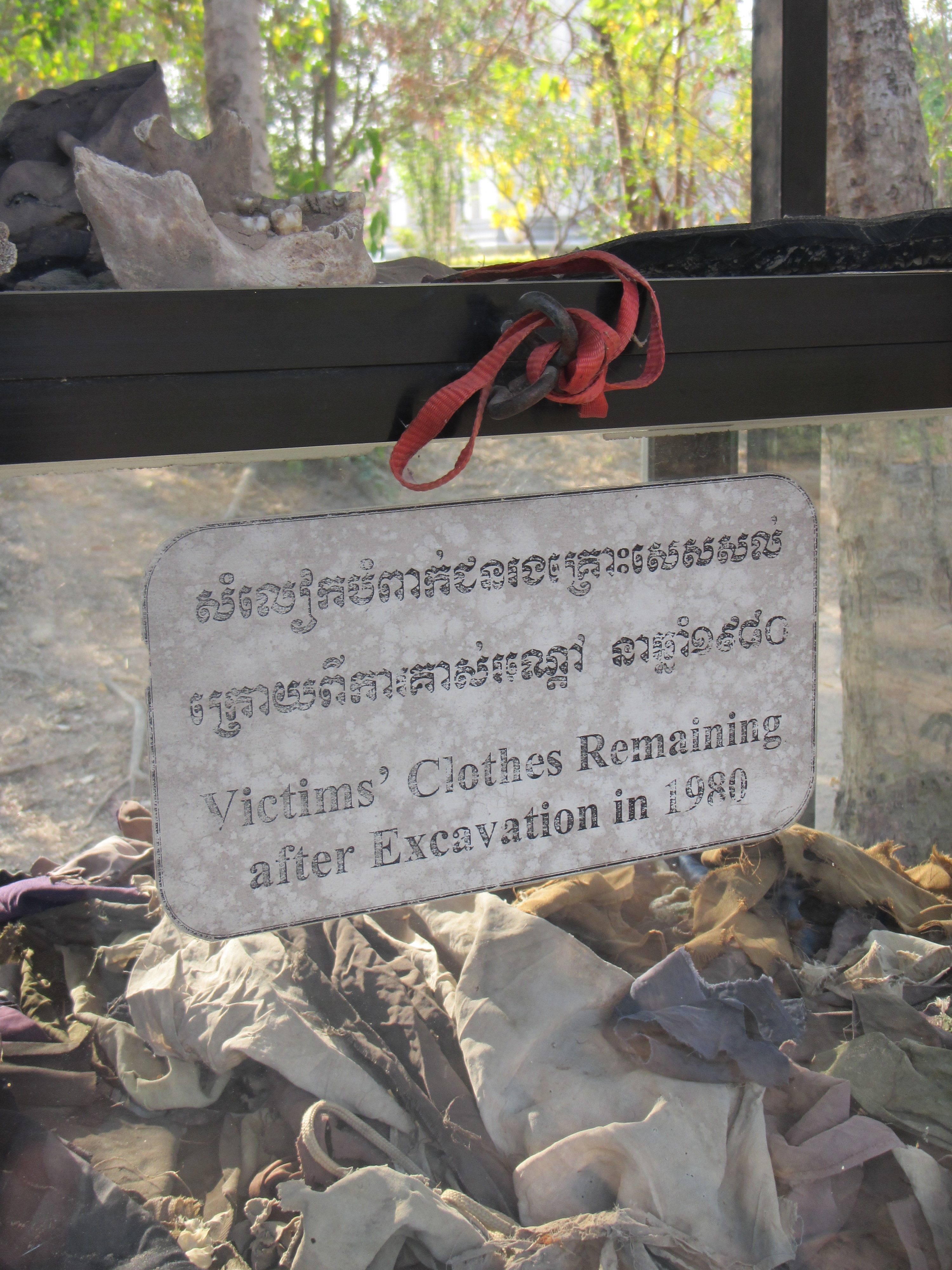
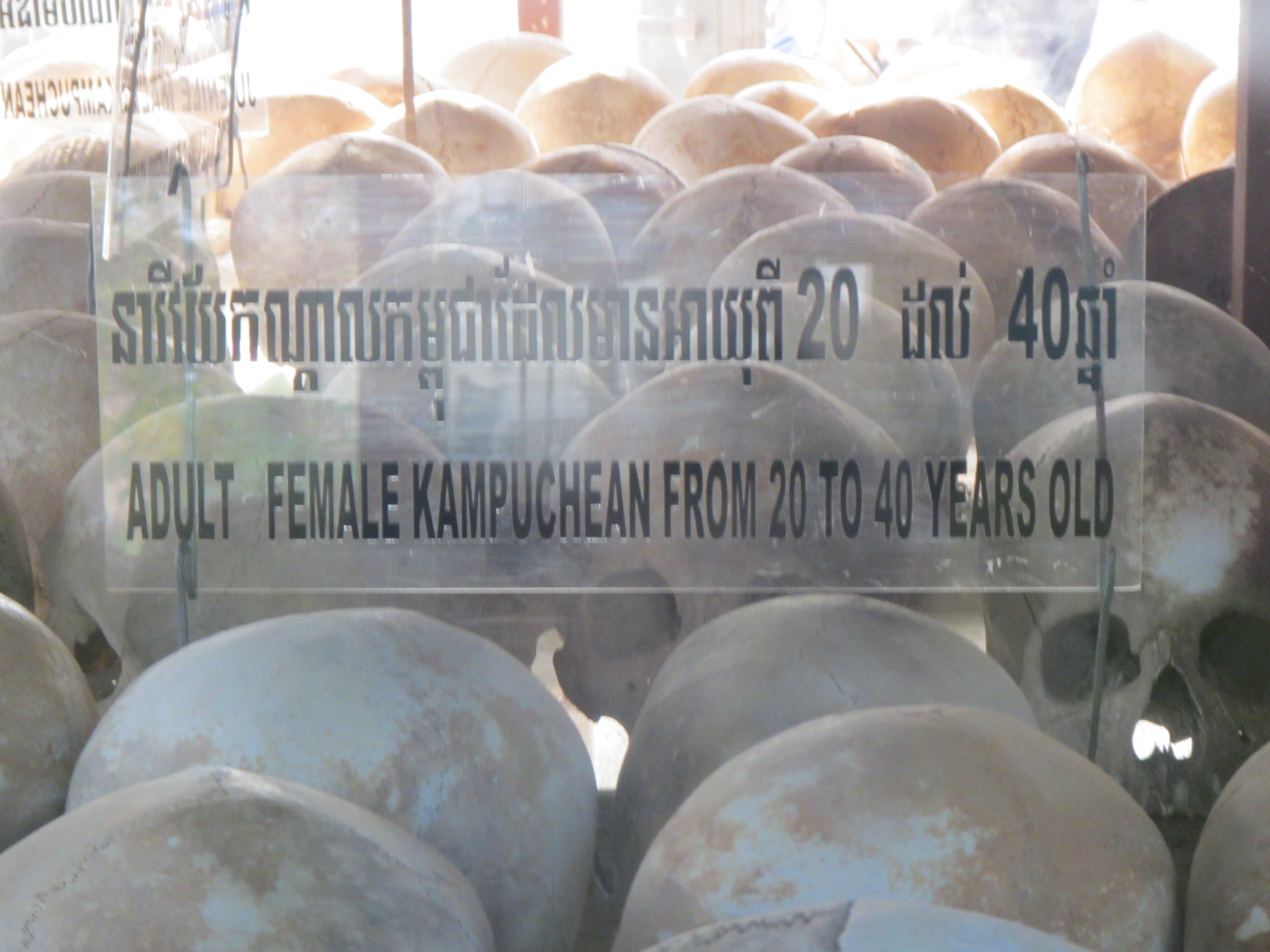
After touring Tuol Sleng, we went to Choeung Ek. It is a pleasant country place, surrounded by rice paddies, orchards, white hump-backed cows, and lotus root ponds. In the middle of the field stands a great tower of a stupa, its glass faces filled with skulls exhumed from the mass graves in and around the field. The audio tour is fantastically informative, giving information about the use of the site itself, about the history of the Khmer Rouge, stories of survivors and perpetrators of atrocities, and even a piece of classical music composed in response to the atrocities.

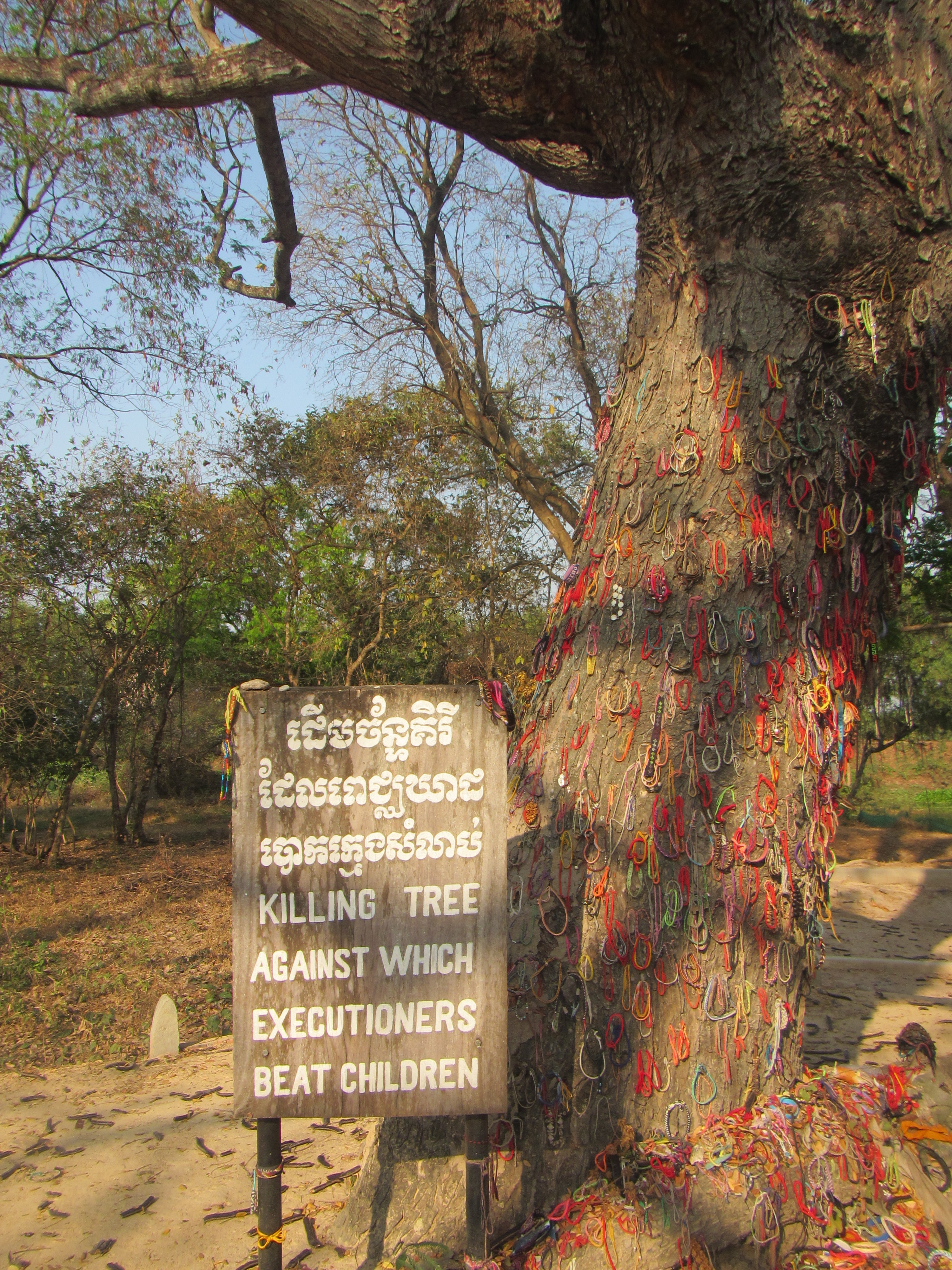
Being informative, it tells you just how bad the whole thing really was. Hideously bad. Shockingly bad. Babies-smashed-against-a-tree bad. They-used-farmtool-clubs-instead-of-expensive-bullets-and-then-DDT-to-finish-the-job bad. They-played-revolutionary-music-on-a-loudspeaker-while-killing-people-one-by-one bad.

IMG_2808IMG_2806

Sometimes people have told me I am too paranoid. It goes with the territory, I suppose, but I cannot look at such history and have any illusions that things are always going to be all right. You never know when something terrible will happen, and destroy your life and all you love. You have to make the most of every moment, and be wary enough to dodge before the gun is lowered against you, and fight politically for a just society. You shouldn’t live in fear, but neither should you live in the expectation of safety. What little we have has been painstakingly built through civilization, and this is why I get angry when some people, mostly men, predict the collapse of civilization with a gleam in their eye, as though they look forward to it. Anarchy means the strong will rape and kill middle aged women like me. Look at the evidence.

IMG_2813

– the Private Eye

PS – the governments of the West all supported the Khmer Rouge for decades because they opposed the North Vietnamese victors. This makes me ashamed.

PPS – the quibble is too stupid to write about after all this. Let me just say that I am a westerner and don’t want to turn all my business transactions into exclusive relationships, and I resent not having autonomy in travel. In short, I want to treat my tuk-tuk like an American taxi and it just doesn’t work easily that way.


Daily Budget in Siem Reap

A previous post mentioned our daily budget in Siem Reap was $80, with $30 for culture. Where does that go? Here’s an example day:

Culture: tickets to view temples were $40/person for 3 days, so ~$30
Room: $8
Morning coffee and breakfast: $4
Bicycle rental: $2
4 large bottles of water: $2
Two coconuts: $2
Sunscreen: $5
Deodorant: $2
Cold Pocari Sweat (Japanese Gatorade): $1
Lunch (splurge, at a fancy western place): $12
Dinner: $5
Shared ice cream cone: $2
One cocktail: $2.50
One beer: $0.50
Two soda: $2

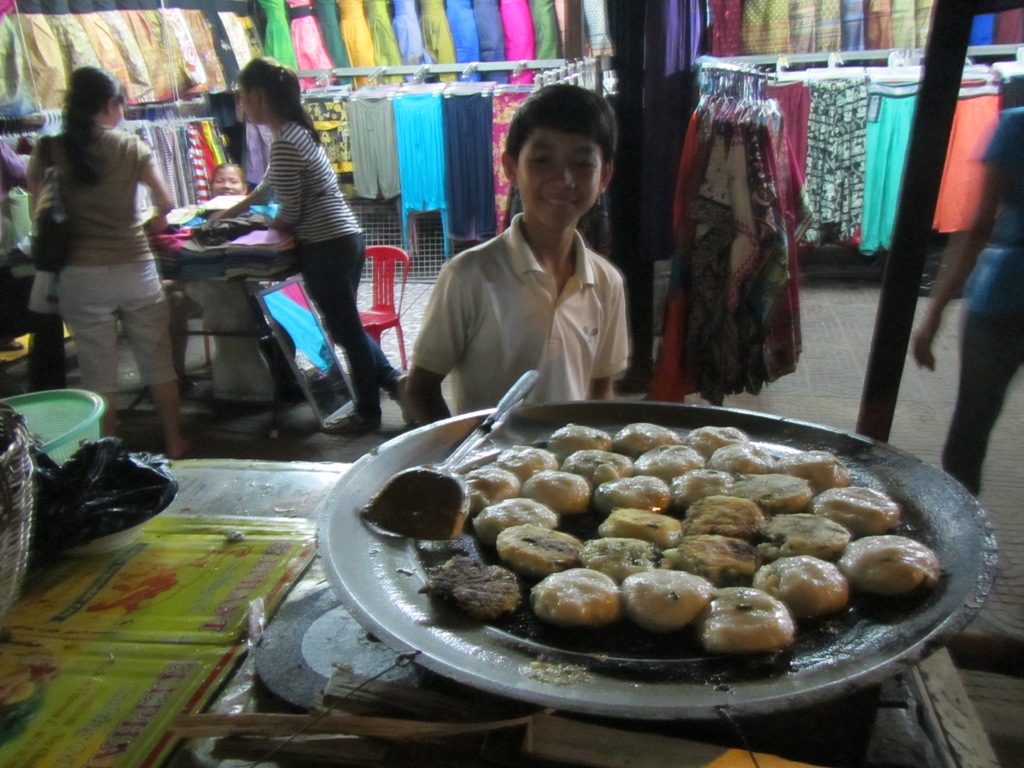
Here is the boy who makes spinach-filled little pancakes (well, when one of his parents is busy), The Private Eye’s favorite street food in Siem Reap ($1 for 3, with sauce):

Singapore-KL-SiemReap 016

— The Professor


Landmines

Cambodia’s severance from history is made much more acute by the atrocities of the Khmer Rouge and Pol Pot in period after the Vietnam War until the late 1990s. Accounts vary, but the goverment killed between 1.2 and 2 million people – approximately 10% of the population. Monks, intellectuals, anyone who could define the country culturally. Nearly 7000 temples were destroyed. In a period of 25 years, the Khmer Rouge destroyed almost all of the historical and cultural record, written, oral, and architectural, of Cambodia. The history and historical identity of the country was severed quite explicitly, suddenly, and intentionally.

The wars and conflict affect Cambodia today physically as well. There are many fewer treks here and minimal wilderness tourism compared with other countries we have visited, because the countryside is sprinkled with millions of mines and unexplored bombs. Many of these are American, placed in this country to stop the North Vietnamese supply-line alone the Ho Chi Min Trail through Laos and Cambodia during the Vietnam War. Many others were placed by the Khmer Rouge and the Vietnamese when they invaded. I encountered at least a half dozen beggars in Siem Reap who were missing limbs, claiming (and mostly likely truly) the cause was landmines.

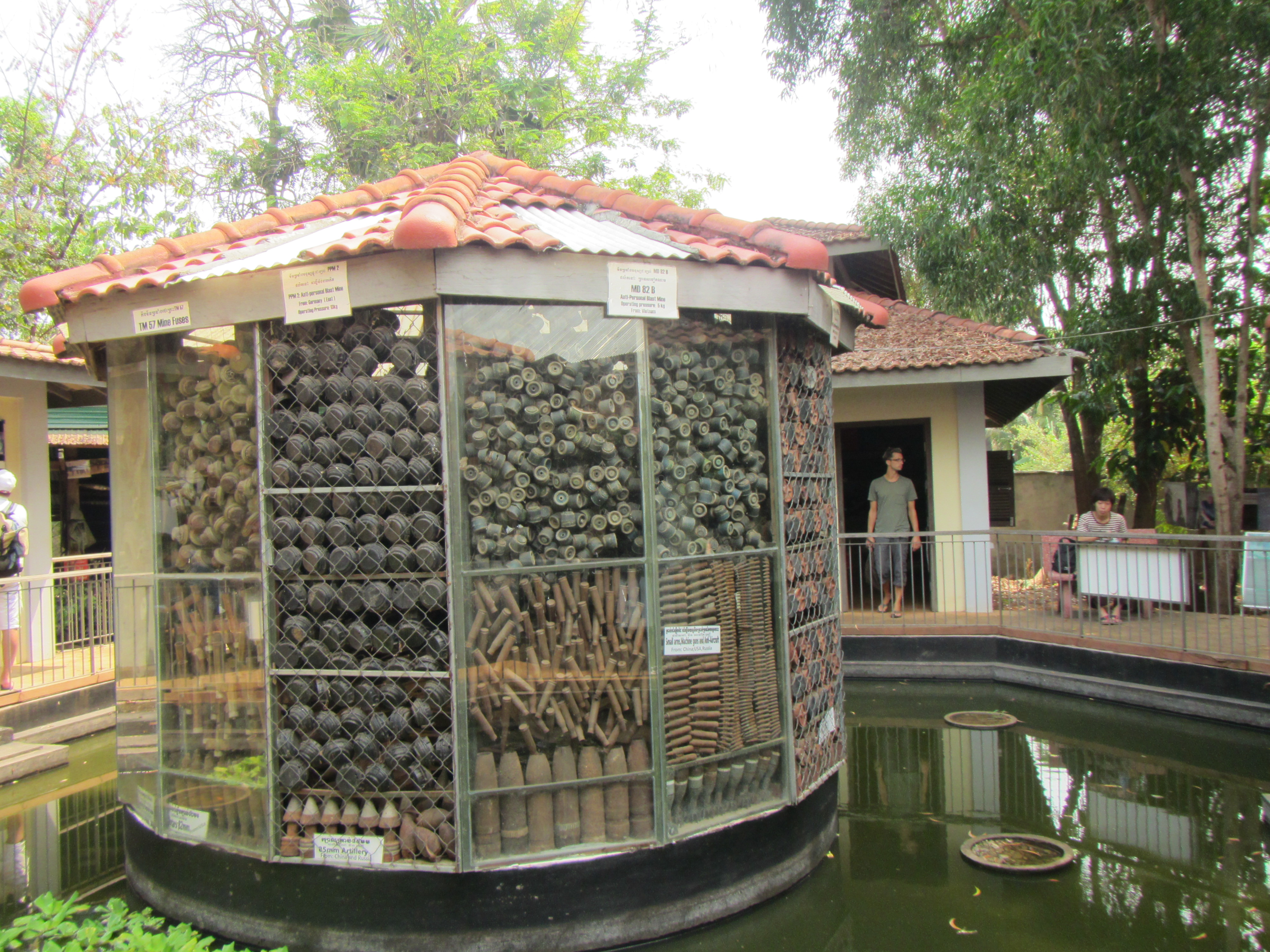
We went to a museum today that detailed one man’s efforts to help rid his country of this unexplored ordinance, or UXO. Aki Ra is famous for his personal quest – he has received numerous international awards and honors. He was taken as a child by the Khmer Rouge and his parents killed when he was 5; he spent over a decade fighting and laying mines, first for the Khmer Rouge, then against the Khmer Rouge, then for the Vietnamese. He chose his name – it is one of many that different people have given him (Akira), the one he liked most, and so he made it his own. He began clearing mines from around Siem Reap, and made a small museum near Angkor Wat of his efforts and the challenges Cambodia faces. The museum’s proceeds support a child care center for children injured by landmines.

IMG_2639

The idea that the wilderness is open and (for the most part) safe is something Cambodians can’t share. Wandering through fields, woods, or remote areas has the very real and commonly experienced threat of a explosive device. Some people seek them out, because the explosive and metal can be sold.

What chills me most about the Khmer Rouge is that it happened in my lifetime. The landmine museum compared it to the Holocaust, Rwanda, and Bosnia in scale and duration. In the moment, it’s easy to ignore the atrocities going on in the world. But after the fact, when the scale of the horror is clear, I wonder how we could have stood by and let it happen. It is hard and a problematic for individual nations to intervene, as then national agendas come into play. I understand (but don’t agree with) a conservative American objection to the United Nations, that it subverts national sovereignty, but it seems to me to be the organization best suited to protect people from governmental slaughter. After reading about Timor-Leste and the UN involvement, my feelings about Indonesia are more… complicated.

— The Professor


Endgame Plans

We have finalized our plans for the end of our time in Southeast Asia. Our time in Siem Reap has been so fascinating that we want to spend some more time in Cambodia. So no quick trip to Vietnam. Instead, we are heading out this afternoon (Tuesday, March 5th) to the capital. Phnom Penh, where we hope to learn more about Cambodia’s history and the Khmer Rouge. We have a flight back to Bangkok on Friday. We will be spending Friday night in Bangkok proper: we figure we should experience it at least one night as backpackers in a guest house, and there are a few last errands we want to run. Saturday we will be heading to The Expat Teachers’ for the weekend. We will be meeting with students at their school on Monday, then flying out super early on Tuesday for Peru.

We splurged on our transit to Phnom Penh: a VIP bus with water, AC, wifi, and a free snack. $12 a person for a 6 hour trip, the extra $4 over just AC seemed worth it. Hopefully we will write an update or two on the ride, such as about the landmine museum, the silk farm, or the very cool rooftop restaurant we played pool at last night.

Singapore-KL-SiemReap 025

— The Professor


Cambodia: Siem Reap

When we departed for Southeast Asia, we had very few entries on our must-do list. There’s a trade off here. If you prepare a lot and figure out exactly what you’re going to do and you are unlikely to waste much time. But you’re also unlikely to take advantage of opportunities or discoveries as they arise. In our usual travel schedule, which for practical reasons is typically is 5-6 days, we try to follow the guideline that each person has one MUST, something we will so or do come hell or high water. For example, when we went to Paris, for The Professor it was the catacombs, for The Private Eye it was the unicorn tapestries at the Cluny. Of course there are lots of things we would like to do, but it’s OK if we don’t get to all of them, while missing a must is a calamity. Given the length of this trip, we gave ourselves a bit more flexibility than just one must each, but tried to keep the list short.

Angkor Wat was near or at the top of the list. Everyone who has traveled to the region and visited it almost always names it first. The Secretly American Englishman told us stories; The Professor’s Traveling Teacher Cousin recommended several days; almost every backpacker we’ve met has either been there or has it on the itinerary.

Our original thought had been to go early in the trip, perhaps after Laos. But the chilliness of Luang Prabang led us to yearn for beaches, and so we headed to Ko Tao and resolved to make Angkor Wat a bookend towards the end of the trip. And so, after the culture of Bali, the beaches of the Gilis, and the fast-paced modernity of Singapore and Kuala Lumpur, we flew to Siem Reap, Cambodia, the city a few kilometers from Angkor Wat and the center of its tourism industry.

The change from the metropoli of Singapore and Kuala Lumpur was wonderful. Here in Siem Reap, we are back in backpacker country, where a restaurant meal is $3, a beer on tap is 50 cents, and street food is typically $1. Our room, with daily cleaning and a fan (but no AC) is $8. Our daily budget is $80 for the both of us, thirty of which is for culture (museum tickets, passes to the temples, etc.).

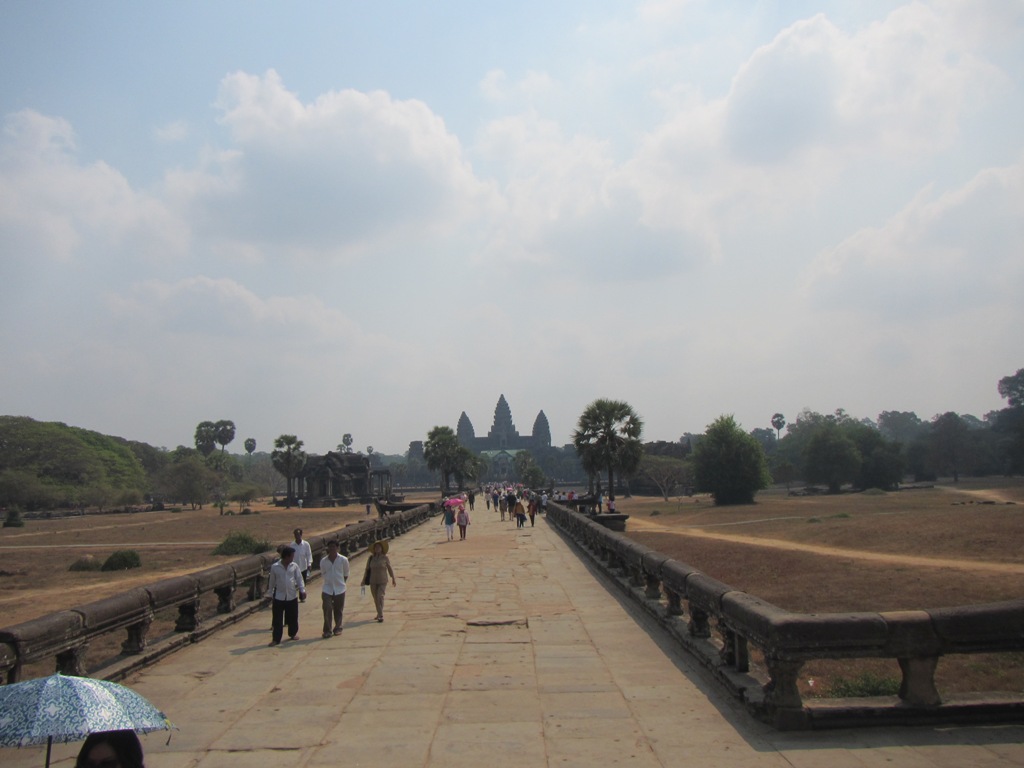
So what is Angkor Wat? If you don’t know, don’t worry – neither did The Professor until his Traveling Teacher Cousin mentioned it. Angkor Wat itself is an enormous temple, built in the 12th and 13th centuries at the height of the Khmer Empire. It is the largest religious structure in the world. But Angkor Wat is not alone. Around it are a multitude of other holy sites and temples of tremendous scale and intricacy, from the holy city of Angkor Thom to the lake temple of Preah Neak Poan. To give an idea of the scale: the lake temple is one of the minor sites, consisting of an artificial lake that is 900 meters long and 3.8 kilometers wide. That’s approximately 3.5 square kilometers of earth that was dug to a depth of several meters, in the twelfth century, so by manual labor. The Pyramids are enormous in their scale: now imagine if they were covered on every surface with intricate carvings of religious and mythological scenes. Some of the sites, such as Angkor Thom, cover square kilometers. These aren’t places you can view on foot – you either hire a tuk-tuk or use bicycles.

Singapore-KL-SiemReap 020

Our first day, an early flight out of Kuala Lumpur meant we were quite exhausted. So we found a place to stay, searched for good bicycles (knowing we would be on them a lot) for $1 a day, and explored Siem Reap a bit. It seemed like a really pleasant place, insofar as the people are friendly but much less pushy, selling-wise, than in some other places we have been.They’ll try to convince you to buy, but also appreciate when you joke about why you can’t ( “No tuk-tuk, we are already here!”) and will sometimes make jokes of their own (“best price, $1000 for you!). There is a river park running through the middle of town, and while the town isn’t fancy it seemed quite comfortable.

In short, a great place from which to go on marvel-viewing excursions. We have done three days of temple gazing. We took one day off in the middle to go to the National Museum, to get a helpful dose of knowledge to inform our second and third days.

The temples were built during a time of religious transition from Hinduism to Buddhism. Angkor Wat itself was build as a monument to the Hindu preserver of the universe Vishnu, but was converted to Buddhist use and remains a religious site. This means that there are monks who come to visit and take pictures, just like regular tourists! It also means that, unlike all the other temples with their spotless park-run toilets, you have to pay to use the bathroom at Angkor Wat.

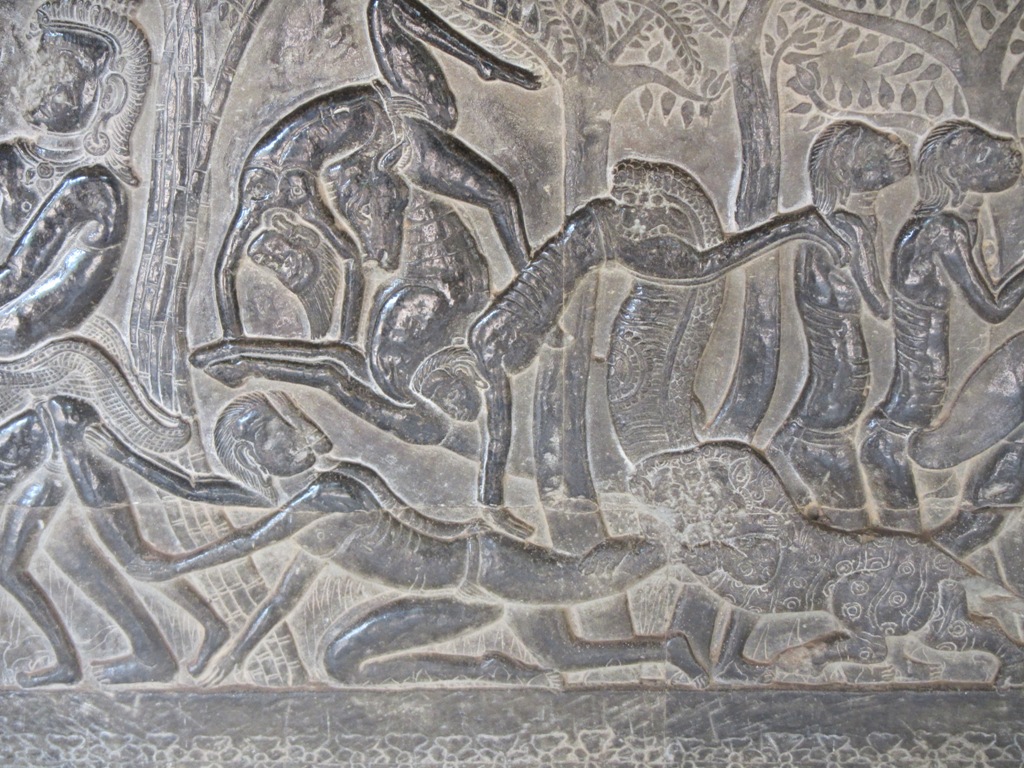
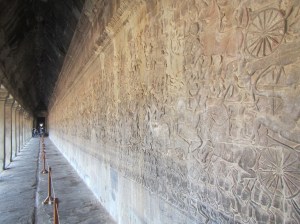
Not that that matters, of course. The building itself was awe-inspiring, a flaming mountain of stone covered with reliefs depicting stories ranging from the Ramayana to the Churning of the Ocean of Milk, a story as to how the gods and demons working together created the elixir of immortality. Additionally, there are endless reliefs of apsaras, beautiful dancing nymphs. We visited it twice, once at dawn when we watched the predawn light from a small, quiet structure with just a few other folks, and once in the late afternoon, when we climbed to the highest level and then descended and watched the clouds turn clear yellow over the walls from the eastern gate.

Singapore-KL-SiemReap 017

Atmospheric animal of the dawn: the white horse sleeping in the field near our mini-temple vantage, who would shake his neck with a jingle of bells every few minutes.

Educational animal of the dusk: the big monkey who robbed the Private Eye of her half-full large water bottle. Having faced off with a monkey for shoes in Luang Prabang, she found herself unwilling to risk a bite over a water bottle – thus encouraging the animal to rob more tourists, as The Professor has accurately pointed out. The monkey promptly opened and drank the contents of his robbery.

In contrast to the Hindu Angkor Wat, Angkor Thom is actually a walled city, with a central temple Bayon, which is covered with giant reliefs of Buddha’s face (said to strongly resemble the king). We explored the Bayon and the rest of the city after watching the sun rise over Angkor Wat. Only the stone structures remain, and a dry and flower-scented forest has grown up where houses and shops and even the wooden palace used to be. Being as it was 7 am, we had some of the smaller temples to ourselves, or almost. At one, a police officer was waiting. Assuming him to be on duty, we asked if we could climb the pyramidal structure. He said yes, and began ascending with us, and then The Private Eye remembered that this could be a scam that a guidebook had warned about. So we got off of the little temple, declined to light some incense with him, and got out as quickly and politely as we could.

Singapore-KL-SiemReap 019Singapore-KL-SiemReap 018

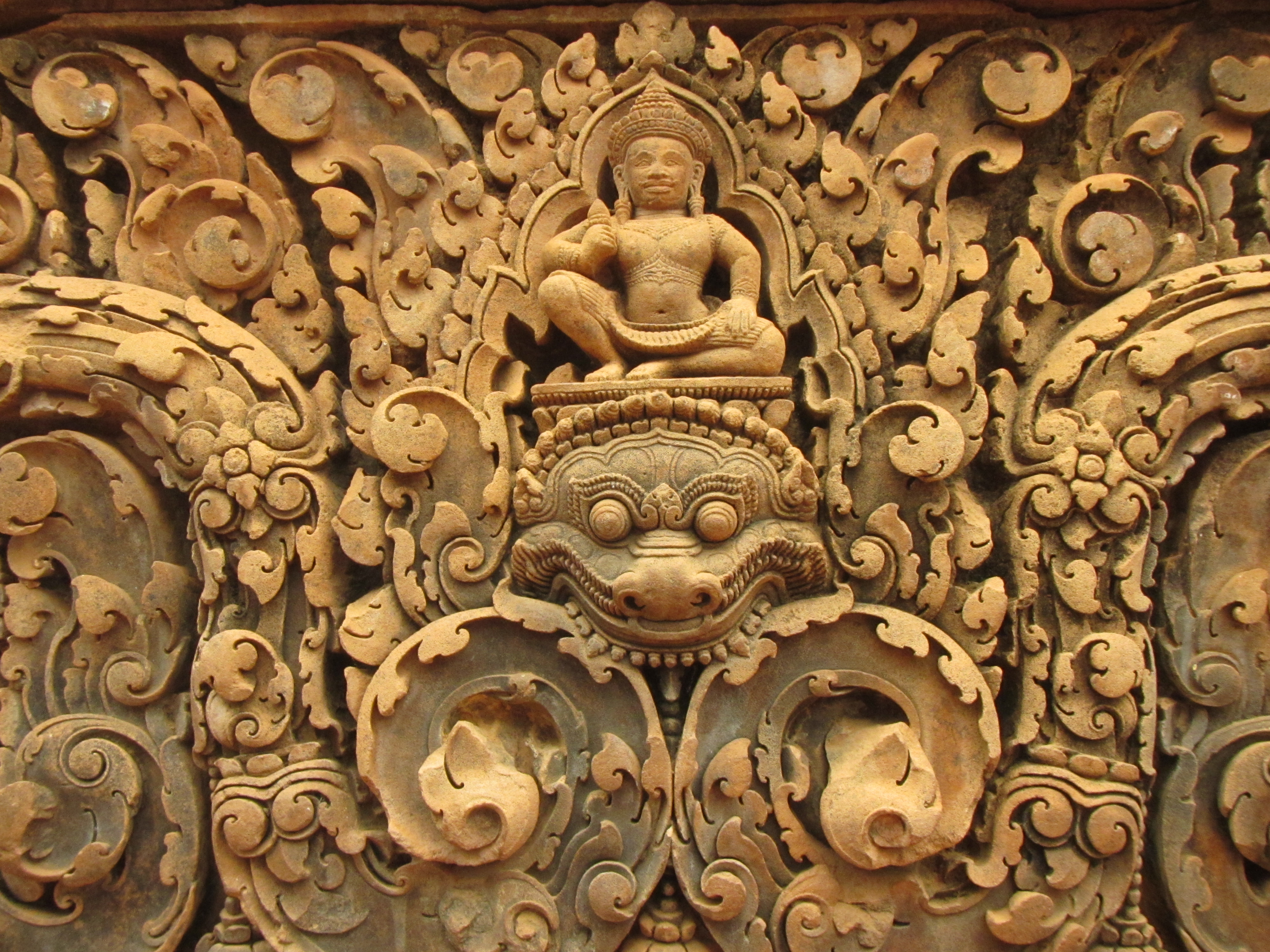
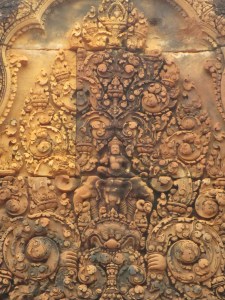
Yesterday, breaking from our usual habit of bicycling everywhere, we hired a tuk-tuk to take us to Banteay Srei, a Hindu temple carved of beautiful pink in sandstone In very intricate reliefs. Though a smaller temple, it was very much worth the trip. Each doorway featured a different scene from the Hindu religion, and they were NOT all the Ramayana. The flowers, the garlands, the apsaras, the monster faces, everything was just beautiful. And though it probably was not actually “built by ladies, no man’s hands could do that work”, we liked that it is presently called the Lady Temple anyway. It was not commissioned by the king, unlike the other temples – it was instead commissioned by an educated man, an advisor to the king, who clearly had wonderful taste. Apparently that particular pink sandstone is also better for carving than other stone.
IMG_2605 IMG_2590

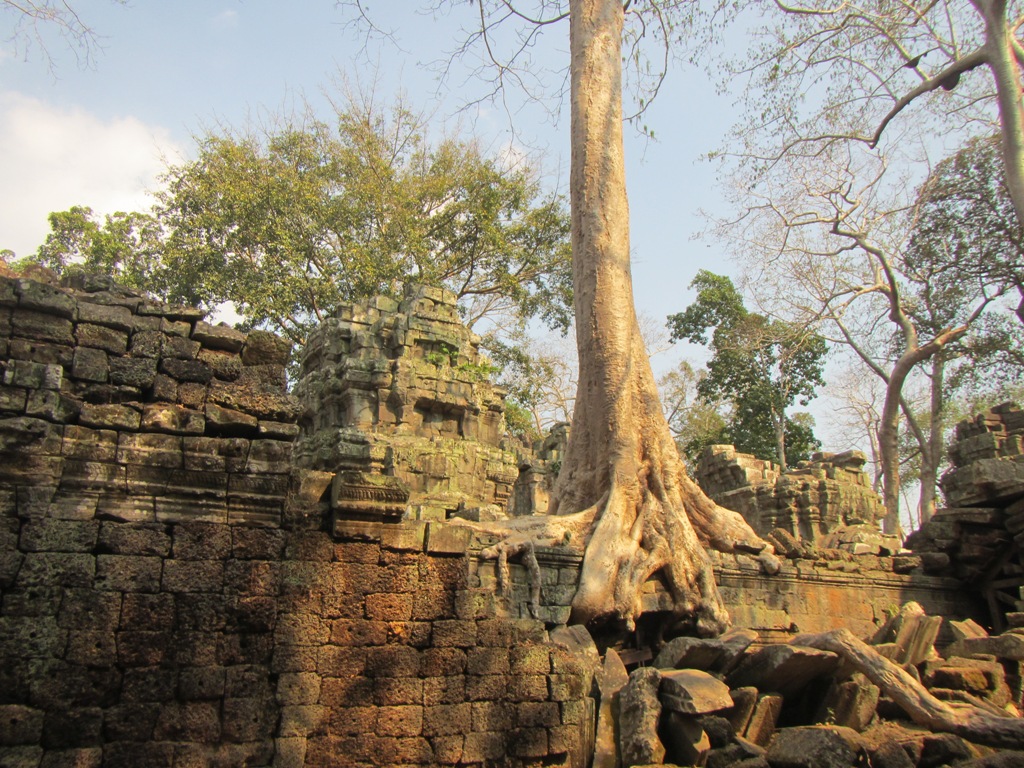
The Professor’s favorite temple: Ta Phrom, eerie in how it is overgrown not by vines, but by enormous trees that grew over decades or centuries:

Singapore-KL-SiemReap 015

What’s amazing about all of these temples, in their scale and number, is that the civilization that built them collapsed and abandoned most of them, much like the Maya abandonment of Tikal. We have read some claims that Angkor was the largest pre-industrial city in the world, larger than Rome. But unlike Rome, we know so little about it. Besides the carvings on its stone temples and the narratives of Chinese traders and diplomats, no written records survive. Why does Angkor Wat face west? When was it completed (we know approximately but not exactly)? We don’t know exactly why the Khmer Empire collapsed, though we know some of the historical factors concurrent to that time, such as the rise of the Thai empires, the Black Plague, and other events that must have impacted what had been the largest empire of Southeast Asia. Some of these temples, which must have taken thousands of people working for years, were completely lost and forgotten. Imagine living in a country that was once the greatest empire in Southeast Asia, but that being part of your identity is near impossible because nothing is known about it. So tourists come to wander these ruins, whose intricate carvings tell Hindu and Buddhist stories, and the only way to connect with them is in the present and the now, since the past is closed off.

Singapore-KL-SiemReap 022Singapore-KL-SiemReap 021

– the professor and the private eye, tag team
 

Cambodia, Briefly

We have been in Siem Reap, Cambodia for the past few days. Angkor Wat and a huge collection of other mind-boggling temples are a few kilometers out of town, so this is where the tourists stay. A combination of very hot and humid weather, a traffic accident which means power is rationed in the region and so we only have electricity from 6pm-midnight, and a lot of bicycling and sight seeing has precluded us from writing details yet. Today, for example, we woke up at 3AM to eat some breakfast and have coffee before cycling to Angkor Wat to see it at sunrise; we spent about 8 hours in total viewing temples before coming back to the guest house for a nap, then early dinner, and now bed at 8.

The most striking thing so far is that we know very little about the temples (e.g., we do not know why Angkor Wat faces west, rather than east), because, in addition to killing 10% of the population (monks, teachers, you name it), the Khmer Rouge government (under Pol Pot) also destroyed almost all historical artifacts, records, and about 7000 structures (temples). So you have the largest religious structure in the world, and a dozen or so other mind-boggling architectural marvels, and know almost nothing about them. Like, why they were abandoned.

— The Professor