RSS

Category Archives: economics

The Road to and from Gibbons

The trip to the Gibbon Experience had three parts: driving fast along a winding paved road, driving slowly offroad to a village, then hiking from the village to the tree houses. Both going in and coming out, we saw something on the fast road leg that’s worth mentioning.

On the way in, we were descending along a hillside with a sharp curve to the left. There was oncea long metal guard rail, but it had been torn away by a tanker truck that had taken the curve too fast and fallen off the road, down into the ravine below, some forty or fifty feet. When we passed by, there was a large tow truck there, and a few people standing around, trying to figure out how to pull it out. When we passed by it again on the way out, the truck was still there, crumpled a bit and cracked, the smell of gasoline strong.

The way back was more distressing. After we left lunch, a large passenger van passed our song-taaws. About 20 kilometers from Huay Xai, we passed through a small village. In the village, a small blue truck had pulled out into the road just as the van sped through. The van struck the driver’s side of the truck cab. The front of both was completely crushed by the impact. There was glass everywhere, twisted metal, and dripping pools of fluid, a crowd gathered around.

Our song-taaw had two medical students (Israeli army doctors, one year from completing their studies), another one had a medical student from Australia. They immediately jumped out and headed to the accident. We saw people run up with a 10 foot long 4×4 board, I think to try to pry the vehicles apart. We saw them carry two people away, limp.

The doctors returned after about 10 minutes, frustrated. There was nothing they could do. The driver of the blue truck was not going to survive. The driver of the van had open fractures on both his upper and lower leg, and a crushed pelvis. The doctors tried tried to explain that they needed a board to splint the left and body and something to tie the person down with, but could not explain it. Instead, locals put the injured person in the back of a van, to (hopefully?) drive him to the hospital in Huay Xai. We left before they did. We passed a police car, but no ambulance. The doctor sitting across from me put his head in his hands and talked about the lack of basic medical care, supplies (no first aid kits in the village that he could find), knowledge, or urgency. The person with the crushed pelvis could have a good chance of surviving if treated properly, but the lack of EMT response or proper care was very bad for him.

But this is the reality of poor rural areas, especially in developing regions of the world. It’s not their fault that they don’t know the best emergency medical approaches, or don’t have medical supplies. All of these things cost money. Economic growth, in addition to material goods, generally brings improved education, improved services, and the corresponding increase in life expectancy. When I hear someone say “don’t buy from China” or “keep American jobs with Americans,” now all I’ll be able to think of is lost economic opportunities to people so much worse off, being deterred from earning the same possibilities and safety that I have.

— The Professor


Hill Tribes

The hill tribes are one of the big tourist attractions in Northern Thailand. The Lonely Planet Thailand book has a long section on them, showing drawings of their traditional clothes and describing their lifestyle, religion, agriculture, and history as well as where they live. When I came across this section of the book I became cross; in all honesty, it read way too much like a gaming book describing the rural tribes of some fantasy continent. But these are real people and societies, not purely imagination.

The idea of visiting a modern instance of a primitive culture (here I use primitive in the technological and economic sense, not ethical or spiritual) as tourism rubs me the wrong way. The analogy I gave – an extreme one, yes, but I tend to do that, as many of you know – is when the British captured African tribesmen and put them in zoos. Going to view other people in their day to day life is not itself problematic: I sometimes enjoy sitting outside a cafe and watching the street as much as anyone else. But when the distinctive feature you’re going to view is poverty, I recoil.

Because that’s what it is, really. You’re not going to see the modern manifestation of an old culture. The selling point is to see it for real – people living much as they did 200 or more years ago, although now they have a motor scooter or two for transportation. Using an analogy closer to home, tourists don’t go to Native American reservations to see a modern Native American lifestyle. There are reservations where residents perform tribal dances and ceremonies in traditional garb for tourists to see (I recall seeing one dance in New Mexico when very young), but re-enactment of history under your own terms (admission fees, camera fees, etc.) is very different than a paid guide taking you into a village.

A particularly noxious example of this are the long neck Karen, whose women use brass rings to push down their collar bones and give themselves long, extended necks. The only reason they do this is for tourism. By going to see the long necked Karen (there are Karen who do not follow the practice), you are paying people to self-mutilate and live in a society which your payment implicitly forbids them from leaving (the village without TVs and running water will see more tourists).

It’s even worse when you pay a guide a bunch of money to take you to a village and they don’t receive anything. Add the fact that most of them are not Thai citizens and so do not have many rights. For example, guides to the hill tribes must be Thai citizens, which means they cannot be the guides to their own culture,

Of course I’m being a bit extremist here. While I’d want to talk with someone who paid a guide to take them to the long necked Karen and point out what they’d done, there are many shades of grey. For example, there is a group (which the hill tribe museum in Chiang Rai praised highly) that pays much of the visit price to tribes, and works with them to organize when and how visits occur, a bit more like the Native American model I’ve experienced.

This was the debate The Private Eye and I were having in Tha Ton. She pointed out that going to a village and buying their crafts was the best thing one can do. The idea of traveling to a village without a guide, seeing if it was alright if we entered the village, and buying crafts made me a little uncomfortable, but I thought it was a light enough shade of grey that I should go so I could have actual experiences with which to understand the situation better.

So we went, I bought a scarf, we tried to be respectful and friendly, and I’ll need to think about it more.

– The Professor


Tragedy Averted

Our travel calamity has been dealt with. We depart tomorrow (12/29) evening for Chiang Mai on a night bus. I hope it is one of the buses we’ve seen that’s all done up with art and decoration. Imagine giant tour buses, with graffiti-style dragons, swirls of color, and other art on the sides, sometimes with fangs or monster faces on the front. We didn’t see them in Bangkok, but it might have been because so many other things grabbed our attention. But since coming to Ayuthaya, we’ve seen many. Not art cars, per se, but art buses, I suppose. Another Burning Man analogy. So we will arrive early on the 30th, stick around for a few days, then join the Expat Teacher in Chiang Rai. We won’t be able to give Chiang Mai its due time and consideration, but we can always revisit it as we return south.

Jan16 26112.31.2012 111

Making the reservation touched on what’s a tricky topic for many travelers: prices. The typical western approach is that there’s a stated price that’s fair and uniformly applied. This of course isn’t always true in practice, due to specials, deals, discounts, and the like, but in their context you’re often given the stated price then told how much you’re saving.

The same isn’t true here. The bus is normally 500B, I saw posters for such in the hall. But the price the owner of the guest house quoted us was 600B (~$20). Rather than there being a fair and even price, the goal of an exchange is to find a price that’s amenable to all parties involved. Given how travel is now, and my financial means, I am happy to pay 600B. But is she pocketing the extra 100B? Or is it passing on to the bus company? I don’t know. The extra 100B doesn’t matter much to me, it’s $3. There is a transfer of wealth, and I could drive for a harder price, but $20 for a 10-hour air conditioned bus ride to Chiang Mai is a good price to me. I am comfortable with the idea that she’s making a good profit and a good life providing the help that I need. But there are degrees here; if she had quoted 1000B I would have balked, probably, given its comparison to train and plane fares. This is the developing world, and to me it’s reasonable that it develops by charging me a slightly higher price that’s still low to me. I recall hearing Mark Salzman, a very skilled wushu artist, talk about the time he was mugged: “He held a crowbar back like this. It seemed like a very reasonable exchange, I gave him my wallet. I even offered him my watch too. Then a few minutes later, I slapped my forehead and said ‘Wushu! Wushu!'”

This means we’re spending an extra day in Ayuthaya, which is nice. Today was a whirlwind tour, starting with the National Museum, followed by riding an elephant, then the Million Toy museum, enroute to which we wandered around some ruins. It’s now early evening, we are considering getting a group to visit what seems to be the cool local bar, Spin. Tomorrow there won’t be much to do, perhaps we will just hang out in the backpacker ghetto and meet some people.

— The Professor


Boxing Day

The Private Eye and Silamander wanted a slow day, but I was itching to wander, so I went out to Siam Center in search of a gift for Silamander’s parents and a pair of pants. When I packed, I hadn’t realized that Thai culture is conservative in dress, such that shorts and tank tops, while tolerated among the foreigners, are seen as sloppy and messy by the Thai, who prize being well dressed and composed. I have two pairs of pants, but one is a special pair with insect repellent soaked into it that I hope to use only when needed, such that when we reach the Amazon I’m not eaten alive.

The shopping trip was a total failure. Siam Center is a combination of high-end shopping mall on one side of the street and a warren of tiny soi (alleys) where budding local designers have a boutique. The boutiques had cool, stylish, but impractical for the climate clothing, and the mall had expensive western stuff. So I had lunch instead for $5 – $1 for bowl of spicy chicken and rice from a street cart, and $4 for a tiny scoop of Haagen-Daz in the mall. So Siam Center was the juxtaposition of streetside Bangkok, aspiring young Bangkok, and affluent Bangkok all within a few hundred feet.

In the evening, we went to Lumpini Stadium for Muay Thai matches. Trying to get to the ticket window was a battle – the different resellers/hawkers descend on you and fight with each other. From what I can tell, the first to put a sticker on you has branded you as a customer and you’re off limits to the others. But when someone pushes you that hard to follow them, chances are they have a scam. So we wandered away to get some cash then made a direct line for the ticket window as the hawkers screamed around us and tried to stop us. Locals can buy tickets for a few dollars (200 baht or so), while foreigners pay through the nose (2000 baht/$65 for ringside seats).

The stadium was a small, indoor arena, seating maybe 1,000. The Private Eye noted that the top stadium for Thailand’s national sport has a corrugated tin roof and ceiling fans. While I’ve seen western tourists of many nationalities while wandering, the ringside spectators were all American.

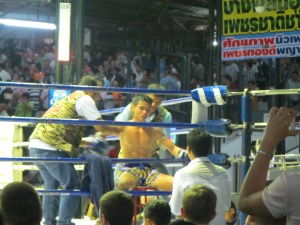
Like Sumo, a match begins with both fighters moving about the ring, in this case dancing and gesturing to traditional music. There isn’t the same kind of posturing as Sumo, but it does give you a chance to get a sense of the fighters and how they move. Each bout consists of 5 two minute rounds. The best fight was the fifth:

IMG_0181_zpsc56ed47e

One of the fighters, dressed in pink trunks, was a bit taller and looked mean. The other, dressed in blue trunks, was much warmer; he smiled as he danced around the ring, moved with much more grace, and continued dancing a bit even after the music stopped. There was a slight feminine touch to his mannerisms.

IMG_0184_zpsa9475294

After the first round, it seemed to me that the mean fighter was going to win, as his greater reach meant he was able to land blows much more easily. The Private Eye said she was sad, because she liked the dancing guy more.

But of course the fight doesn’t really start going until the third round. The mean guy lashed out with his foot, the dancing fighter grabbed it, pulled, and threw him to the ground without losing the least bit of his own balance, jumping and dancing away. A few more times he threw the mean fighter to the ground, sometimes dancing away, sometimes jumping on his chest. The mean fighter didn’t even stick around for the decision, and stormed off as soon as the fifth round completed. The Private Eye and I were both delighted. We had to leave just after the sixth match to make our way to Expat Teacher for a day of hiking, but we spent the evening of Christmas Day watching Muay Thai in our own version of boxing day.

— The Professor


Boxing Day

OThe Private Eye and Silamander wanted a slow day, but I was itching to wander, so I went out to Siam Center in search of a gift for Silamander’s parents and a pair of pants. When I packed, I hadn’t realized that Thai culture is conservative in dress, such that shorts and tank tops, while tolerated among the foreigners, are seen as sloppy and messy by the Thai, who prize being well dressed and composed. I have two pairs of pants, but one is a special pair with insect repellent soaked into it that I hope to use only when needed, such that when we reach the Amazon I’m not eaten alive.

The shopping trip was a total failure. Siam Center is a combination of high-end shopping mall on one side of the street and a warren of tiny soi (alleys) where budding local designers have a boutique. The boutiques had cool, stylish, but impractical for the climate clothing, and the mall had expensive western stuff. So I had lunch instead for $5 – $1 for bowl of spicy chicken and rice from a street cart, and $4 for a tiny scoop of Haagen-Daz in the mall. So Siam Center was the juxtaposition of streetside Bangkok, aspiring young Bangkok, and affluent Bangkok all within a few hundred feet.

In the evening, we went to Lumpini Stadium for Muay Thai matches. Trying to get to the ticket window was a battle – the different resellers/hawkers descend on you and fight with each other. From what I can tell, the first to put a sticker on you has branded you as a customer and you’re off limits to the others. But when someone pushes you that hard to follow them, chances are they have a scam. So we wandered away to get some cash then made a direct line for the ticket window as the hawkers screamed around us and tried to stop us. Locals can buy tickets for a few dollars (200 baht or so), while foreigners pay through the nose (2000 baht/$65 for ringside seats).

The stadium was a small, indoor arena, seating maybe 1,000. The Private Eye noted that the top stadium for Thailand’s national sport has a corrugated tin roof and ceiling fans. While I’ve seen western tourists of many nationalities while wandering, the ringside spectators were all American.

Like Sumo, a match begins with both fighters moving about the ring, in this case dancing and gesturing to traditional music. There isn’t the same kind of posturing as Sumo, but it does give you a chance to get a sense of the fighters and how they move. Each bout consists of 5 two minute rounds. The best fight was the fifth:

IMG_0181_zpsc56ed47e

One of the fighters, dressed in pink trunks, was a bit taller and looked mean. The other, dressed in blue trunks, was much warmer; he smiled as he danced around the ring, moved with much more grace, and continued dancing a bit even after the music stopped. There was a slight feminine touch to his mannerisms.

IMG_0184_zpsa9475294

After the first round, it seemed to me that the mean fighter was going to win, as his greater reach meant he was able to land blows much more easily. The Private Eye said she was sad, because she liked the dancing guy more.

But of course the fight doesn’t really start going until the third round. The mean guy lashed out with his foot, the dancing fighter grabbed it, pulled, and threw him to the ground without losing the least bit of his own balance, jumping and dancing away. A few more times he threw the mean fighter to the ground, sometimes dancing away, sometimes jumping on his chest. The mean fighter didn’t even stick around for the decision, and stormed off as soon as the fifth round completed. The Private Eye and I were both delighted. We had to leave just after the sixth match to make our way to Expat Teacher for a day of hiking, but we spent the evening of Christmas Day watching Muay Thai in our own version of boxing day.

— The Professor