I will admit that for a couple of days, I actively disliked Ubud.
How can this be, you might wonder? This is, after all, a city where art reigns supreme, where mask-carver, batik-maker and painter are viable day jobs. Further, this is the city of love in Eat, Pray, Love. But I didn’t love it to start, though i came to like it very much, and I hope the reasons why may be of use to other travelers.
First: my greatest regret about our preparations for this trip is that neither of us learned to ride a scooter. Despite the fact that one of our dear friends is nothing less than the Scooter-Preneur of San Francisco, and another of our dear friends owns and rides a scooter, in our presence, all the time — we just never learned. In Asia, we soon came to understand, this is the equivalent of deciding not to learn to drive a car in America. You can do fine in major cities, but in the country or in a place without strong transit infrastructure, like Bali, you will be hiring a car and driver, which was a largely unexpected and unwelcome expense. Self-driving car rental here is thin on the ground. Locals tell you about all the tourists who die every year learning to ride scooters here. Fellow travelers who didn’t heed the warning invariably show you some scrape or another from a more minor accident.
This being the case, we decided to base ourselves in the center of Ubud, so we could walk quickly to many of the main attractions, rather than basing ourselves in some blissed-out rice paddy twenty minutes by foot from town proper. This turned out to be a fine decision for many practical reasons, and I really liked our guesthouse, but the center of Ubud is now well and truly touristed. Picture being at Pier 39, but every shop is filled with interesting things, and has a kind-looking woman out front urging you to buy. Every street corner has a man asking if you if you want taxi, transport. It’s great for shopping, but a bit overwhelming for me – I tend to notice everything, and everyone, and feel drawn to connect based on very minimal contact. This is a great quality for my work, but a lousy one for navigating a new bazaar in a new country where I feel unsure of myself. Point being, our particular location meant that we could not walk anywhere without being subject to 10 minutes or more of this.
Add to this the 90+ degree heat and humidity that turns my face into a 12 hour wellspring of sweat every day, and I was having trouble enjoying all that is amazing about this place.
But what a difference a new friend makes! The day after we met the Art Teacher (the expat from Canada who lives in Turkey and was here on vacation), we did not see her. She was doing her batik class, and we were making our rings, which I loved as it was both quiet and fully engrossing. Afterwards I had a tougher time enjoying myself, though The Professor and I did a nice sunset walk on the Campuan Ridge (rice paddies, towering pastel cloud views, charming local teens smoking and flirting in quiet corners of a thatch-field atop the ridge), and saw the Kecak and Fire Dance.

Both are very worth seeing, by the way. The former features a cast of shirtless men who chant monkey-like chitterings as the only musical accompaniment to a drama of a portion of the Ramayana; the section stars Hanuman the monkey king, of course. The latter features a man, supposedly entranced, who is “riding” a hobby-horse over a bed of hot coconut husk coals barefoot, each charge of knight and steed resulting in a beautiful and shocking shower of embers directly at somebody’s face, but never touching them. Attendants swept the coals back into a pile after each pass, until the man astride the magic gallops through them again. Eventually he collapses from exertion and is revived by the priest. I know this is an old ritual tarted up for tourists, but it remains powerful.

And yet despite the wonder I remained discontent! But that all changed the next day when we met up with the Art Teacher at the Threads of Life textile center for a lecture. It’s a worthy organization with an approach both practical and academic to preserving Indonesian weaving traditions throughout the archipelago. And the Art Teacher was so enthusiastic and knowledgable about it, and about Bali/Ubud in general. She is very smart, and tells good stories, and it was a pleasure to talk with her. Suddenly, I could appreciate the quiet lanes off the main roads more, and feel a bit less affected by the pleading on the busier streets.
The lecture was followed by a lunch of delicious suckling pig in a nearby warung, where we relaxed despite future daily specials squealing on a balcony one floor below us. Then, following the clue that our laundress had been all dressed up that morning, we went to the temple of the dead. We missed the ritual, but enjoyed seeing the architecture and banyan trees, and just sat around on a shady platform talking. Then we got the bright idea to go to the Setia Darma Museum of Masks and Puppets in the village of Mas, which was exceptional – and was another great place to sit and talk when we weren’t appreciating remarkable art.


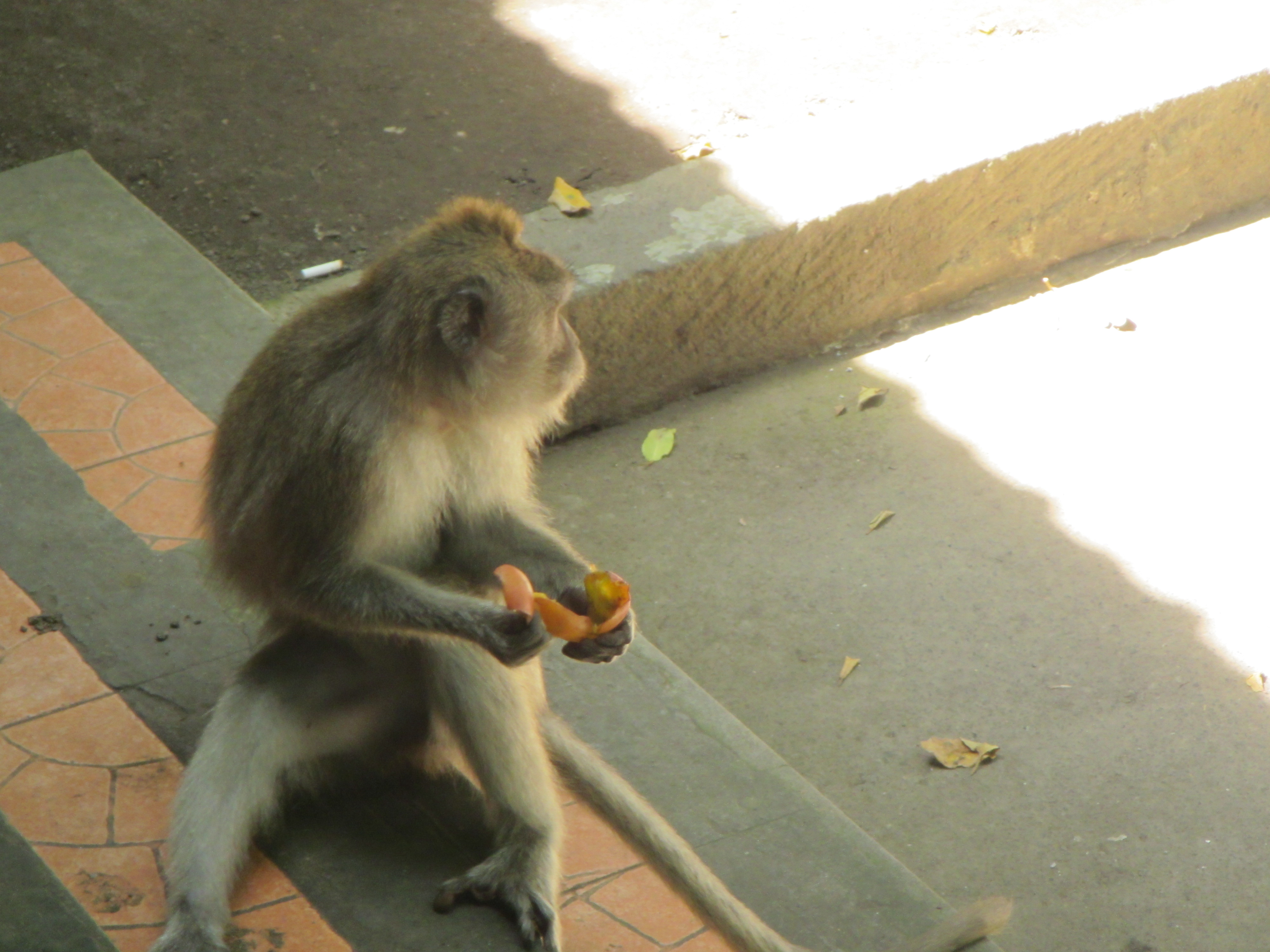
When we got back, we separated near the Art Teacher’s part of town, which is still busy but less frantic, near the Monkey Forest. We parted, and the Professor and I decided to find the studio of the artists we had met in the gallery on Hanuman Street. It turned out that the studio lay directly behind the sacred monkey forest, and that there is a “bike path” (scooter route) that leads there which follows the exterior fence of the forest. We saw plenty of monkeys on our walk, including a baby monkey that was so tiny, it had trouble managing its rambutan fruit.And we didn’t have to pay to go into the forest! And here are full-grown ones:

Behind the forest, past a woodcarver’s house, lay the studio. It was open walled, cement floored and tin roofed, and the artist I had spoken with for a long time at the gallery was the only one at home. There were stacks and stacks of paintings in racks along the edge of the space, and suitable seating for such a place, such as old car seats and a large sculptural high chair, and some cheap plastic stools near a home-made table. The artist welcomed us, and we shared our mangosteens, and talked until the sun set about Indonesia and America and his art and the yoga-people who come to Bali — both the good and the over-the-top ridiculous: “yoga blah blah blah”. Also hilarious: his explanations about why Balinese men get a lot of action from female tourists, though our host did not relate that he had had any such adventures. I admire a man with discretion.


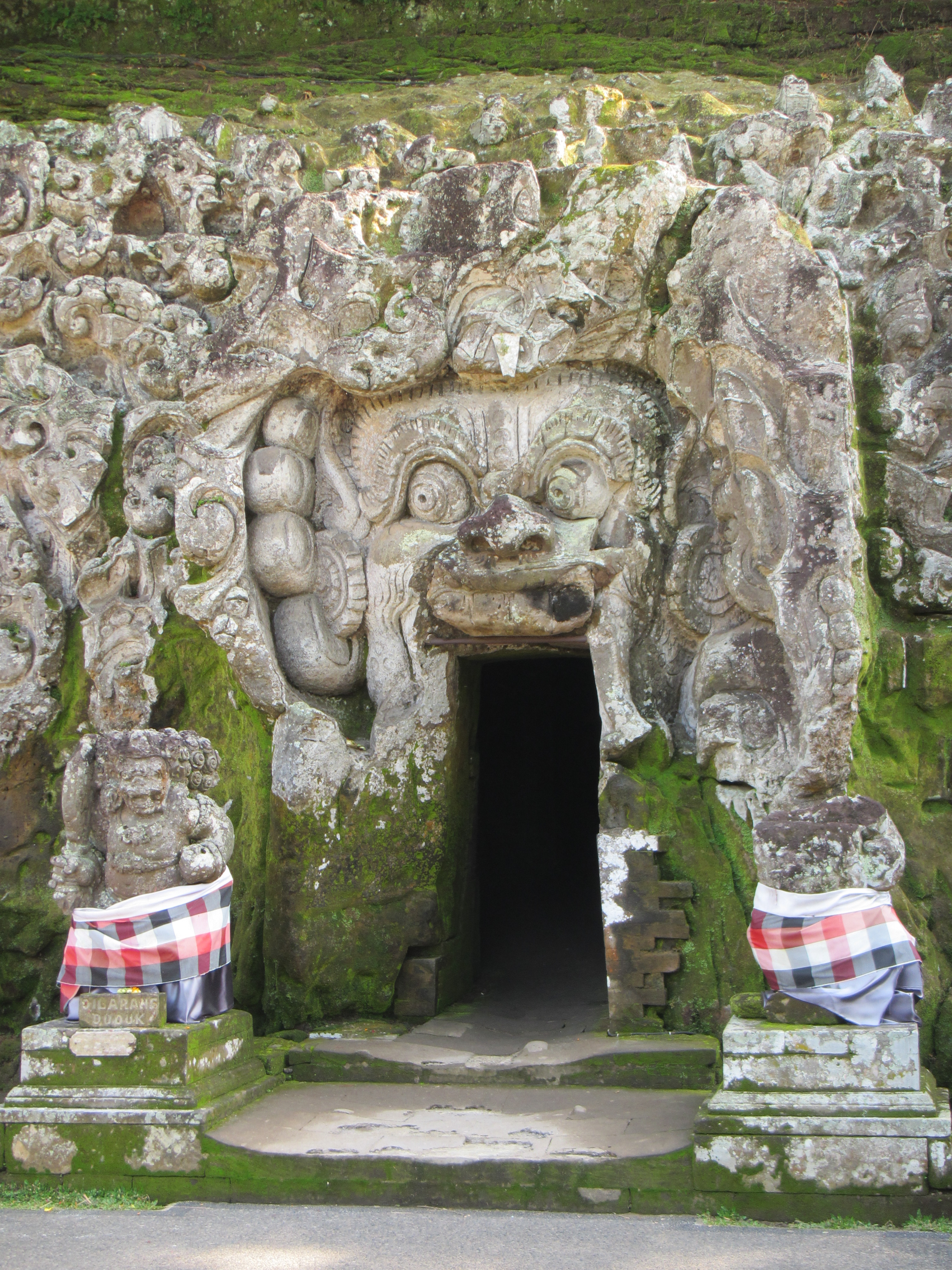
We bid him farewell and had a nice duck dinner, and then went to bed. On the next day, the Art Teacher, the Professor and I walked to Goa Gajah, a cave whose opening is carved in a monstrous face. We then went to Gunung Kawi, a site of old ruins in niches of a rock face. We retired to our homestay for the heat of the day, where I spent my time learning Bahasa Indonesian words from our host’s children, while teaching them English words for things. It was fun; I also tried to teach the oldest tic-tac-toe, but I fear I am a poor teacher and we turned it into a counting game.
Later, we went back to the palace and enjoyed a much more exciting Legong dance than our first one, the dancers seemed much more passionate. We also saw the Barong dance, in which a large, shaggy embodiment of good does some onstage comedy with a monkey, and later fights a demon. Predictably, I love the Barong. So do children everywhere!
Barong: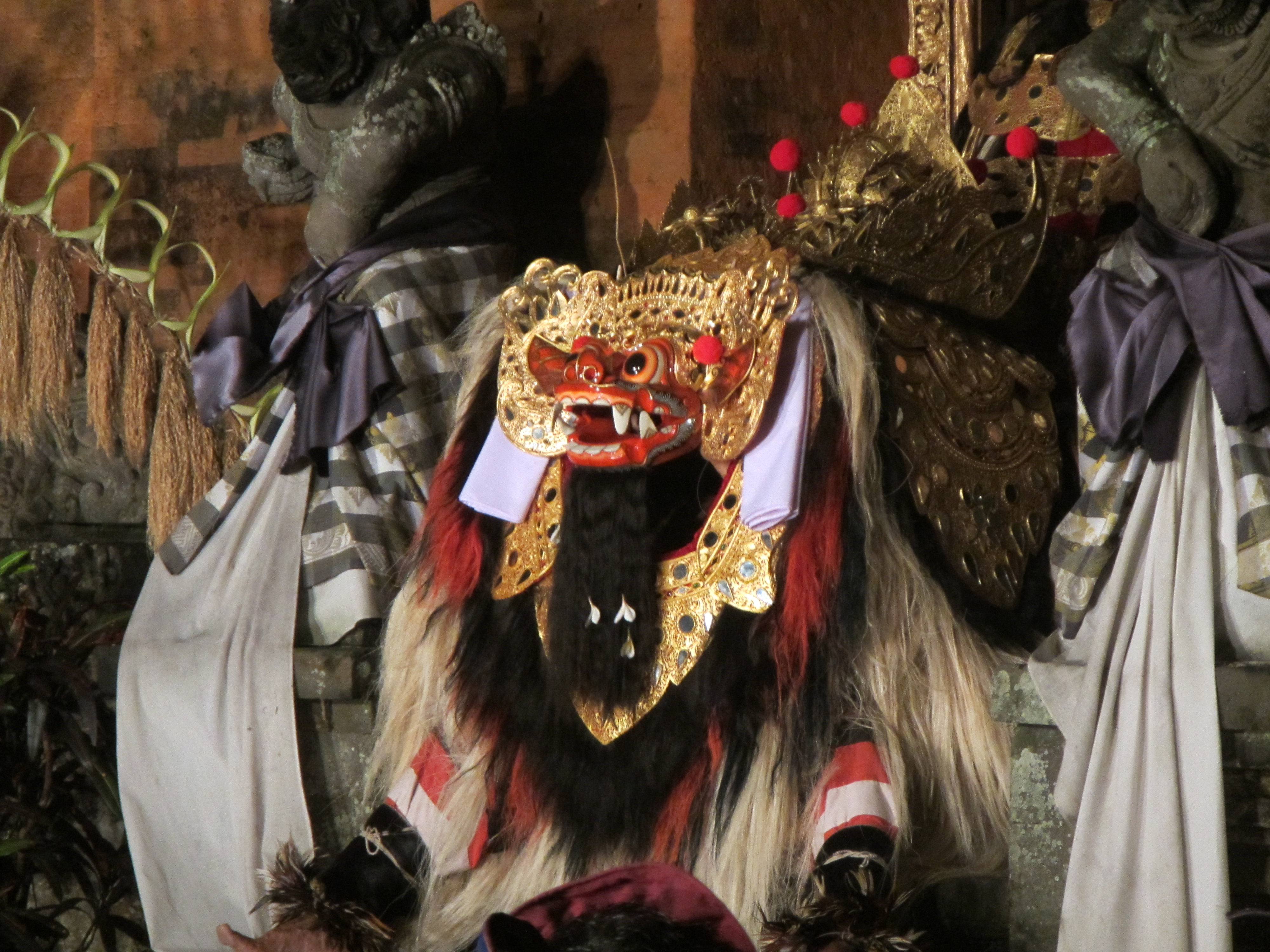
Demon: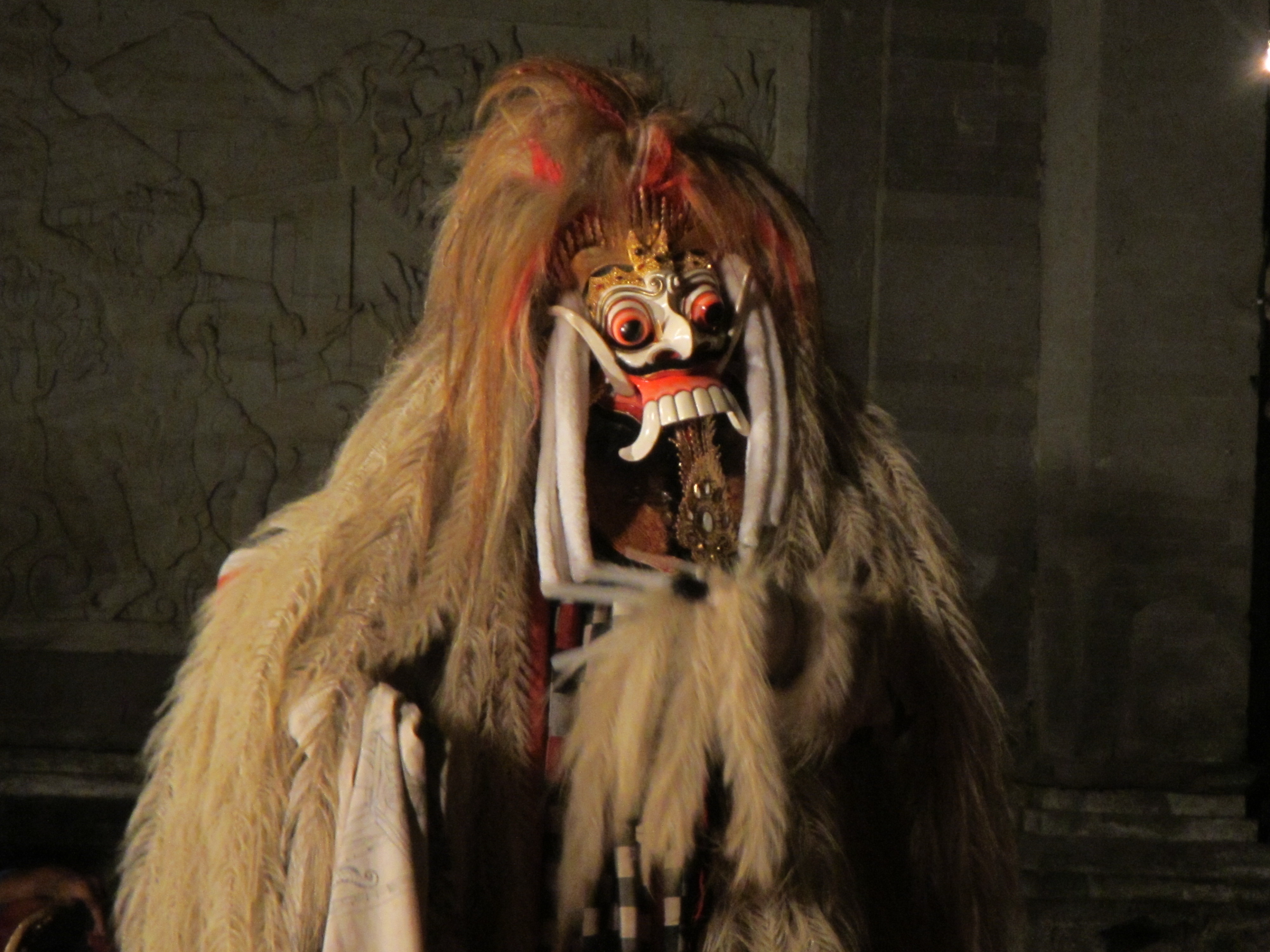
It was a great performance.
Today, we head on to Amed on the east coast to dive the wreck of the USS Liberty. I am looking forward to less humid weather, but I have come to appreciate Ubud more, thanks to our hosts, their children, the artist and the Art Teacher. It is amazing how much kindness and conversation can turn your whole view around.
– The Private Eye
 The Professor and the Private Eye: Adventures Abroad