At 3 am on the dot, I awoke to the sound of the radio playing a tinny AM station so romantically, I was briefly transported to a time I think more recognizable to my father, or even grandfather. Why not grandmother, you might ask? Sadly, when I think of old-fashioned radios and AM stations, I only think of men.
The stars were dim in the misty night, but visible. We drank coffee, loaded up the canoe, and began the long morning’s journey.
Shortly after beginning, Señor pulled our boat to the side of the river. He pointed out to us a very small crocodilian creature, I think a caiman. It was only a year old, and its eyes shone just above the water in the torchlight. Señor picked it up, and put it in a big shopping bag. We came across a second one, but let it go. We tried to make our best time, cutting out bends in the river by going straight through the flooded forest, which left me with a small lizard on my head. I have not mentioned them, but these lizards were abundant. Señor called them iguanas, but I will need to look up their English name at home.

When we arrived at the little ruined cabana for breakfast, Señor pulled the caiman from its bag. He let each of us pet its pleasantly firm, ridged back, and showed us how to hold the beast. We each got to hold it, and then we let it go in the river. It stood in the bottom of the shallow water for a few minutes, and then crawled away into the waterlogged plants. We commented that we had just made the bathroom a bit dangerous, as I went wading in my rubber boots into the forest to answer the call of nature.
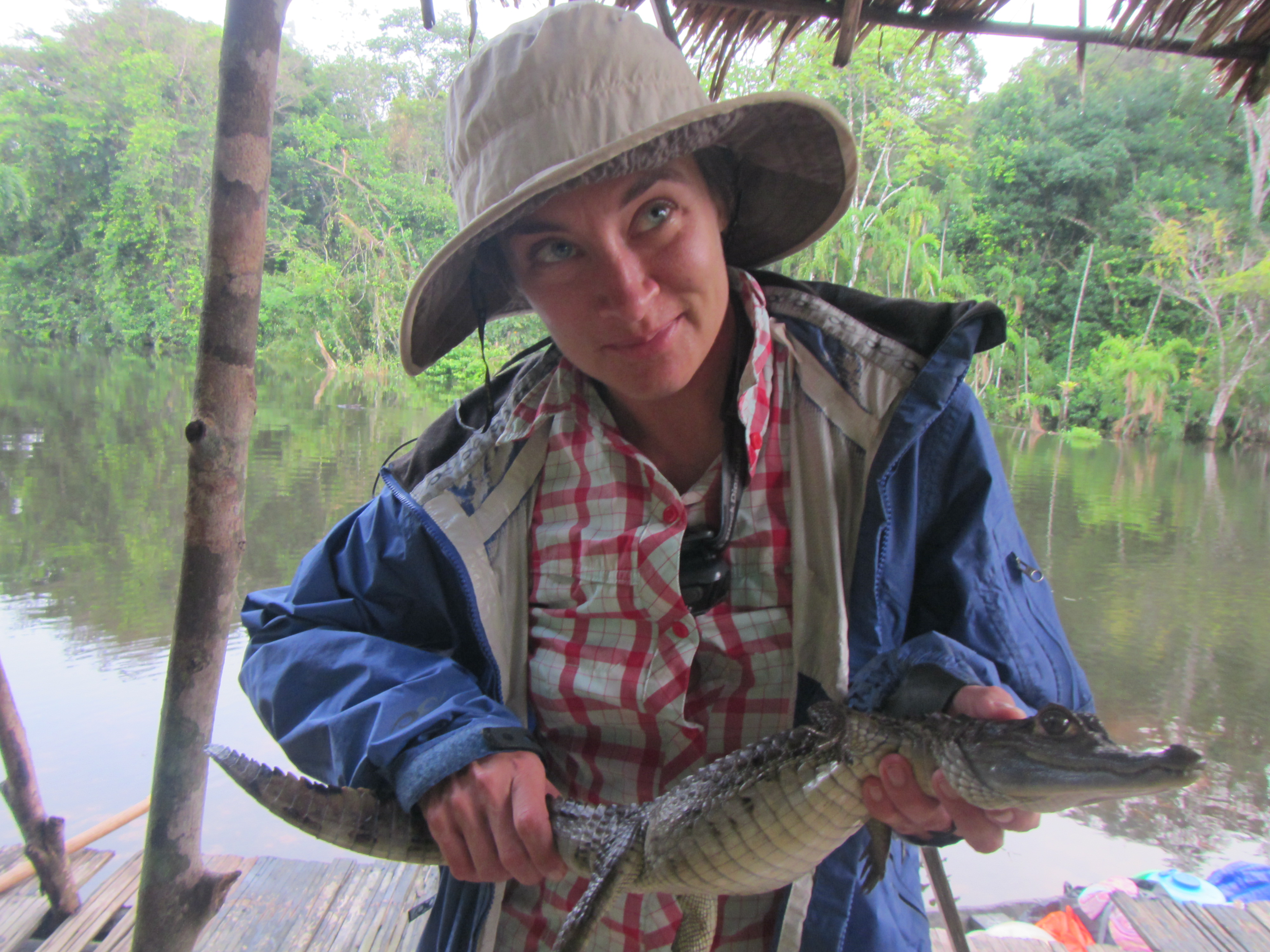
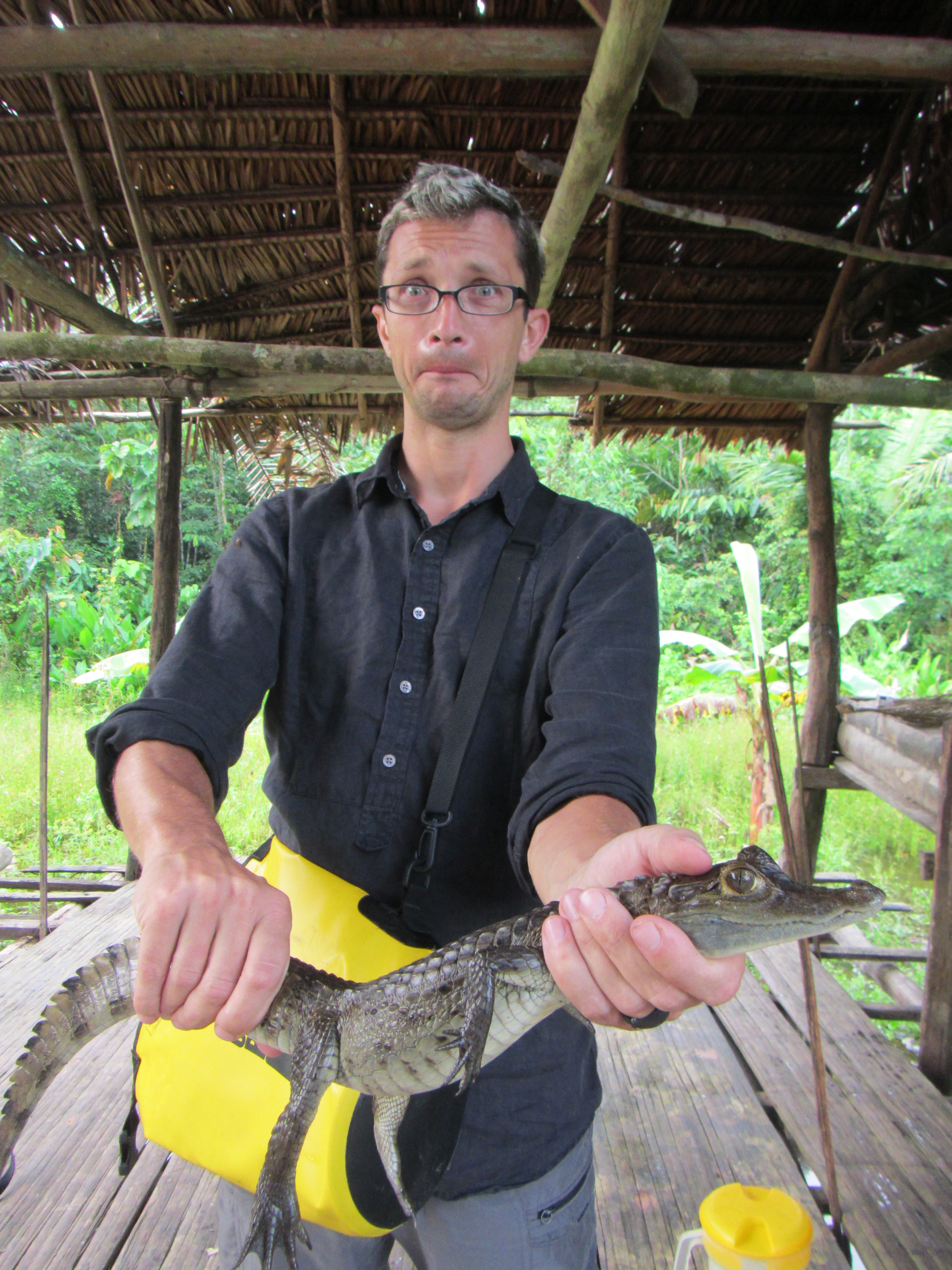
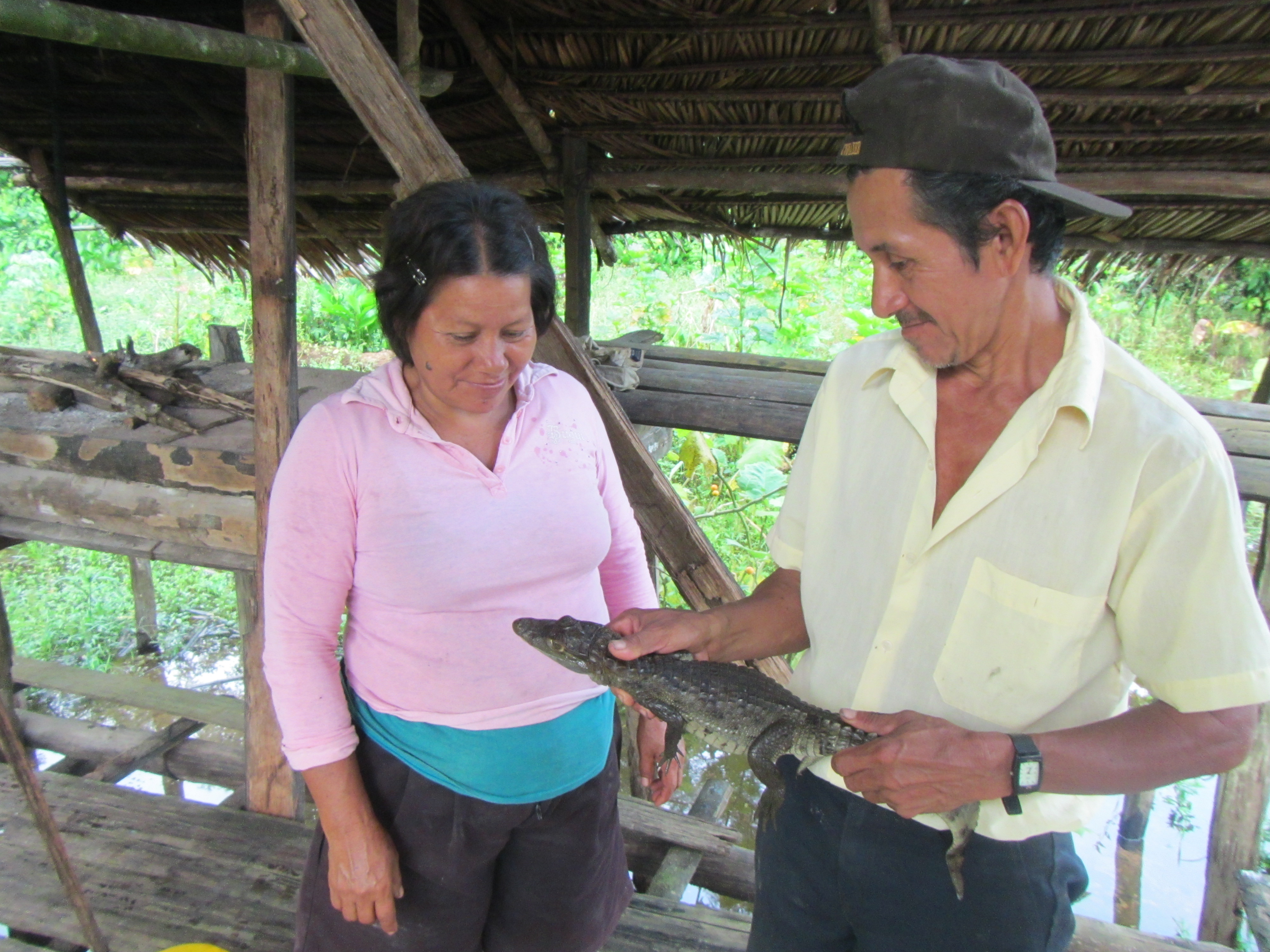
As we were eating breakfast, the sky darkened. We piled our things quickly into the boat, knowing that the cabana was in danger of collapse in a major storm. We covered everything with tarps. I put on my raincoat and the Professor’s rain pants, which he did not want, because they were hot and he would be rowing. Señor and Señora had made it clear that the larger boat required of this journey was a real bitch to row upstream, and the effort was hard on their older bones.
I was not feeling great either – I had slept on my back in a bad way the night before, and found myself unable to move my torso without a great spike of pain in my left hip. There we only a few positions I could take in the boat that were not painful, and none were comfortable. The Professor was not in pain, but had slept badly and was exhausted. We were none of us at our best.
We paddled off into the river. The sky opened in a terrific rainstorm. At first, I felt nonchalant about it, and enjoyed being in a real rainshower in a real rainforest. But soon, I began to feel like my wrists were wet. That’s odd, I thought, I am wearing a good raincoat, an old reliable that has kept me dry for years.
But I felt inside my sleeves, and sure enough, I was wet. My shirt felt damp too. As the rain poured on, I quickly discovered that my raincoat was failing me. Later, upon removing it, I saw that through heat in the backpack or simple wear, the waterproofing of the fabric had rubbed off along the seams in my shoulders, upper back, and hood.
In very little time, water was coursing down my chest. My legs, in brand-new rain pants, remained dry for longer, but soon the rivulets across my body flowed into a lake in the seat and underthighs of the pants. Being waterproof, they of course held the water excellently, just like a balloon.
Trying to adjust my position for the sake of my back, the back of my hands were briefly on the outside of the boat. The boat brushed into a section of palm tree poking out through the water. It was covered with spines. They embedded themselves in my knuckles. We paused a few minutes to work out the splinters.
Señor and Señora were working their hearts out, with the Professor speeding us along in high-current areas. I was distressed: in pain, soaking, and very very worried that Señor would throw out his back, or that Senora’s heart would burst. She had told us over breakfast that she took medication for her heart. There was nothing practical I could do besides keep my mouth shut and stay out of the way.
There was no sightseeing of animals, of course. Every single time Señor could cut off a meander by crossing the flooded forest, he did so. Sometimes, this made us pause as he stood in the front of the canoe, machete in hand, cutting us a path in the pouring rain. Once or twice, the big canoe got stuck between two saplings, or on submerged wood. At the most difficult one, Señor hopped out of the boat onto a log blocking our way. The log collapsed a few feet under the water, leaving him thigh deep in the wet stuff, but letting the boat go forward a little further.
It was still wedged between trees too close to each other. At the front of the boat, Señor pushed one half-submerged broken sapling aside. Señora stood on the collapsed log at the back of the boat, pushing. The Professor grabbed a tree to his right and a sapling to his left and mantled as though he was pushing himself above two rocks. The boat inched forward. It inched forward again. Finally, we were free. Señora got back in the boat, Señor hacked through some trivial brush like a swordsman among green opponents, and we finally gained the main body of the river. We crossed it and entered the forest again.
Señor had said it would be three o’clock by the time we got to the ranger station, but with all the shortcuts and The Professor’s help, we were there by noon. We were so happy to be somewhere dry. We all hung out our wet clothes, changed into dry ones, and ate pasta for lunch. We did our best not to bother Señor and Señora, so they could rest. I read a booklet from the ranger office about conservation of the lobos del rio, or giant river otter. We didn’t see any, but Señor had told me they had returned to being numerous in the region.
For dinner, we ate grilled goat with starches and salad. I asked Señor again about the man who had been sick back at the cabana.
He clarified things for me. In the heart of the forest, he said, lives a second kind of anaconda – the black anaconda. Everyone knows the yellow anaconda, he said, but the black one has never been in any book. Once, his own father was hunting for tapir, and he came across one, and tried to attack it. It ran as well as it could, but not far – it already had a young black anaconda wrapped around one of its legs. The little beast could not subdue the tapir, but it began calling for its mother, who could and did appreciate the giant meal.
The sick man had come across one of these black anaconda, Señor said. The man was struck by terror of the snake. The fear made him sick.
I asked Señor if he had any questions about the United States. He asked when boys and girls first get boyfriends and girlfriends. I told him usually between 13 and 17, though of course there are early and late bloomers. He said it was much the same locally, and told us that the (apparently 20something) ranger’s girlfriend, who was living with him at the station, was 15 years old and pregnant.
I was quick to say that we don’t generally want our people to start their families so early, and that teenagers often use birth control. He asked if we use the three-month shots, and I told him that we use those, and the pill, and also condoms and IUDs and implants. He was surprised at how long the latter two last. I felt a bit like an alien. He said he does not trust the pill because he has seen a case where a woman got pregnant while taking it, and the child was not normal.
He also was surprised that we neuter our cats and dogs. And I could understand why. After all our travels, I have come to the view that our pets are far more domesticated and controlled in the USA than in perhaps anywhere else in the world. I approve, but it is remarkable how unique it is.
– The Private Eye
 The Professor and the Private Eye: Adventures Abroad