RSS

Category Archives: politics

Landmines

Cambodia’s severance from history is made much more acute by the atrocities of the Khmer Rouge and Pol Pot in period after the Vietnam War until the late 1990s. Accounts vary, but the goverment killed between 1.2 and 2 million people – approximately 10% of the population. Monks, intellectuals, anyone who could define the country culturally. Nearly 7000 temples were destroyed. In a period of 25 years, the Khmer Rouge destroyed almost all of the historical and cultural record, written, oral, and architectural, of Cambodia. The history and historical identity of the country was severed quite explicitly, suddenly, and intentionally.

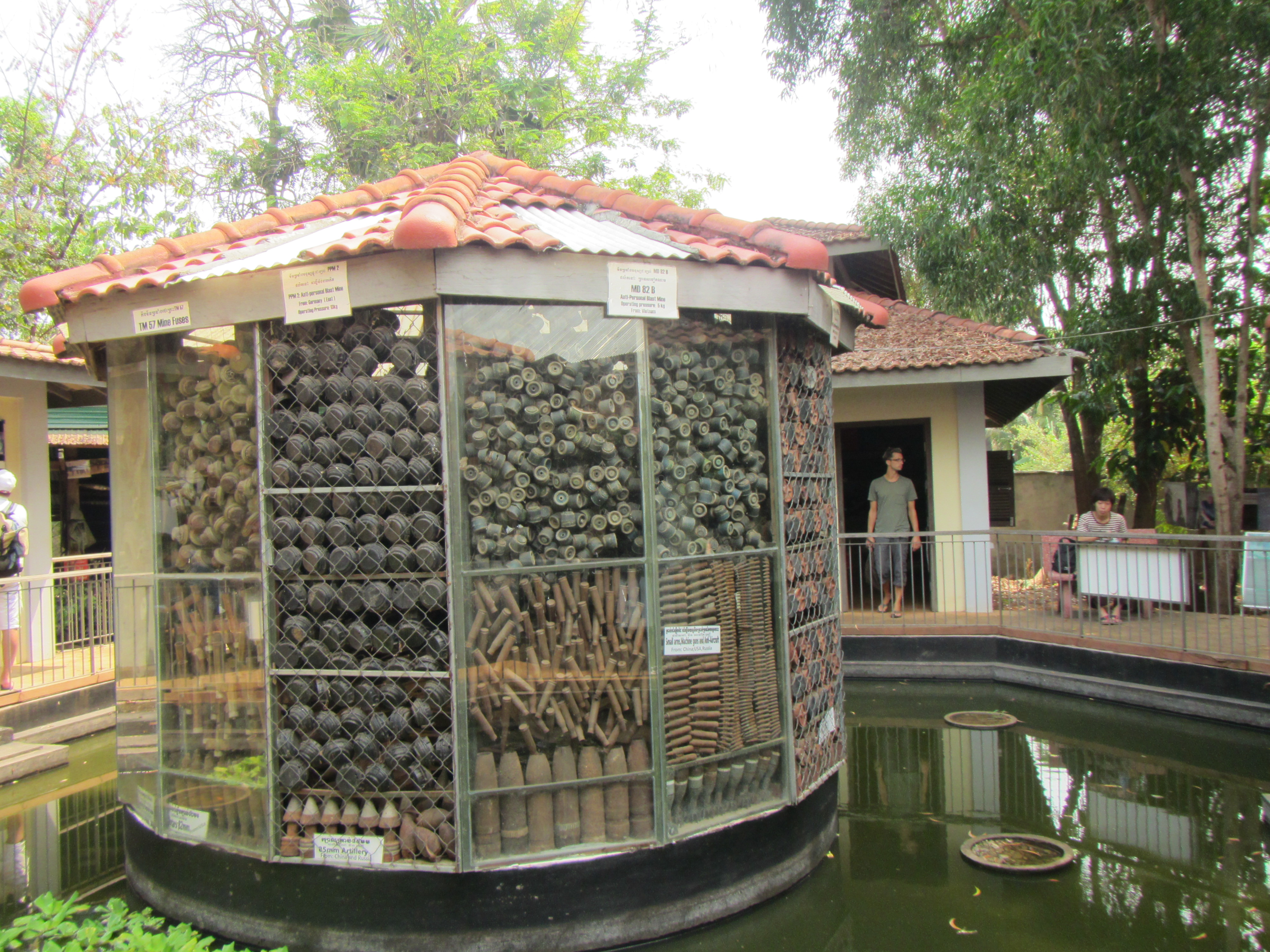
The wars and conflict affect Cambodia today physically as well. There are many fewer treks here and minimal wilderness tourism compared with other countries we have visited, because the countryside is sprinkled with millions of mines and unexplored bombs. Many of these are American, placed in this country to stop the North Vietnamese supply-line alone the Ho Chi Min Trail through Laos and Cambodia during the Vietnam War. Many others were placed by the Khmer Rouge and the Vietnamese when they invaded. I encountered at least a half dozen beggars in Siem Reap who were missing limbs, claiming (and mostly likely truly) the cause was landmines.

We went to a museum today that detailed one man’s efforts to help rid his country of this unexplored ordinance, or UXO. Aki Ra is famous for his personal quest – he has received numerous international awards and honors. He was taken as a child by the Khmer Rouge and his parents killed when he was 5; he spent over a decade fighting and laying mines, first for the Khmer Rouge, then against the Khmer Rouge, then for the Vietnamese. He chose his name – it is one of many that different people have given him (Akira), the one he liked most, and so he made it his own. He began clearing mines from around Siem Reap, and made a small museum near Angkor Wat of his efforts and the challenges Cambodia faces. The museum’s proceeds support a child care center for children injured by landmines.
IMG_2639

The idea that the wilderness is open and (for the most part) safe is something Cambodians can’t share. Wandering through fields, woods, or remote areas has the very real and commonly experienced threat of a explosive device. Some people seek them out, because the explosive and metal can be sold.

What chills me most about the Khmer Rouge is that it happened in my lifetime. The landmine museum compared it to the Holocaust, Rwanda, and Bosnia in scale and duration. In the moment, it’s easy to ignore the atrocities going on in the world. But after the fact, when the scale of the horror is clear, I wonder how we could have stood by and let it happen. It is hard and a problematic for individual nations to intervene, as then national agendas come into play. I understand (but don’t agree with) a conservative American objection to the United Nations, that it subverts national sovereignty, but it seems to me to be the organization best suited to protect people from governmental slaughter. After reading about Timor-Leste and the UN involvement, my feelings about Indonesia are more… complicated.

— The Professor


National Indentity

The history of these three nations formed after World War II – Indonesia, Singapore, and Malaysia – provided a contrast of how the past can shape the future. This is something The Private Eye and I have been talking a lot about as we wander, as her posts have alluded to.

First, one thing impressed upon us by the couple we met at Cocktail Cycle in Chiang Mai is that Indonesia is a somewhat precarious federation. On one hand, unity with Java provides economic opportunity and drives growth. On the other, Java is where the power lies, and other parts of Indonesia feel that, at times, they have to march to Java’s drum. So a bit like Germany and the EU, albeit without the wounds and distrust of the early 20th century. This became a bit clearer to me as I read about Papua, where armed uprisings against the government are not unheard of in very recent memory, and to which the government answers with executions of political leaders. I was unaware of Timor-Leste’s separation in 2002; The Private Eye commented that she remembered it, but it was at a time when terrorism was flooding international news out of the headlines.

Bali and the Gilis, while part of Indonesia, clearly had their own identity which was not strongly tied to the identity of Indonesia. This is in contrast to Yogyakarta, where Indonesian history was important and presented prominently. Both are technically Muslim nations, but Indonesia has a breadth of cultures and religions; while many of its citizens are Muslim, it seemed more an element of personal rather than national identity. Malaysia, at least Kuala Lumpur, defines itself very much as a Muslim nation, tying its identity to Islam in the Middle Ages and Renaissance.

This very strong Muslim identity makes sense given its history. Throughout the colonialism of the 15th to 20th centuries, the major point of conflict with European colonial powers was whether the people of Malaysia could continue to follow their own customs and religion. The pattern seemed to generally be that the Sultans would sign a treaty granting trade and military rights in return for cultural sovereignty, which the Europeans would soon break, and conflict followed.

This history of not only colonialism but also cultural and religious meddling sheds some light on Malaysia’s split with Singapore and Malaysia’s laws that favor ethnic Malaysians. Where Singapore was a city and port built by the British in the colonial era, Malaysia was a booming hub of trade when European powers arrived. Portugal’s initial efforts were diplomatic; when the Sultan of Malacca took members of the delegation captive and killed a few, Portugal sent a fleet and took the port by force. Colonialism kept Malaysians at the low rungs of the economic ladder. And so where Singapore wants equality among its ethnic groups, Malaysia wants to correct inequalities encouraged by past colonial politics.

And so, its heritage of Islam suppressed for so long, Malaysia, once independent, strongly asserted that part of its identity. The National Museum goes into the different Sultans and when they converted to Islam; the Islamic Art Museum is more notable than the National Art Museum; the space agency has exhibits tying modern concepts of the cosmos to Islam’s astronomers in Al-Andalus and North Africa. Singapore, meanwhile, looks solidly towards the future, less focused on history from 500 years ago.

Malaysia is clearly prospering. The architectural icon of Kuala Lumpur, the Petronas Towers, are the office buildings for an oil company. And so Malaysia also shares that aspect of national identity with many Arab nations, although Malaysia also has a lot of agriculture. The Islamic world is vast. Remember World Without Oil, the game played on web bulletin boards a few years ago? I want to go back and see if anyone seriously explored the implications the end of oil will have to Islam.

— The Professor


Yogyakarta and Indonesian Independence

Dear reader, I must be honest with you. I’ve been a bit deceptive in my descriptions of Yogyakarta, relying on the imagination rather than fact. When I wrote that Yogyakarta is unique in Indonesia in that it still has a monarch, a sultan, and that the city centers around his palace complex, called the kraton, I wrote the truth. But when I read those words, I imagine something from myth: gilded domes, brightly painted pillars, courtyards and steps of marble, and a dignified man sitting on a rug, sipping tea, with bodyguards and the smell of exotic spices. The reality is a bit less interesting: a wall, painted white, some streets, mostly western style buildings, and a thin, older gentleman whose father really liked photography. So much more similar to the king of Thailand than what at least my imagination conjures.

Much like the King of Thailand, the Sultan of Yogyakarta is loved by his people. Yogyakarta remains a monarchy because, when Indonesia sought independence in 1948-9, and different regions began to discuss the idea of forming one nation, the Sultan of Yogyakarta was strongly supportive and wanted to join the effort. Yogyakarta was the capital for a short period of time. Because the sultanate was so instrumental to the formation of the nascent nation, it received special dispensation to remain a monarchy. Recently the region had democratic elections, as part of a slow process of modernization: the people elected the sultan with an overwhelming majority,

In the United States, our war for independence was hundreds of years ago. The country has evolved and grown since, but the moment of national birth was before the industrial revolution. For Indonesia, however, this moment was just over sixty years ago, when politicians engaged with other countries, such as the U.S., and students took to the streets to fight the British and Dutch. Indonesia’s war of independence when my father was 9 years old – it still exists in living memory.

One wrinkle to this very recent birth and slow formation of a national character is how geographically and culturally diverse the country is. It is 70,000 islands, from Sumatra in the west to Papua in the east. It encompasses the funeral culture of Tana Toraja, the animistic Hinduism of Bali, the Dani of Papua who first met white people in 1938, and the bustling metropolis of Jakarta. Forging a national identity out of this patchwork of hundreds of previously independent cultural groups is a challenge – the closest analogy I can think of is India, except imagine if India’s regions were islands, and consider the greater isolation that brings.

Our next destination, Singapore, provides an interesting contrast to the path of building a national identity. Singapore was originally part of Malaysia. While there were significant cultural, religious, and political differences between it and the rest of the country, the belief was that seeking individual independence wasn’t feasible for political and economic reasons. But irreconcilable differences emerged very quickly, especially on questions of preferentially treating certain ethnic and racial groups. And so, more like China and less like Indonesia, Malaysia pursued a national identity in part defined along ethnic lines, leading Singapore and the rest of the country to part ways.

But unlike the tenor this idea takes in Europe and the U.S., where discriminatory policies are typically conservative (seeking to maintain the status quo), in Malaysia they are intended to change the status quo and build a Malaysian middle class to stand along side the wealthy other ethnic groups (e.g., Chinese). So more similar to some of the policies in Latin America.

These thoughts are jumbled and incoherent, mostly because I need to read more – these are based on impressions and observations whose supporting facts might be incomplete or incorrect. The world is more stable than it was just after World War II, but many nations are still figuring out a place and identity since their birth and creation, whether it be Indonesia, India, or Israel. An example I should look at is Italy and Garibaldi – something which I will most definitely do when visiting The Medieval Scholar in Siena this June.

— The Professor