RSS

Category Archives: rainforest

A Few Practical Things About the Rainforest

The Private Eye has written about our experiences canoeing in the white and black water of an Amazonian tributary, and I don’t think I can say any more. But there were a few things that surprised me.

  • The climate: simply put, it wasn’t that hot on the river. Ubud was hotter. When the sun was out, sure, it was warm, but since the river water is from the mountains, it was reasonably cool. This was only true on the river; when we ventured onto land, sweat poured in buckets due to the 100% humidity. The knees of my pants were soaked, and I wondered if I had stepped in slightly too deep water for my boots. I hadn’t; it was the sweat coursing down my legs and then hitting fabric right above the boot.
  • The fish: there were so many fish, the sound of a splash as one nabbed an insect from the surface was frequent. Drop some food scraps in the river, and 20 or so would congregate to feast. Most nets we stopped at had numerous fish in them. Our guide, when fishing with a pole, gave up after 3 minutes, because if he hadn’t caught something by then, it was too long.
  • The water: there were times when there was no land for hours. It wasn’t just a river: it was an enormous flood plain. My guess is that the water was 6-8 feet above its low point. Because we were so close to the mountains, there were no real industrial uses of the river upstream of us. This meant that locals could drink the water freely, and later in the trip our water was boiled river water.
  • Fire: cooking was over an open fire, with either some bricks or a few pieces of rebar to hold pots up. We started fires with matches and… large pieces of clear plastic cups. They burn easily, hot, and for a while. Wood for the fire was chopped from logs left in the cabana, and once our guide chopped down a small tree to then chop a few logs.
  • Safety: I think the only really dangerous situations would be a traumatic injury, because of distance from a radio, or both of our guides falling unconscious when we were deep in the reserve, because we might get lost trying to make our way back upriver. Both of those were exceedingly unlikely; this is their day-to-day life. Having local guides, who knew everyone else we met on the river, meant there was no danger from people. It’s a very small community. In Yurimaguas people tried to aggressively sell themselves as guides until we said we were with Jefe; then smiled, said OK, offered to help us with our bags. I would not have felt safe if we were just ourselves.
  • The fauna density: partially because of the amount of time we spent on the river, and partially its undisturbed state, we saw many, many animals. Often we wouldn’t stop, later in the trip. Of course, we didn’t see them; our guide did, and pointed them out to us, at which point they became apparent. The jungle in Laos was silent in comparison, even when gazing oveer the canopy at sunset and sunrise. I wonder if this is true in California redwood forests as well, which at times seem so desolate. I had once read that soil in the Amazon is very nutrient poor; I had incorrectly assumed this meant there was sparse life. Instead, it’s because the forest so quickly takes up the nutrients, otherwise the rain will leach them away.

— The Professor
 

Day 1 in La Selva, March 16

Jefe introduced us to our guides on the night of the 15th, but we met them for real on the morning of the 16th. I will call them Señor and Señora, a married couple in their early 50s. Señor is a trim, dapper man, short, muscled, beginning to feel his age a little, but still plenty strong. Señora has a sadder face, a stouter figure, and a few missing teeth, but comes by them honestly. Jefe picked The Professor and I up in a moto version of a pickup truck, and drove us to his office, where we met the two of them.

We were fitted for tall rubber boots, and left our sneakers and my oversized straw hats in the office for a week. We did not want to get the former dirty, nor potentially spread Asian tropical pests into virgin rainforest with the latter.

The Professor, I, Señor, and Señora were bundled into the moto-pickup again, along with a lot of stuff – big lidded buckets of water, basins, fruit, dry goods, mattress pads, blankets, mosquito nets, etc. Heading out of town, we stopped at the police station, where the police logged our passport numbers and told us that if we have any problems we should come to them. Though their T-shirts with police logo rather than more formal uniforms, inscrutable eyes and machine guns made me feel insecure, I was quite sure they were sincere about keeping the gringo tourists safe.

We drove for about half an hour to the Pacaya Samiria National Reserve. Once there, Señor and Señora loaded things into a wooden dugout canoe, while Jefe, the Professor and I went to sign in at another register, this one for the government controllers of the reservation. For some reason this discussion seemed a little tense between Jefe and the controller, and we had the distinctly (or so I have heard) Latin American situation of sitting around in an office for an unaccountable delay, waiting for the fellow to sign off on our entry. But eventually he signed.

Meanwhile, Señor and Señora had moved our things from their usual boat to a bigger boat. Not many people come to Pacaya Samiria in the rainy season, so it had been a while since there was anyone touring with them for more than a week, obviously requiring more room in the boat for provisions.

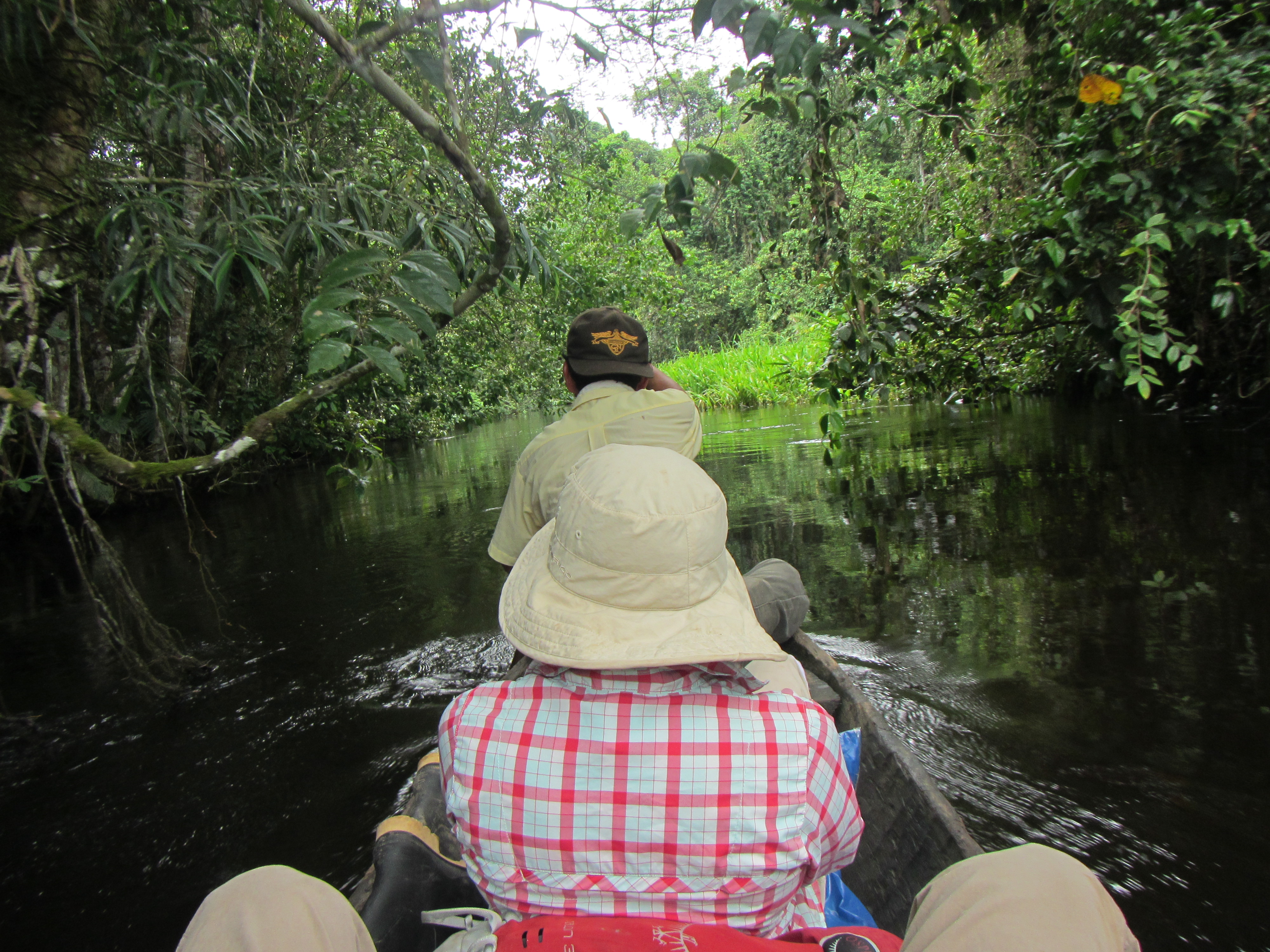
We boarded our wooden vessel, Señor manning an oar in the front, then me, then The Professor, and then Señora manning an oar in the far back. The Professor had an oar, but wouldn’t be using it for the downriver portion of the trip. We would be canoeing four days into the reserve, and then returning the way we had come, heading into the current for the way home. We were sailing on the Samiria River, one of the two that gives the reserve its name.

IMG_2999

We smoothly and silently entered a world of vivid, vivid green, more vivid than Ireland because it is more all-encompassing, green plants beside us, green trees above us, green reflection in the river below us. The first day’s journey was largely on blackwater, one of a few river types in the Amazon basin. Nutrient poor, it looks like strong black tea, and logs in the water are the color of tea-boiled eggs.

The government allows the local mestizo people around Pacaya Samiria to continue their subsistence and small scale economic activities in the park, within limits. Logging is not allowed, but fishing for both personal consumption and small scale marketing appears to be. Hunting of the non-endangered wildlife for personal and family consumption is allowed. As a result, the local fishing people appear quite earnest about supporting the restrictions on use for the preservation of the forest long-term.

At least, Señor is. One of the fishermen who plies the rivers when he is not guiding turistas, he merrily told us over the week which animals are delicious, and which forbidden. As such, both he and his wife know the river very, very well, and how to spot the animals in the gallery forest on either side. I doubt we would have seen 1/4 of the animals we did without them.

But with them, it was a safari. We had not been in the reserve for more than an hour when Señora called out for us to stop and observe an enormous, handsome green lizard with orange spangles around its eyes. It was perched in some branches that were almost at eye level. “Chameleon,” Señor told me. We saw a second within another hour. There were also many birds, including a number of large hawks and a startling amount of blue and gold macaws.

IMG_3009

The gallery forest on either side of us was completely flooded. What I mean by that is that there was no land, that we could literally have taken the boat anywhere we could have fit it between trees. Sometimes we did. Doing so, we saw what Señor called a renaco, a giant tree whose branches all had sent roots of their own to the ground, like a tentacular tree monster or forest spirit. It was very beautiful. Señor showed us our first piranha of many that we would see and eat.

IMG_3004

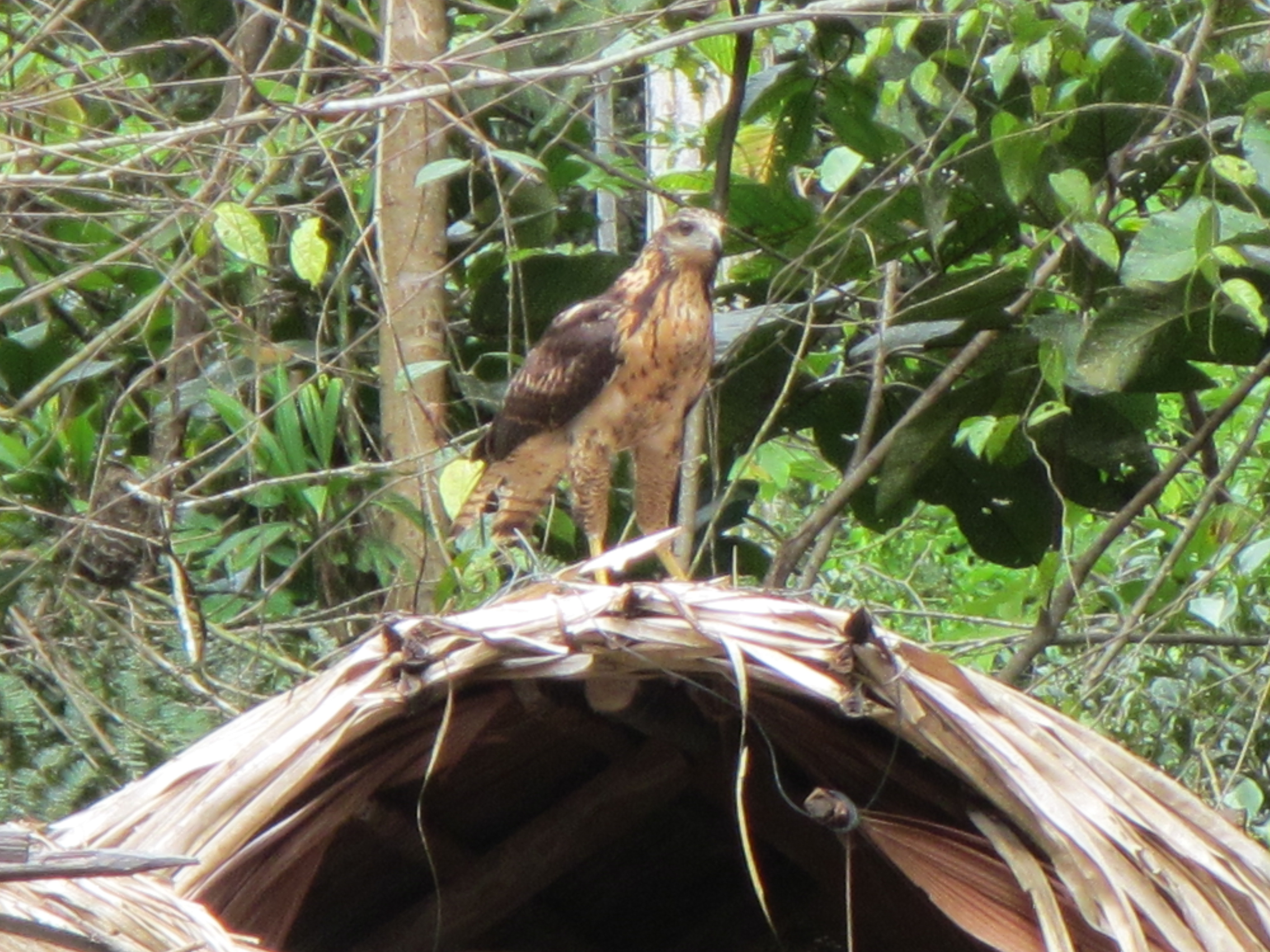
We stopped for lunch at what I would learn to call a cabana, a wooden structure, stilted, with minimal to no walls and a thatched-palm roof. While we were eating, a majestic hawk (or eagle, still need to identify it) landed on the outhouse building, where it took an enormous projectile dump as I watched with my mouth open. It took us a while to stop laughing.

IMG_3025

We saw two kinds of monkeys, one tiny kind in a big family group, possibly saddleback tamarins. The bigger variety were black monkeys with white hair on their faces. At one point, we saw a monkey leap right over a stream, from tree to tree like a heroine from building to building.

We stopped for the night at Poza Gloria, a very established cabana with half walls and even a shower. We ate dinner and went to bed early.

IMG_3029

– The Private Eye