RSS

Category Archives: Thailand

Next Steps

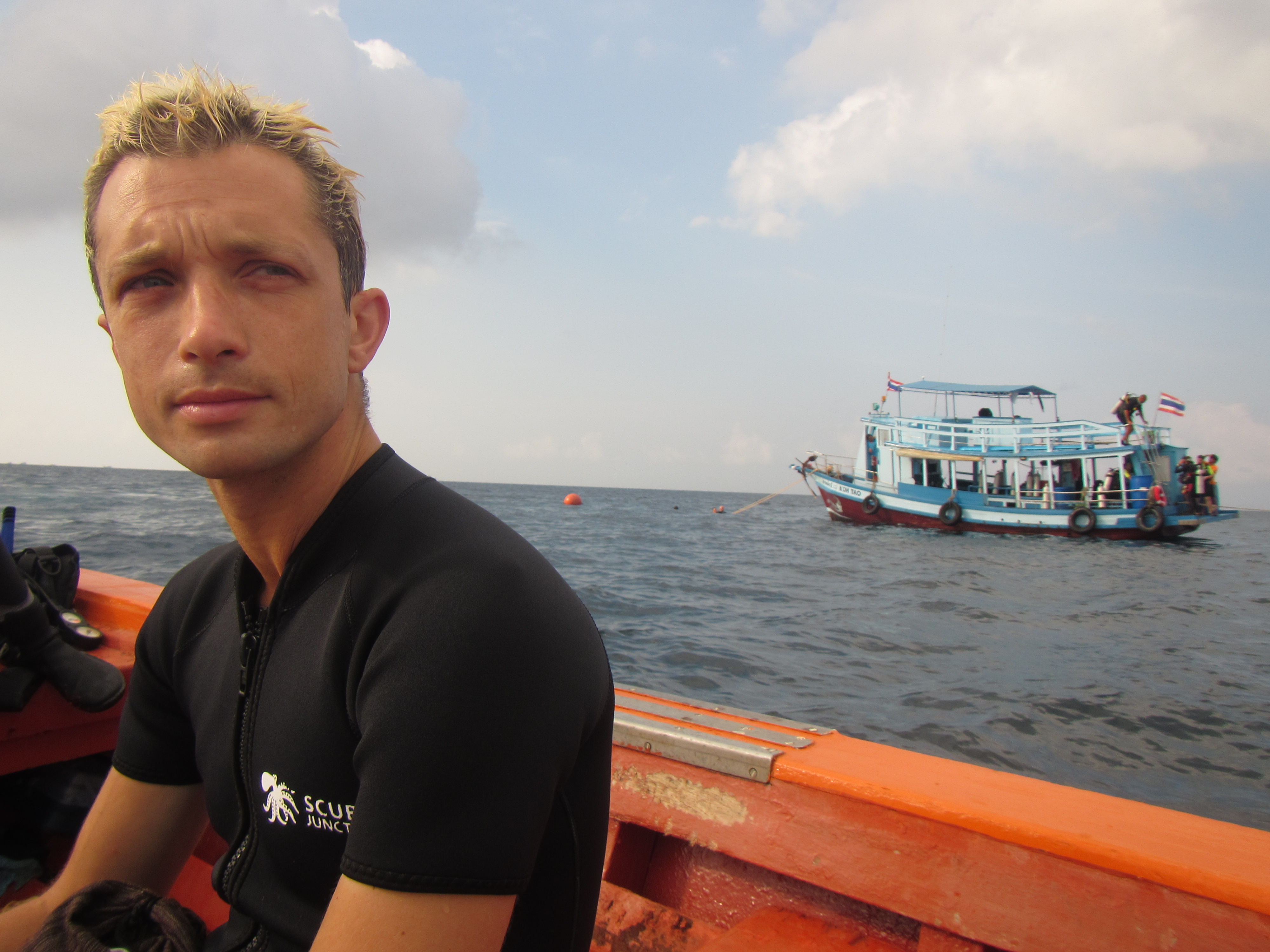
We have two more dives here in Ko Tao, our two wreck dives. One of them will be nitrox. Our instructor, Gemma, will be bringing a camera so we will have pictures of us diving a wreck! It seems silly that we’ve spent so many hours underwater and have no pictures to show for it.

We’re then catching a boat to Ko Phagnan on the 25th. The full moon party is the night of the 26th, we will dive Sail Rock on the 28th. We booked a flight (through Kuala Lampur) to Bali from Phuket (western side of southern Thailand) on Feb. 1st. . So between the 28th to 31st, we will choose between diving some more in Ko Phagnan, rock climbing near Krabi, or maybe even dive the Similans as a day dive. Or some combination of these options. We can’t dive on the 31st as we are flying on the 1st so I suspect we will rock climb or travel that day.

Met a wonderful couple yesterday, originally from Toronto, now living in Gold Coast. We all went out to dinner and mid-dinner they remembered it was their second anniversary! I’m glad we chose a nice Italian place, recommended by the scuba instructor from Milan.

Today we are going to finally walk around the island a bit, as we have no more afternoon class work. Meeting up with the SF burner for dinner.

I’m missing all of my friends back home! Hope they are all having a wonderful time. February is my favorite month in the Bay Area, I’m sad I’ll miss it. Well, only kinda sorta sad. 🙂

— The Professor


Vacationers and Finding Beauty

We had hoped to dive Monday morning, but had to delay our training dives for a day due to my having some food poisoning. I slept for 15 hours and am now better, although not quite 100%. I figure I’ll be fine by tomorrow morning, when we do our first enriched air nitrox (EAN) dive. We went over the materials with our instructor, Gemma, today, measured the nitrox tanks we’re using tomorrow, and did some sample nitrogen and oxygen calculations. While EAN lets you stay down longer because it has a lower nitrogen concentration than standard air (79%), as this nitrogen is replaced with oxygen you can suffer from oxygen toxicity due to a higher oxygen level in your blood. So this means EAN lets you dive longer and have shorter surface intervals, but you can’t go as deep. For medium depths (60 to 100 feet), it’s greatly helpful.

This pushes our departure date from Ko Tao to the 25th. The Private Eye booked us a room on the north side of Ko Phagnan starting the night of the 25th. While the Full Moon Party and other dancing is mostly on the south side of the island, the diving is on the north side. Since we want to dive Sail Rock (reportedly a great place to see whale sharks), we figure staying in the north and heading down south (a short taxi ride) when there’s good music seems better than trying to sleep for a day of diving near Hat Rin.

After Ko Phagnan we will either head to Krabi for some rock climbing or go to Bali. It depends on how much more of the idyllic tropical beach vacation we want. The Private Eye is loving it here. Swimming is so easy and so pleasant. The air is warm, the water is warm, and you can go to the beach at a moment’s notice.

I’m less taken than she is. Don’t get me wrong, I love tropical beaches. Were we alone and basking in the idyllic serenity of solitude, I might feel differently. Ko Tao is a pretty busy place, and a stop-over point for many. Unlike Luang Prabang or Chiang Mai, the draw is the beach, not the people or culture. Accordingly, it draws a different crowd, one I have trouble finding much commonality with. What’s especially unfortunate, and something I need to take a hard look at, is why.

The first signifier for me was the tattoos. A lot of the guests here, both men and women, have tattoos. At first, I thought that was a good sign. But after a few minutes, it seemed a bit off. Sure, they are tattoos, but they are large, noisy, muddled, and rarely beautiful. For example, one man had the right side of his back with a cutaway of his ribs and internal organs. Could be cool. Except it didn’t line up right. The drawn ribs didn’t fall on top of his actual ribs, and their curvature wasn’t quite right. There’s a lot of blue work. A lot of swords, snakes, feathers, and other shoulder designs.

I mentioned this to The Private Eye, she thought for a bit, and asked “Do you think it’s a class thing?” After chewing on that for a day, I have to admit she’s right.

Living in San Francisco, it’s easy to lose perspective. When someone we know decides to get a tattoo, they go to one of the best shops in SF, arrange for a consultation, sit down with the artist for an hour, maybe more than once, to figure out the exact tattoo. Then you book an appointment, wait a few weeks, and get the tattoo. Excellent artists charge $200 or more, such that a large or complex design can easily set you back $2000. That’s a lot of money, but since it’s something you’ll have for the rest of your life, it makes sense to pay for it.

But that care and resulting beauty is a luxury. If you don’t have $2,000, you can’t hire the artist that charges so much and sits down with you for an hour and spends a lot of time coming up with a custom design for you. Put more honestly, and here is where I have to look hard at myself, you also can’t afford to hire someone with taste. Not everyone can buy the nicest things, even sometimes.

Wandering along the beach last night didn’t help, seeing guys peeing high up on the beach, behind buildings, where the urine will stink, rather than go to a washroom or just pee in the sea.

One of my students (The Brewer) once commented that he didn’t know anyone as concerned with aesthetics as much as I am. Clearly he doesn’t know The Private Eye well enough. One thing she has impressed on me over the years is how important it is to surround yourself with beauty. That beauty can be natural or man made. It can be permanent or ephemeral. It can be physical, or the beauty of a person’s mind and heart. And maybe that is my problem here. I see the beauty of Ko Tao, but I do not see the beauty of its guests. It is my failing, and maybe that is why I shrug when The Private Eye beams.

That being said, I ran into a burner from who lives on Potrero Hill Monday night, we are going to meet up for dinner tomorrow Wednesday night:

IMG_0717

— The Professor


SCUBA!

We’ve now settled in to Ko Tao. We are staying at least until the 23rd, and might stay longer depending on how our Ko Phagnan plans shape up. The full moon party is on the 26th, and finding a room can be difficult. If we can arrange one from here, we might leave later. Otherwise we will probably need to leave on the afternoon of the 23rd. We’ve moved from our B1200 bungalow to a much smaller and minimal B400 one:

IMG_0694

Our diving schedule is this:

  • Jan. 17: arrive, arrange for refresher course, sleep
  • Jan. 18: refresher classroom in the morning, skill refresher and fun dive in the afternoon
    (Twins)
  • Jan. 19: arranged for dives and courses in the morning, fun dives in the afternoon (Twins, White Rock)
  • Jan. 20: fun dive in the morning, deep diving classroom in the afternoon
  • Jan. 21: deep dives in the morning, nitrox classroom in the afternoon
  • Jan. 22: nitrox dives in the morning, wreck classroom in the afternoon
  • Jan. 23: wreck dives in the morning, catch the ferry to Ko Phagnan in the afternoon?

Deep diving is learning about the issues and dangers that arise when you go below 60ft, which is approximately 3 atmospheres of pressure. The basic summary is that you need to be more careful when you ascend because you can have nitrogen in your blood at higher pressure. That’s the really dangerous thing in diving: coming up too quickly from higher pressure, so gas dissolved in your body forms bubbles (like a soda you have just opened). Nitrox is using a gas mixture that has a higher oxygen content (lower nitrogen) than regular air, which lets you stay down longer, something very useful when diving deep. You have to learn about oxygen poisoning and new dive tables. Finally, wreck diving is learning skills and guidelines for diving sunken shipwrecks, such as don’t touch anything because it might fall on you. You typically want deep diving certification for wrecks because they are deep, and nitrox as well so you can stay that deep for more than 5 or 10 minutes.

IMG_0732  IMG_0728

Our instructor for the refresher course was Leane, an English woman who used to work in corporate finance and wants to return to school for a Ph.D. in psychology, most of all at… Stanford! We talked a little about it and I offered to talk with her about her motivations and whether a Ph.D. is right for her. She was a fantastic instructor. The Private Eye sometimes takes 2-3 minutes in her initial descent (her ears equalize slowly), and Leane was very supportive, helpful, and patient. We did lots of high fives under water.

Today, our dive leader was Rachel, also from England, who used to be a punk, loves hip hop, and I’m sure could beat me up in a fight (not that that’s saying much). She was also excellent. When we found a lionfish hiding on a rock, something she had recently discovered and not told many about yet, she did a little underwater fist pump dance. Enthusiasm is infectious!

After a dive, you log what you did: how deep, how long, where, when, conditions, and what you saw. The post dive logging generally involves the dive leader walking you through everything you saw, a long list of fish, coral, sea cucumbers, and crustaceans. But, in all honesty, these aren’t the things that capture my attention or imagination. The lionfish was kinda cool, yeah, but the moments that made me stop and stare were much larger in scale. Like the time on our first dive when I looked up at the reflective surface of the water and saw silhouetted two schools of fish, one made up of hundreds of silvery fish about 6 inches long, the other 8 longtail fishes, these yellow, black, and white fish that are about a foot long and have a long, thin, white trailing fin on the top of their body. These hundreds of fish filled my field of view, not quite blotting out the sun but putting me in deep shade. Or, in our White Rock dive, when I looked down in a deep region and couldn’t see the bottom, just a blue green nothingness below, with shadows of fishes of all sizes flitting back and forth before fading into the unknown depth.

We have chosen this dive schedule because one of the instructors at our school, on hearing we wanted to dive the Liberty wreck, nodded a lot and said it is a fantastic dive. So in our agenda of seeking peak experiences, spending our time on Ko Tao diving to learn skills so we can dive the wreck is the plan.

Our camera can actually go to 10m underwater. I’m going to see if we can get some pictures to post. Given we are diving deep it might be tough, but hopefully I can figure out a way.

— The Professor


Ko Tao

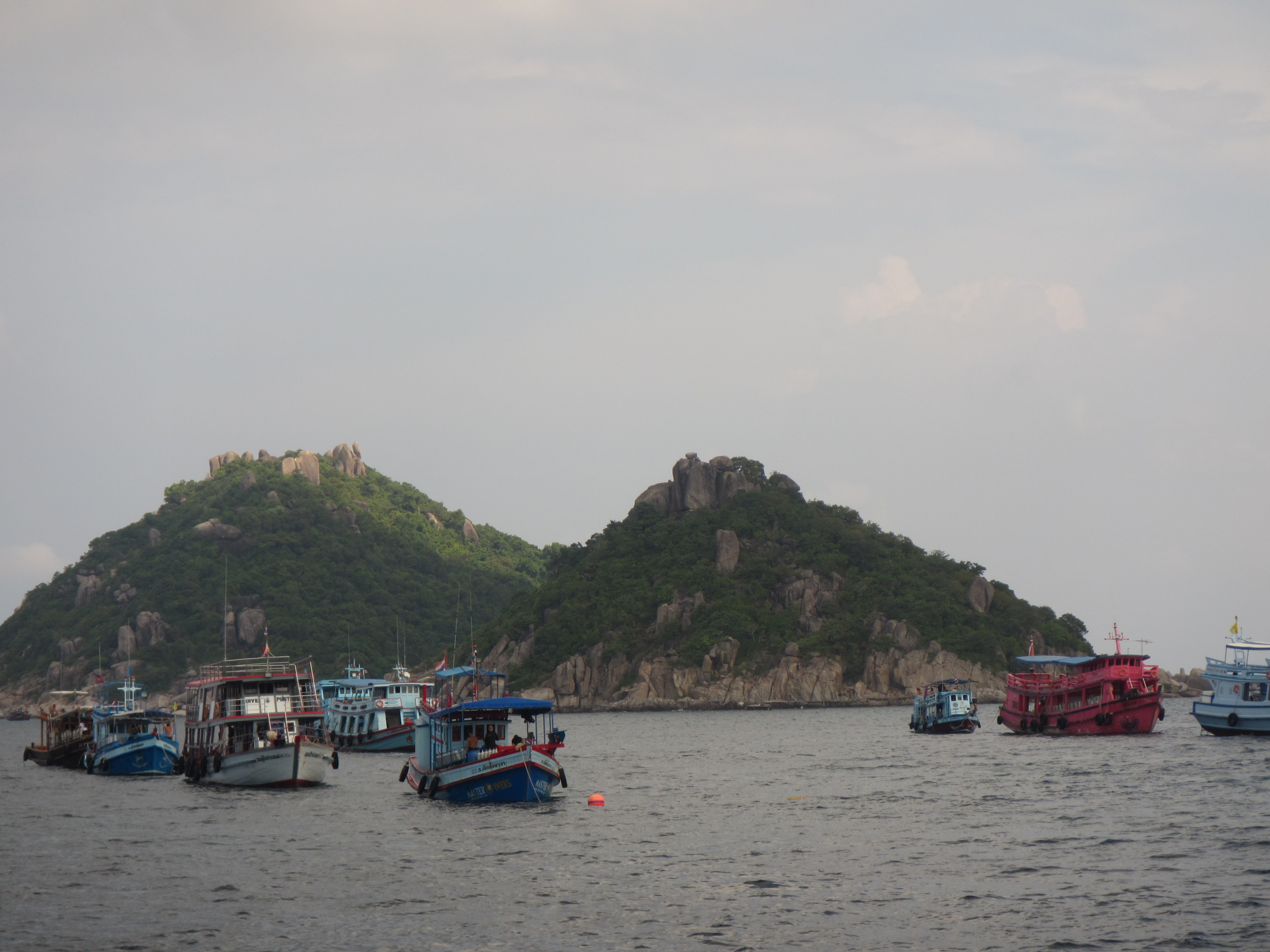
There are three islands close to one another on the east coast of southern Thailand: Ko Samui, Ko Phagnan, and Ko Tao. None of them are cheap like Laos is cheap (all you can eat buffet for $1.25!), due to their being beautiful tropical islands, but I listed them above in decreasing cost. Ko Samui is a well developed resort island, Ko Phagnan is famous for its beach dance parties, and Ko Tao, the little brother to the others, has become a diving mecca. Here you can see dive boats clustered around a dive site (I think this is Twin Pinnacles):

IMG_0735

Of course it has fine diving (we dove today and it was the best dive of my life, except maybe the time I swam alongside a turtle off the Kohala coast in Hawaii), but other places in the region have fantastic diving. As the cheapest of the three islands, Ko Tao is the place to learn how to dive and to take more advanced diving courses. Half of the places you can stay have dive schools, and in the afternoon every pool is filled with classes of people learning.

So this is our first stop in tropical Southeast Asia. The Private Eye and I haven’t dived in two and a half years, so we wanted to stop here to refresh our skills, maybe learn some new ones, and get recommendations from the local divers. After this, we’re thinking we want to dive Sail Rock (either from here or Ko Phagnan), I’m excited about the wreck dive near Bali (the Liberty), and we are considering going to the east coast of Thailand to dive the Similan islands. Originally the Similans had been high on our list, but it can be expensive, since it’s near the higher-end resort beaches of Phuket. So depending on how money is feeling when we wrap up here, we might head to Phuket, or, if money is tight, we might instead head to Railay Beach and Krabi, also on the east coast, for some oceanside cliff climbing.

Arriving here was, for lack of a better word, a bitch. We took the night train from Bangkok to Chumphon. We wanted a sleeper car, but it’s still busy enough around here, and we did it the day of, that all we could get were 2nd class seats. Since there was no AC, the windows were open, which meant passing trains were a deafening roar. A lot of other uncomfortable things meant each of us slept 3 hours at most. One night of poor sleep is not too hard, but we’d also only slept 3-4 hours the night before. We arrived in Chumphon at 5 am to take a bus at 6 am to a high speed catamaran to Ko Tao, departing at 7. The sea was rough enough that I started to become queasy, and almost lost it as I made my way to the back of the boat. What made it especially hard was that my eyes were so tired I couldn’t stay focused on the horizon – looking at the horizon I was fine, eyes closed or unfocused was bad. But once I was at the stern and could watch the churn of the water from the engines, I was fine. I actually feel asleep, sitting down, head resting on the railing. I arrived soaked in salt water, but with a stable stomach.

We caught a soorng-tao to Sairee beach, where a few of the most recommended dive schools are, found a too-expensive room that was fine for one night (B1200/$40) since we needed to sleep so badly, arranged for a refresher class the next day (Friday the 18th) with Scuba Junction, a seemingly awesome diving school (they are), and crashed out.

So this is a tropical island, with all that entails: beautiful white sand beaches whose sand is so fine in parts it feels like clay. The beach itself is all bars, restaurants, and dive schools. So you can, for B60 ($2), get a cup of coffee as well as toast with jam and butter, and eat them lounging on a patio that ends 10 feet from the surf. All of the beach is free access, so you can walk up and down it as much as you want. It’s not crowded. While it might be hard to find a patch of beach which has no one else for 30 feet, it’s trivial to find a spot for your towel. Sairee beach is about a kilometer long, with rocks at both of its ends, so you can walk it in 15 minutes.

I woke up before The Private Eye so did exactly that, walked up and down the beach, sitting down a few times, for an hour or so. Three people gave me fliers for events that evening as I walked: a new yoga studio, a flying trapeze show with free trials, and a bikini/trunk fashion show. I tried to be in the Burning Man spirit; rather than say no, I took every one offered with genuine interest. The Private Eye awoke, we had grilled barracuda for dinner (actually a big, square meal) and went to the trapeze show, whose details I’ll elide because I think The Private Eye night have more to say.

So we went to be early, woke up at 8 or so, booked a cheaper room, and made our way to Scuba Junction for our refresher course at 10AM.

— The Professor


Crossing into Laos

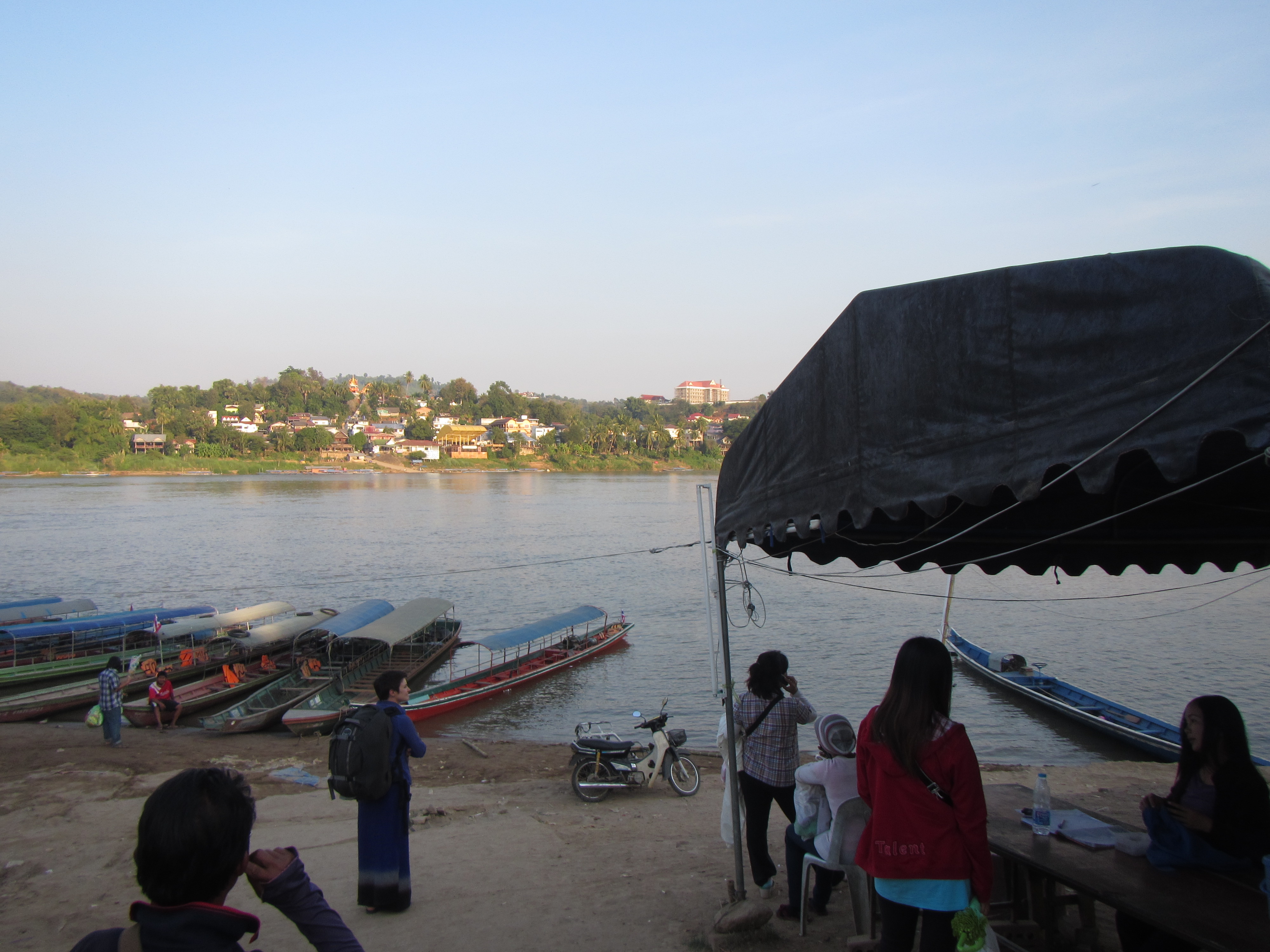
We spent one night in Chiang Rai and caught a bus to Chiang Khong, a small border town that sits on the Mekong River. After a bit of discussion, we decided to just cross over into Laos immediately, rather than spend one night more in Thailand. We had to hurry – it was 4:30 and the border crossing closes at 6. We hired a tuk-tuk to take us the kilometer north to the dock, filled out our Thailand departure card, and hopped on a longboat to the other side: Huay Xai, Chiang Khong’s Laotian sibling.

Jan16 455

An entry visa is $36, which we paid in USD. We had been debating what to do when we arrived in Laos. Our hoped for plan was to embark on The Gibbon Experience. But since we had no reservations, this might be tricky. Email correspondence suggested hopefulness, but nothing was certain.

The Gibbon Experience has three options: express, classic, and waterfall. Express is 2 days and one night, while classic and waterfall are 3 days and 2 nights. Classic involves getting up early to see and hear gibbons, while waterfall involves no gibbons but a beautiful waterfall and pool to swim in.

Our first choice was the waterfall (we didn’t know yet it doesn’t have gibbons). But we were arriving on the night of the 5th and it departs the morning of the 7th. So we decided to just go to the office and find out whether there was space and if so sign up. The Private Eye ventured out and discovered that they had space for the classic on the 6th but waterfall on the 7th was only a maybe. Huay Xai is pretty boring, so we decided that gambling and maybe sticking around to the 8th was a bad plan, so signed up for the classic on the 6th. This made me happy – I am feeling a bit jumpy and in need of activity, so the idea of crossing into Laos and at 8am the next morning embarking on an adventure sounded great.

I won’t try to really explain the Gibbon Experience in words – I’ll upload some photos and hopefully a video as soon as I can.

— The Professor


Hill Tribes

The hill tribes are one of the big tourist attractions in Northern Thailand. The Lonely Planet Thailand book has a long section on them, showing drawings of their traditional clothes and describing their lifestyle, religion, agriculture, and history as well as where they live. When I came across this section of the book I became cross; in all honesty, it read way too much like a gaming book describing the rural tribes of some fantasy continent. But these are real people and societies, not purely imagination.

The idea of visiting a modern instance of a primitive culture (here I use primitive in the technological and economic sense, not ethical or spiritual) as tourism rubs me the wrong way. The analogy I gave – an extreme one, yes, but I tend to do that, as many of you know – is when the British captured African tribesmen and put them in zoos. Going to view other people in their day to day life is not itself problematic: I sometimes enjoy sitting outside a cafe and watching the street as much as anyone else. But when the distinctive feature you’re going to view is poverty, I recoil.

Because that’s what it is, really. You’re not going to see the modern manifestation of an old culture. The selling point is to see it for real – people living much as they did 200 or more years ago, although now they have a motor scooter or two for transportation. Using an analogy closer to home, tourists don’t go to Native American reservations to see a modern Native American lifestyle. There are reservations where residents perform tribal dances and ceremonies in traditional garb for tourists to see (I recall seeing one dance in New Mexico when very young), but re-enactment of history under your own terms (admission fees, camera fees, etc.) is very different than a paid guide taking you into a village.

A particularly noxious example of this are the long neck Karen, whose women use brass rings to push down their collar bones and give themselves long, extended necks. The only reason they do this is for tourism. By going to see the long necked Karen (there are Karen who do not follow the practice), you are paying people to self-mutilate and live in a society which your payment implicitly forbids them from leaving (the village without TVs and running water will see more tourists).

It’s even worse when you pay a guide a bunch of money to take you to a village and they don’t receive anything. Add the fact that most of them are not Thai citizens and so do not have many rights. For example, guides to the hill tribes must be Thai citizens, which means they cannot be the guides to their own culture,

Of course I’m being a bit extremist here. While I’d want to talk with someone who paid a guide to take them to the long necked Karen and point out what they’d done, there are many shades of grey. For example, there is a group (which the hill tribe museum in Chiang Rai praised highly) that pays much of the visit price to tribes, and works with them to organize when and how visits occur, a bit more like the Native American model I’ve experienced.

This was the debate The Private Eye and I were having in Tha Ton. She pointed out that going to a village and buying their crafts was the best thing one can do. The idea of traveling to a village without a guide, seeing if it was alright if we entered the village, and buying crafts made me a little uncomfortable, but I thought it was a light enough shade of grey that I should go so I could have actual experiences with which to understand the situation better.

So we went, I bought a scarf, we tried to be respectful and friendly, and I’ll need to think about it more.

– The Professor


To Tha Tun

After our cooking class we went to bed a bit early and read. Our hosts at Taicoon guest house told us there is a direct bus from Chiang Mai to Tha Ton, leaving from the north bus terminal. We looked up the schedule and found it is a four hour trip, departing every 90 minutes or so. We thought catching the 9am would be best, but if we slept in 10:30 would work. Our alarm didn’t go off, but we managed to return our bicycles, buy pastries for breakfast, and get to the bus by 8:55.

A bus winding along mountain roads was a bit rough on two of the kids on the bus, who threw up, but a great breeze through the open windows made sure the smell wasn’t a problem. The bus dashed from town to town, stopping at a half dozen or so spots in Chiang Mai, Chiang Dao, and Fang before arriving in Tha Ton. We had a brief delay when the bus blew a tire in Fang; we limped a half mile to a tire shop, then a bunch of Thai men took off their shirts (Thai men in tank tops! The scandal!) to employ pneumatic tools and jacks to get us on our way. I’m glad it happened there and not halfway between towns, that could have been disastrous. So we rolled into Tha Ton and booked a room at the Garden Home for 300B ($10) a night.

Jan16 375

Tha Ton is a small, rural Thai town. There is one main street, which goes over the Maekok river (which the locals call the Limkok river, I believe, making directions difficult the first few tries). It’s surrounded by corn farms, garlic farms, guava orchards, and other agriculture. The mountains overlook to the west, and there are several Wats hidden in their tree-covered clefts and seams, visible at times from the road. The humidity gives everything a thick haze, so the river seems to wind away into a milky nothingness.

Jan16 378

The Expat Teacher is staying with her family and a few friends at a nice resort a kilometer from town, along the main road. We walked there, talked with her while gazing out over the fields, joined her and her family for dinner (Khao Soi for everyone!), then continued talking over a drink. Come 10pm, The Private Eye and I decided to head home. It was too late for a sōrng-tāa-ou, so we decided to take the 10 minute walk home.

For two city slickers who love nature but don’t actually spend much time in rural areas, it was an adventure. Some of it was fun, like the silent white cow looking ghostly in the moonlight. The part that was scary was when we walked by a home and a trio of dogs started growling and barking furiously. But unlike other homes with barking dogs, these dogs weren’t behind a fence. So they came out onto the road and followed The Private Eye, growling and surging forward, then slowing. None of them were very big dogs, so we weren’t in serious danger, but a bite or two would certainly have been painful. And in all honesty, we don’t quite know how to deal with dogs in a pack who are that aggressive. Our uncertainty and surprise led to a lot of adrenalin, but nothing happened. They followed us for a hundred yards or so – seemed like a mile – then turned back. In the same spirit of honesty as The Private Eye, I’d like to say that it didn’t bother us at all, but that is not true; we were both scared as this trio of dogs growled at our heels and calves on the otherwise deserted and dark road along the hillside.

We woke early, while it was still cool, to climb up to the most ornate of the Wats that one can see for the road. There’s a series of 8 different stages, from small Buddha shrines, to a large golden Buddha with a Naga hood (the Naga eyes light up at night?!?!?!) to finally the temple on top. Inside it was beautiful, but also creepy; there were lifelike wax figures of two famous monks whose pictures were all over the temple, sitting in the central prayer area, while a recording of monk prayer played over the speakers. When I first saw them I thought monks were actually praying (why was the cleaning lady using her vacuum then, of all times?), but no, just creepy wax figures. The Expat Teacher’s husband, who also visited the Wat, but later in the day, saw them as emblematic of the decline and corruption of Thai Buddhism. “No attachment, indeed,” he said.

We wandered down to the docks to arrange for a private boat to take us 6 down river to see hill tribe villages (The Private Eye is great at this), and found a lady who said her daughter could teach us how to ride a motor scooter when she returned from school. Unfortunately the girl had cold feet – she was only 12 after all – so we will have to learn some other time.

Being in Tha Tun has been wonderful because it’s rural. After Bangkok and Chiang Mai, we needed some quiet, nature, and clean air, all of which are here in abundance. It’s a sigh of relief. But it’s of course also a bit slow, which I have trouble with after 48 hours or so.

Jan16 404

The Private Eye and I went over a bunch of possible plans for our next steps. Our hope is to do a nature adventure trip in Laos called the Gibbon Experience, which involves sleeping in tree houses 200 feet up and going across 2km of zipline in the jungle canopy, then heading to Luang Prabang. Depending on how much time we take, we have a lot of options. If we spend a lot of time in Luang Prabang, we might head directly south to Ko Tau. If we have a few extra days before most European tourists clear out on the 15th, we might head south to Vang Vieng, which seems to have thankfully cleaned up a bit recently (no more bars at the top of the tubing region of the river). If we have a bunch of extra time, we might just fly over to Angkor Wat and give it the 3 or more days it deserves.

— The Professor


Thai Food and Thai Cooking (Chiang Mai, day 3, New Year’s Day)

We awoke a little lazily after our late night out. The Private Eye headed out to run a few errands (drop off laundry at one of the nearby homes that offer the service, renew our bike rental, etc.). I tided the room before heading to Black Canyon Coffee, which although very bland inside actually makes excellent coffee, to read my book. Almost everyone we know who’s been to Thailand has recommended taking a cooking class, and Chiang Mai is supposed to be one of the best places to do so. The classes range in complexity from an all day class that involves traveling to a local farm to an afternoon/evening affair for 4 hours. Given our late rise, we decided that we’d try to do the latter. We’d bike to and wander around a shopping district in the northwest to try to find The Private Eye another pair of pants, then come back to the old city for our cooking class.

So we ventured out to this one Soi nearby where there seemed to be several cooking classes, with the hopes of signing up for one this afternoon. None of them panned out, including the two our guest house hosts recommended. Since we’re leaving tomorrow morning for Tha Tun, our situation looked grim. But I remembered what our new Melbourne friends has said the night before about finding rooms – just try again later, and chances something will have opened up. So we ventured to the northwest, planning to stop by Asia Scenic, the most highly recommended school, just before the class to see if an opening had appeared.

There’s a huge amount of street food of many kinds, in a fashion that regulations in a place like San Francisco would never allow. Yes, that old man has a sidecar on his motorcycle, which is a propane stove and table. Yes, that’s a huge wok of boiling oil that he’s frying chicken in with that stove, 6 inches from the sidewalk. If you tripped, you could land your hand or face in the oil. In return, a large, enough-for-lunch fried leg and thigh is about 85 cents. The pickings were slim today compared to last night, but this fried chicken vendor was along the road were bicycling on, so lunch for 2 (fried chicken, sticky rice, some vegetables) for $2, slightly less than a cappuccino. A papaya salad is $8 for takeout at Regent Thai in Noe Valley; from a street vendor, it’s 85 cents.

While Parisians famously frown at street food (the recent encroachment of falafel is fascinating), the Thai love it. But this reflects something about the cuisines as well. While a properly made coq au vin takes 3-4 hours to make, a good 90 minutes of which is work, most Thai dishes are astoundingly simple. You can make a bunch of them in the morning and serve them all day. Furthermore, seemingly very different dishes turn out to have almost identical ingredients. The only difference between a red and a green curry is the chili pepper used (fresh green or dried red). Pad See Yew, Pad Thai, and other stir fry dishes have identical seasonings, just different ingredients. So one set of prep can provide for many different dishes.

We dropped by Asia Scenic at 4pm, and, indeed, they had space for 2. We wandered to a nearby coffee bar along this narrow, quiet Soi and read in the shade of a forested oasis before heading back over for our class.

The class itself was delightful. Our group of 12 had four people from Toronto, four from San Francisco, two from Sydney, and two from Frankfurt. The other Californians were really from Sonoma, so we talked a bit about markets to buy the ingredients. Of the 6 possible courses, 2 were picked for us (curry paste and curry) and we as a group could pick 2 from appetizer, soup, stir fry, and dessert. We chose soup and stir fry. For each course, you chose one of 3-4 dishes. After choosing your dishes, you walk to a nearby market to have a bunch of ingredients explained and shown. 3 hours, some chopping, propane, and stirring later, we ate our own cooked Thai food and left with a cookbook.

Jan16 365

Tomorrow morning we’re catching a 4 hour bus to Tha Ton, to meet up with The Expat Teacher again. We plan to stay there until the 5th, at which point we will either head east to Pai and Mae Hong Sun, or north to Laos. I’m itching to get south, to the islands and beaches, Indonesia especially, but doing so before the 15th is probably a bad idea due to the super-high tourist season. I’m fascinated by Brunei Darussalam, in part because I haven’t yet heard anyone say anything about it and in part because of its virgin rainforests. I wonder if it’s off the beaten track because there’s no alcohol, so not a partying destination? We will have to ask The Expat Teacher tomorrow.

– The Professor


Rolling into Chiang Mai

Our bus rolled into Chiang Mai around 8AM. It didn’t drop us off in the city center. Instead, it dropped us off at a guest house/tour company who gave us a free coffee to keep us there while they explained all of the wonderful deals they have. We left as soon as we finished our coffee, combining forces with another couple to hopefully find a pair of rooms together. But unfortunately it was not to be – since it’s the New Year, rooms are scarce. We found one just south of the East Gate, Pratu Tha Phae, on Soi 3 of Th Moon Muang. It’s simple and bare bones – a bed, a folding table, a stool, a clothing rack with a few hangers, and a private bathroom. It doesn’t have air conditioning, but Chiang Mai so far is a good 10 degrees cooler than Bangkok and Ayuthaya, and the hotel cooler still, so we didn’t even need to turn on the fan when we sacked out until noon or so.

Chiang Mai has a central old city, surrounded by a somewhat crumbling wall and a moat. We wandered around the old city a bit, getting some surprisingly good coffee and a bunch of practical items, such as mosquito bite ointment, a shiny purple tshirt for The Private Eye, a small personal bag for me, and another prepaid phone card. Sundays have the Sunday night market, so as we wandered west, across the old city, towards Chiang Mai University we saw people starting to set up.

We were heading to CMU (academic readers are probably as initially confused as I was when I first saw it) because it’s supposedly the place to catch a sōrng-tāa-ou, a kind of communal cab made from a pickup truck whose bed has a roof and benches on both sides. When you flag one down, they’ll let you get on if your destination is reasonably along their existing route. Some of these cabs gather near CMU’s main gate to gather groups of passengers to head to Wat U Mong, a forest temple up in the hills behind Chiang Mai, some 12km away.

Riding in the back of a pickup as it wound up the hills, surrounded by lush trees and sweet air, the trip up was a delight. It felt a bit like winding into Tilden, but with a damper and lusher forest and without the distinctive smell of eucalyptus.

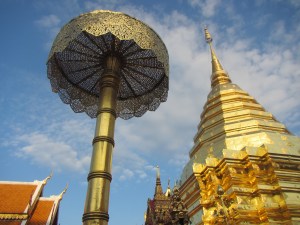
The Wat was beautiful, but of all of the temples we’ve visited so far, this was the worst experience I had. It was a strange, crowded mix of tourists posing by notable features and people coming to pray. Outside the Wat was a horrific traffic jam, complicated by all of the yelling and cooking fires. There were even food vendors within the Wat itself. This meant that as some people walked in a circle around a central golden pillar, praying and holding lotus flowers, they did so passing by empty soda cans and discarded corn cobs. The Private Eye said she was in a small shrine on the side when she saw a man come in, give the Buddha a bracelet, pray for a moment, then as he stood, start talking on his mobile phone. The lack of reverence in such a beautiful, secluded temple, its confusion between tourism, rote, and belief, well, all kinda sucked.
12.31.2012 136

After the temple, we rode down the mountain in another sōrng-tāa-ou, but this time, rather than sit inside, The Private Eye stood up and hung off the back, seeing and smelling the forest pass by. We transferred to another at the zoo, and had a nice chat with a couple from Toronto who are planning on moving to Bangkok in a year or so.

And then back to the old city, where Sunday Walking Street was in full swing, with people shoulder to shoulder making a slow clockwise circuit up and down Th Ratchamandoen, each side crammed with arts, crafts, food, and clothes, the center filled with musicians, many visibly blind, busking. We finally made our way to Pratu Tha Phae, and found, right on our corner, the bar for us.

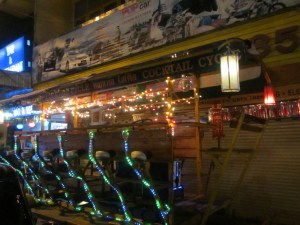
You see, it isn’t a building, more a trailer. Set up in the middle of the sidewalk. A trailer in that it’s pulled. It was a tiny, narrow bar in the center, with just enough space for a bartender and twenty so bottles of liquor and mixers, with coolers at his feet for beer and soda. The bar seats were all bicycle saddles, with roughly-welded foot rests. The bar and seats were raised, so you have to clamber up and sit with your feet about 3 feet off the ground. A worn, hand painted sign said “Cocktail Cycle” and the only real decoration was a string of Christmas lights with plastic straw pieces stuck over the ends to add color and texture (the bendy bit of the straw). It was, in short, a bar that belonged in Black Rock City just as much as Chiang Mai.
Jan16 315

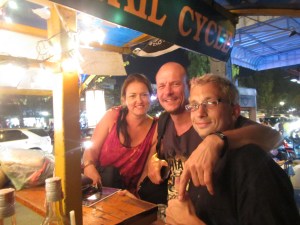
When we sat, it was empty except for one couple. By the time we left, it was full. The couple was born in Australia and New Zealand, but now live in Malaysia and work in Indonesia. He’s a gold miner, she works in orphanages. We talked about San Francisco, gold mining, and travel. We of course asked for recommendations – they both spoke glowingly of Gili Island, near Lombok, and he told us of a wreck dive near Bali. So when we make our way south, to the beaches, we have two items at the top of our list.
12.31.2012 143

After one side car and one seltzer water we had spent the last few baht of our daily budget, and exhausted from the night bus, we walked 100 feet home.

— The Professor


Farewell, Ayuthaya, hello Night Bus!

I had really mixed feelings about Ayuthaya. It was only natural, I suppose – my first encounter with the backpacker infrastructure and all that it entails, my first nights sleeping (badly) in a fan room rather than an air conditioned one, my first mosquito bites, my first participation in a gratifying but possibly dubious activity (elephant rides). Despite many pleasures – museums! Ruins! Meeting Hans, the awesome 50 something who is cycling around Thailand solo! – I found myself getting really grumpy about the heat, the traffic, and the cost of everything.

12.31.2012 097

Now wait a minute, you may be thinking, Thailand is cheap! Well, it is and it isn’t – the thing that surprises you is that it doesn’t scale as you’d expect. My two coffees today cost 100 baht. That is around $3, which is about what they would cost at home. But our room in Ayuthaya cost 400 baht. That means coffee can be 1/4 or more of the cost of your room, which is very expensive. I am starting to worry about affording experiences that cost far beyond this, like zip lining or diving, which I had hoped to enjoy. I’m thinking of giving up the American style coffee I had been clinging to.

Anyway, these worries and discomforts were getting to me, so I decided to get away a bit. We went to Wat Phanan Choen, which has an absolutely enormous Buddha and is a working Wat, not a ruin. It was touching to see people wrapping the giant Buddha in ceremonial orange cloth and tossing the loose bolts of it into the crowd, which people strained to touch and pull about their own heads. We saw people praying to many different smaller sculptures and images of the Buddha around the temple. We saw people release fish into the river adjacent, which were quickly eating by much larger fish that were wriggling on the surface of the river in excitement.

We ate some egg custard served by an ancient woman with betel nut stained teeth, which I had read about but never seen before.

I then parted with The Professor and did a solo bike ride on the far side of the river, in the Muslim quarter. Muslim outskirts would be more like it. I rode through long green shining rice paddies filled with herons and the like, past long-eared skinny cows with humps on their backs, and by practical rural businesses: the lumber yard, the hardware store, the coffee stand. Here were both new palatial homes and tin-sided shacks that I never would have realized were homes were it not for the flip flops out front and the glimpse of a mattress behind a curtain door.

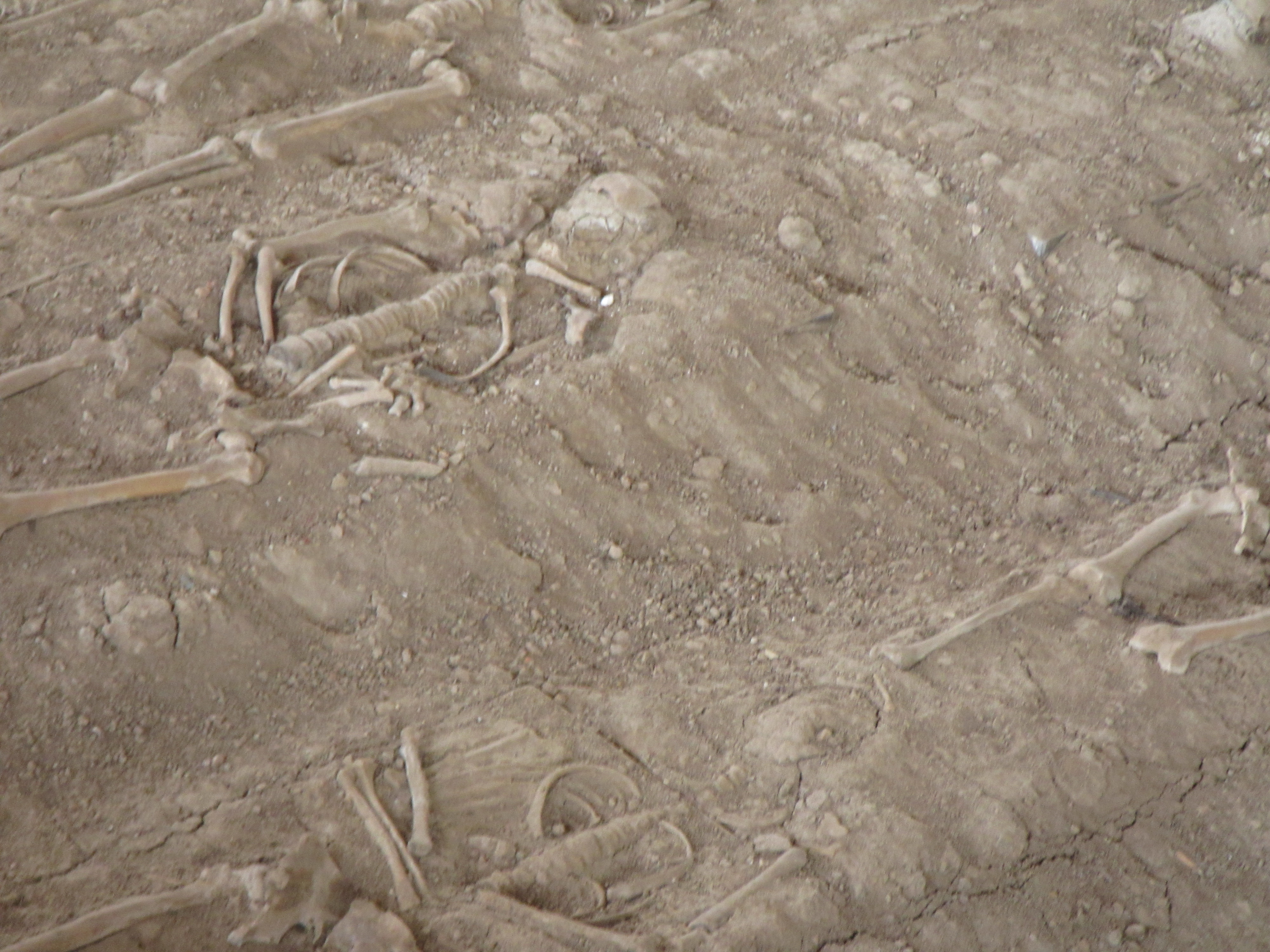
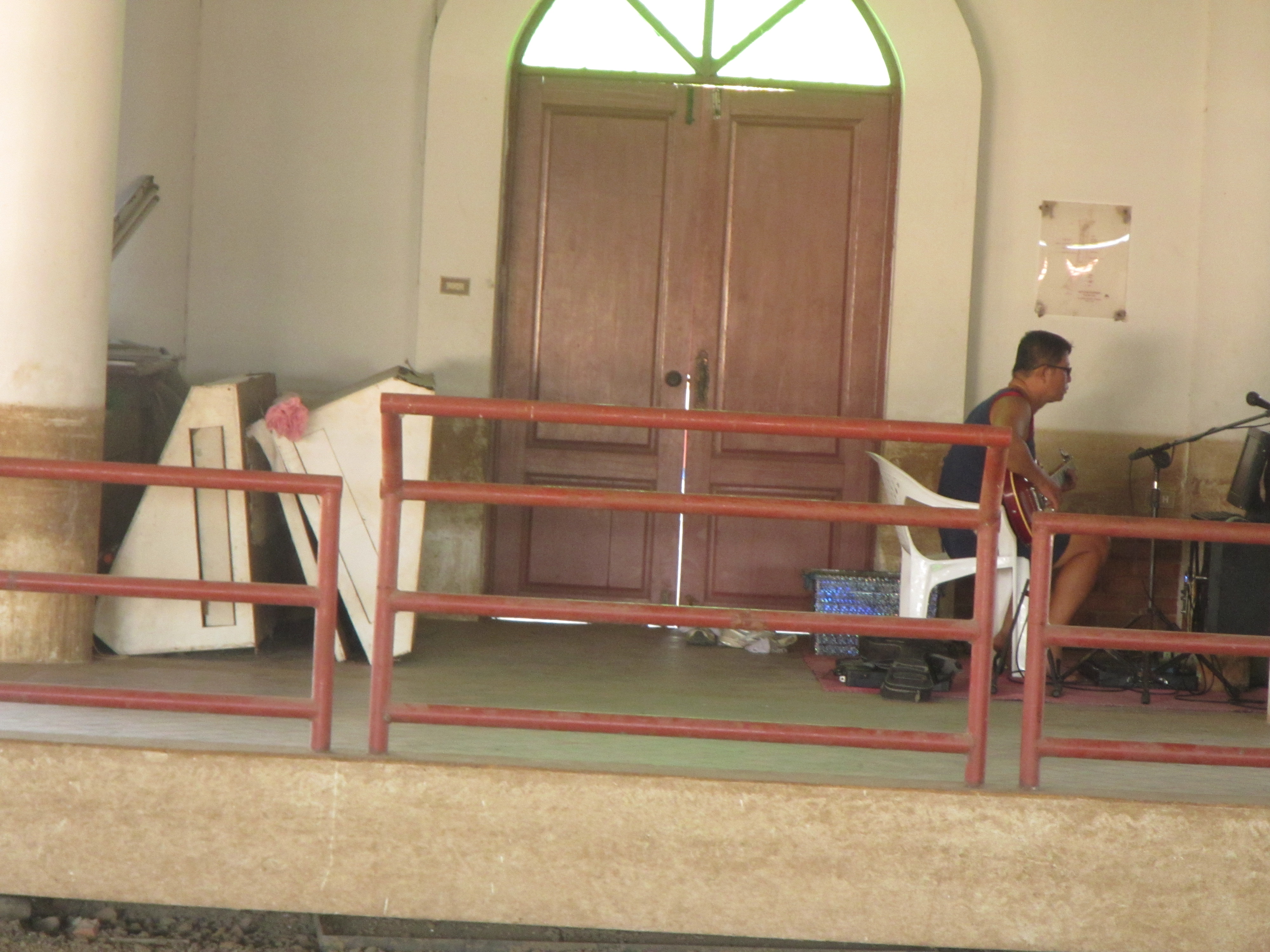
I was really happy to be in a sweet smelling green place, where the only amplified sound was a few moments of a muzzein noting a time of prayer for these folks. I bought some satay, sticky rice and a tamarind soda from some smiling women at a roadside stand. I then biked to the ruins of a Portuguese settlement, where a man was practicing electric guitar ballads next to the excavated skeletons of European merchants.

12.31.2012 114

12.31.2012 115

It was a good ride. The Professor and I took the rest of the day easy. Good thing: the overnight bus to Chiang Mai that night was a freezing cold, loud, bumpy 12 hour experience. But we survived and are now happily settled for a couple of days.

– The Private Eye