RSS

Category Archives: Uncategorized

To Yurimaguas, March 14

On the 14th, we flew to Tarapoto, and from there took the local tuk-tuk, called a mototaxi, to a gas station where lots of men were hanging around. One of them was the driver of a collectivo, a sedan which will make the drive to a given destination when it has four passengers, or their equivalent fare. We rode with one other passenger, choosing to pay more rather than cram a third person into the back seat with us and our things, which we were too mistrustful to put in the trunk. Pretty much everyone, from books to locals, agrees that your possessions are not safe in Peru, as sneak thievery and outright robbery abound, to say nothing of burglary.

From there, we drove for two hours to Yurimaguas. On the way, we were impressed by the beauty of the landscape, which as we passed the Cordillera Azul was full of cool highland rainforest, stunning green peaks against a blue and white sky. Later, the land was more agricultural, but still beautiful, and we were impressed by the fact that these poor farming communities were so much cleaner than anything we had seen in Asia. The buildings were remarkably similar – open-air wood houses on stilts, with thatched palm or tin roofs, often with no doors in the doorways and no screens in the windows. But there was no trash littering the area in front of the homes. The packed dirt looked quite carefully swept. The walls had little paint left, if they ever had any, but they seemed as though they had been scrubbed or brushed, with no stains or even rainspatter. It made me cheerful to see such a place. I imagine it is better off than rural Asia – we saw more than a few satellite dishes, and the street lights were both omnipresent and bright.

Not all was perfect, however – we were stopped on the highway at by a group of soldiers. Our driver, who had very good English, said that these men were not police, but that they patrolled the road. Previously, he said, there were bandits at this location, who would rob passerby. Instead, we simply gave these men with machine guns the few soles in change we had in our possession, and we were waived on our way. The thing is, if robbery is an issue, I think it quite reasonable for the police to establish a checkpoint, and to charge a toll for it. The informal nature of this one, though, of course gave me the willies.

Soon, we entered Yurimaguas and were driven to possibly the fanciest hotel in town, where the office of our tour agency was located. We talked with the man the owner had brought in to help with his business, an English speaker who had a lot of experience running touring companies and as a river guide on the other side of Pacaya Samiria, nearer to Iquitos. The man tried to up sell us a bit for more days in the reserve, but after mulling it over we decided to stick with our original plan – 8 days and 7 nights in the reserve. We also met the owner, a man who seemed more quiet at the time, but who I grew to like later over the next day’s boat ride. The fellows set us up in a good room, and we went to sleep, ready to embark the next morning on a river voyage to Lagunas, doorway to Pacaya Samiria.

– The Private Eye
 

A Few Short Words on Lima

Given the distortion of reality that an 11 time zone shift brings, we didn’t venture out much into Lima. After a first night at a business hotel, we moved to Miraflores, an upscale (read: safe) and busy neighborhood for our second night. Lima and San Francisco are not sister cities, but they should be. Lima is of course warmer, but it’s not hot, at least this time of year. Like San Franciso, a breeze from the Pacific cools it. At certain times of year, impenetrable banks of fog move in unannounced and stay longer than welcome, enough so to earn mention in a discourse on the terrible sides of the color white in Moby Dick (which I happen to be reading). It feels good, like home, to have a cool, damp breeze, wide sidewalks, and the roar of the Pacific at the edge of town, with scores of surfers waiting for a good break.

The Private Eye is buzzing with excitement and can’t stop reading her Neotropical Companion. Since she saw that nature program as a teenager, it’s been a life dream to see the Amazon and the pink dolphins. We are almost there…

— The Professor


27 hours later…

After sleeping 4 hours and flying for 27, we’re now safely at our hotel in Lima. It’s a nice hotel targeted at business travelers. We chose it because it is so close to the airport; wandering around delirious from lack of sleep at 111PM seems like a bad idea. We will catch a taxi to a backpacker neighborhood tomorrow, pick up some last minute supplies (Imodium, batteries for head lamps, SIM card for the phone). Day after tomorrow, we fly to Tarapoto and start our journey into the rainforest. The Private Eye used her Spanish in the cab ride; when she explained to the female driver that she speaks a little and I don’t, the driver said that’s the best situation. 🙂

But now it is time to sleep.

— The Professor


Peru bound!

It’s our last day in Asia. We have a 7 AM flight tomorrow to Lima (through Tokyo and Houston). Due to the dateline we depart 7AM on the 12th and arrive at 10PM on the 12th (total transit time is 27 hours). Trying to find a room at midnight when completely exhausted is an easy way to be robbed, so we booked something for our first night. We have one day in Lima then fly to Tarapoto on the 14th, from which we take a bus to Lagunas, spend one night there, then head into the Amazon for ten days.

Today, we went to The Expat Teacher’s school and talked with kids at lunch about our careers. We’ve sent off our last package home, and now have slightly lighter packs than when we started, since some clothes will not be needed in the rainforest.

We watched Lincoln last night and had a discussion about why we found it riveting but Mr. Expat Teacher’s students (he teaches history) find it boring. I think it’s a bit like Dickens – because the language is subtle and at times playful, you have to enjoy that kind of word play. Just a hypothesis.

We will be home in just over two weeks – I have started to have to handle a few work things (arranging a course I am teaching in the spring) since we will be completely disconnected once in the rainforest. I am so glad that we spent the effort on this blog, not only for the benefit of our friends and family, but also so we have detailed memories we can re-read. I chatted with my department chair before I left, and she commented that her family was on the 5 year anniversary of their year long travel journey; each day, they sat down together and looked back on where they were five years ago, recalling many details and reliving the experience. Maybe we should try the same thing in 2017-18.

— The Professor


English Subtitles Most Wonderful

Our last night in Phnom Penh, we turned on the TV in our luxurious room (AC! Fridge! TV! Free laundry!) and encountered a kung fu movie involving a child monk, an old and wizened master, and a villain with spiky shoulder pads. The action sequences were not great, but the English subtitles were fantastic entertainment:

“The teacher empty senior the big defeats thief’s person greatly and courageously.”

“Higher than that thief’s person’s effort… That why would you be anti- to win. So a should have another to losing a teacher sad BE is not. However I still needed to give public recognition today empty. The is empty you beat today the very brave dozen have to be good.”

“The first teacher can teach me a to recruit extremely. The second teacher can give me adjust a bed. Master’s elder brother’s feet were too smelly.”

“This still doesn’t hurt that on the whole how just hurt on the whole. I have already dashed in to chase little LIN2 SI4 YI2 as flat ground.”

— The Professor


Dance in Bali, Java, and Cambodia

We’ve seen dances in three different cultures: Java, Bali, and Cambodia. Rather than discuss the differences, I thought I’d just give examples. These are from Bali:

Java (sorry it is sideways):

Cambodia:

— The Professor


Bangkok, Revisited

We’ve returned to Bangkok, this time arriving through DMK rather than BKK – we now rely on low-cost carriers, the JetBlues and Southwests of Southeast Asia rather than the Uniteds and national airlines. We left Bangkok months ago after a night at The Expat Teacher’s home and a hike through a national park, with the Silamander. On our return we headed to Soi Rambuttri, a backpack enclave, found a room, found noodle soup from a street vendor, and now sit in our room playing Ticket To Ride. Saturday and Sunday night we will be back with The Expat Teacher for some weekend catchup.

— The Professor


Calamity and quibble

The calamity, of course, is the bloody reign of the Khmer Rouge. Yesterday we went to the Tuol Sleng museum, where the regime tortured its countrymen, and to the memorial park at Choeung Ek, where the regime then murdered them. Each is one of a series of such places in use in the late 1970s – today, the symbol for them all.

I feel inhibited writing much about history that I don’t know all that well, and from highly derivative sources at that. You can read about the Khmer Rouge elsewhere. I will just say that it killed more than a million – likely millions – of its own people as it took power, purged dissidents, and then turned in on itself with such viciousness that in 1978, 300 or more people a day were murdered in Choeung Ek, many of them the Khmer Rouge’s own officials or military. Those numbers included vast numbers of women and children, in a move designed to eliminate the possibility of family revenge – all of a targeted person’s family was destroyed.

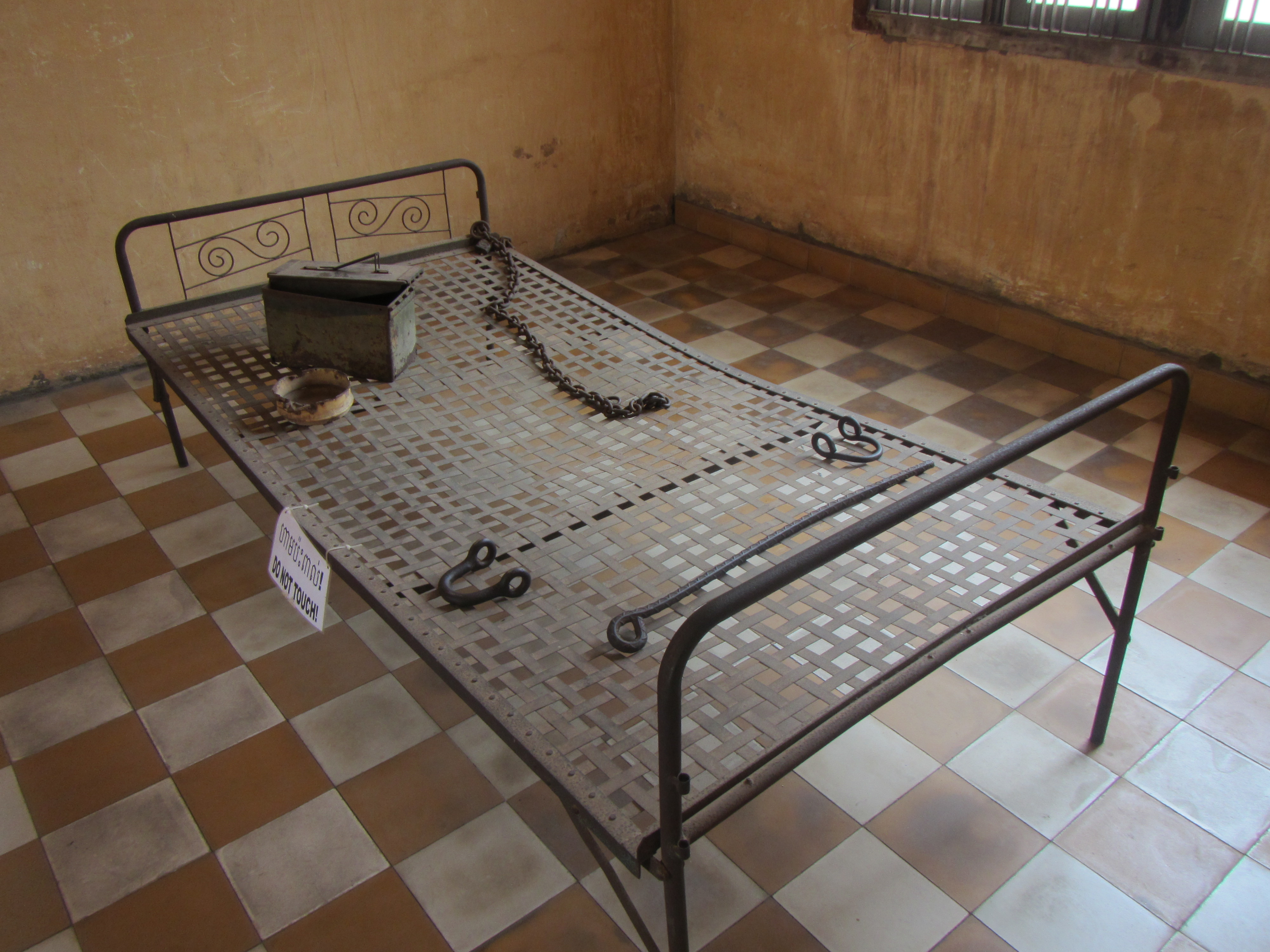
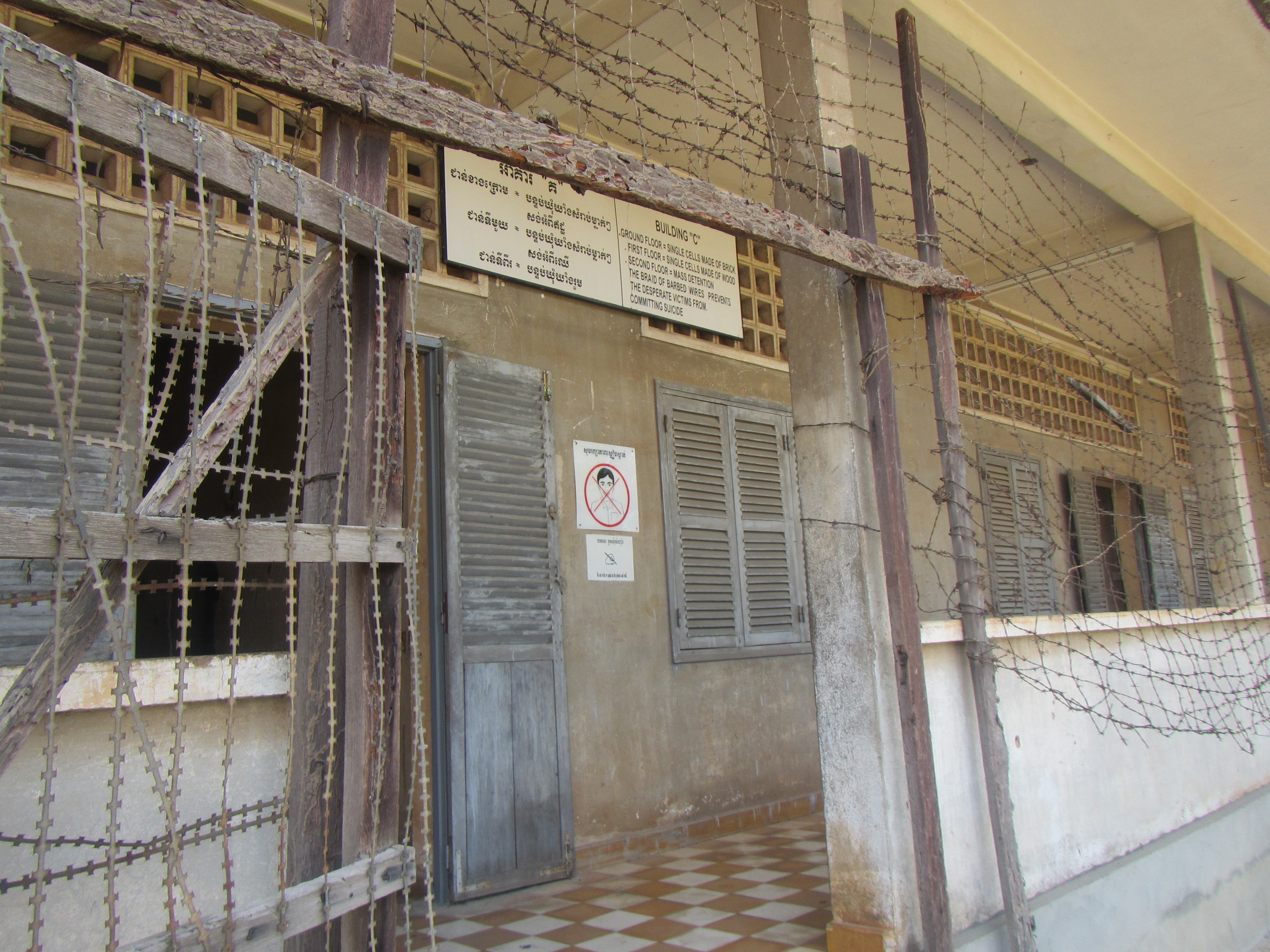
Tuol Sleng itself had been a school prior to its use as holding cells and torture chambers for supposed dissidents. It is easy to imagine eager pupils in the cool cream and terra cotta tiled classrooms, with the windows looking out on leafy streets and a courtyard. But the museum has left the metal beds there, and the shackles made of rebar, and the empty munitions boxes. On some of the walls are photos of the last 14 corpses found in and around those beds when the place was liberated. There are bars on the windows, and when I saw a sparrow fly in and around the room, I wondered how many birds the prisoners had seen, and if their unhampered flight brought comfort or despair. I am guessing the latter, because the prisoner were underfed and shackled to their beds, and probably couldn’t reach the sparrows to eat them.

IMG_2786IMG_2754

Some of the classrooms were built out into dozens of little brick cells, each basically long enough for a man to lie down in, and a chain sunk into cement on the floor.

IMG_2790

The most powerful part, of course, was the hundreds of photos in some of the rooms. Numbered prisoners, men, women, and children. Bright faced young children conscripted for the cause, turned into child soldiers, prison guards and murderers, in fear of their own lives if they didn’t cooperate.

I love people. I love listening to their stories. It’s why I am a private eye. Looking at the faces, I could imagine so many personalities – that smart young man who has trouble with his temper. That girl with the lazy, confident smile of a hippie chick. That woman, my age, with my haircut, but with a more aged face, probably a grandmother, with a whiff of good sense about her. The honest man who has finally gotten mad and stares into the camera defiantly. So many faces. Most dead, and the others living with the memory of what they did to stave off death.

I got very quiet when I saw the photos of intellectuals. In such a revolution, The Professor and I would be among those first up against the wall.

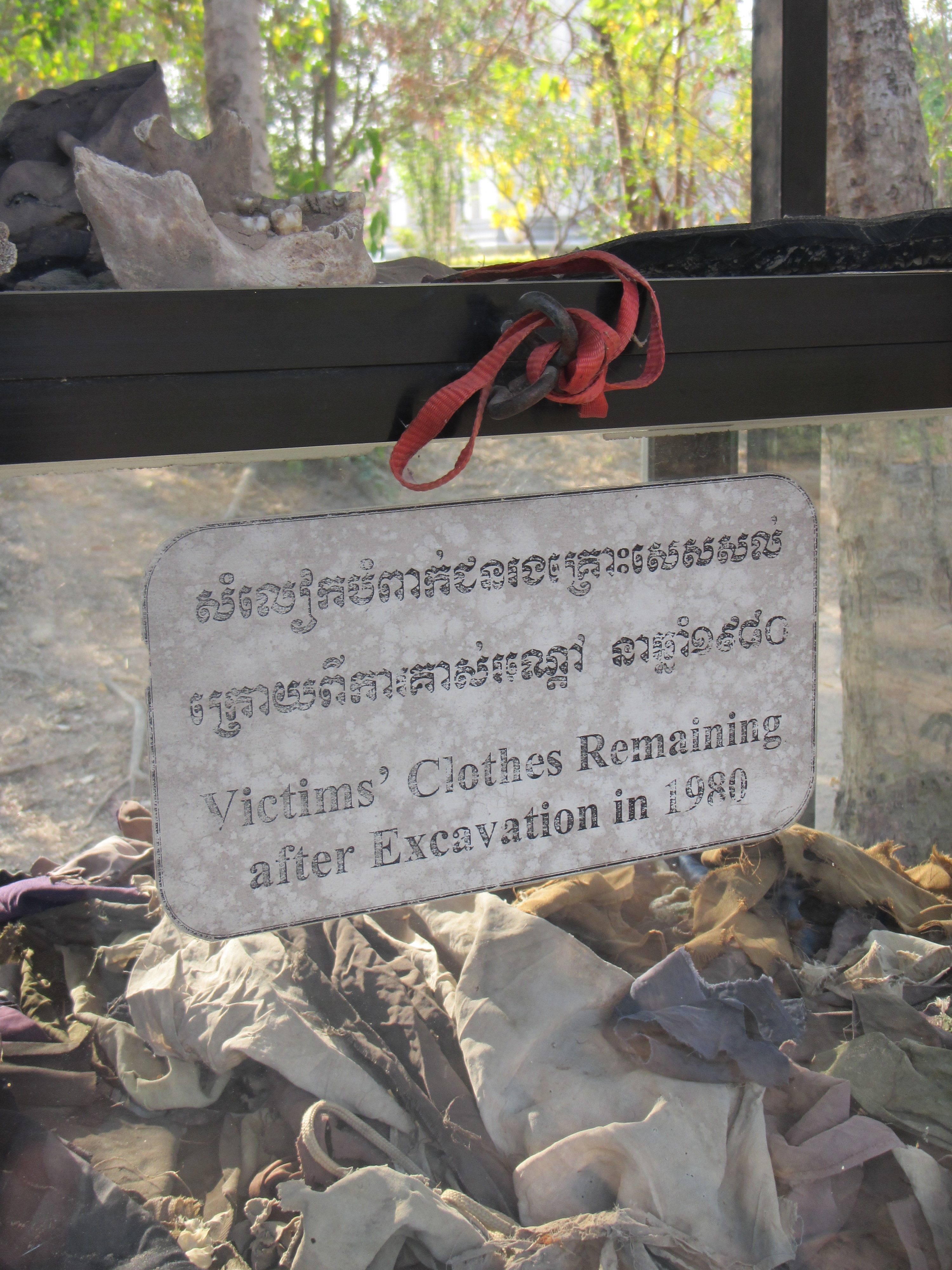
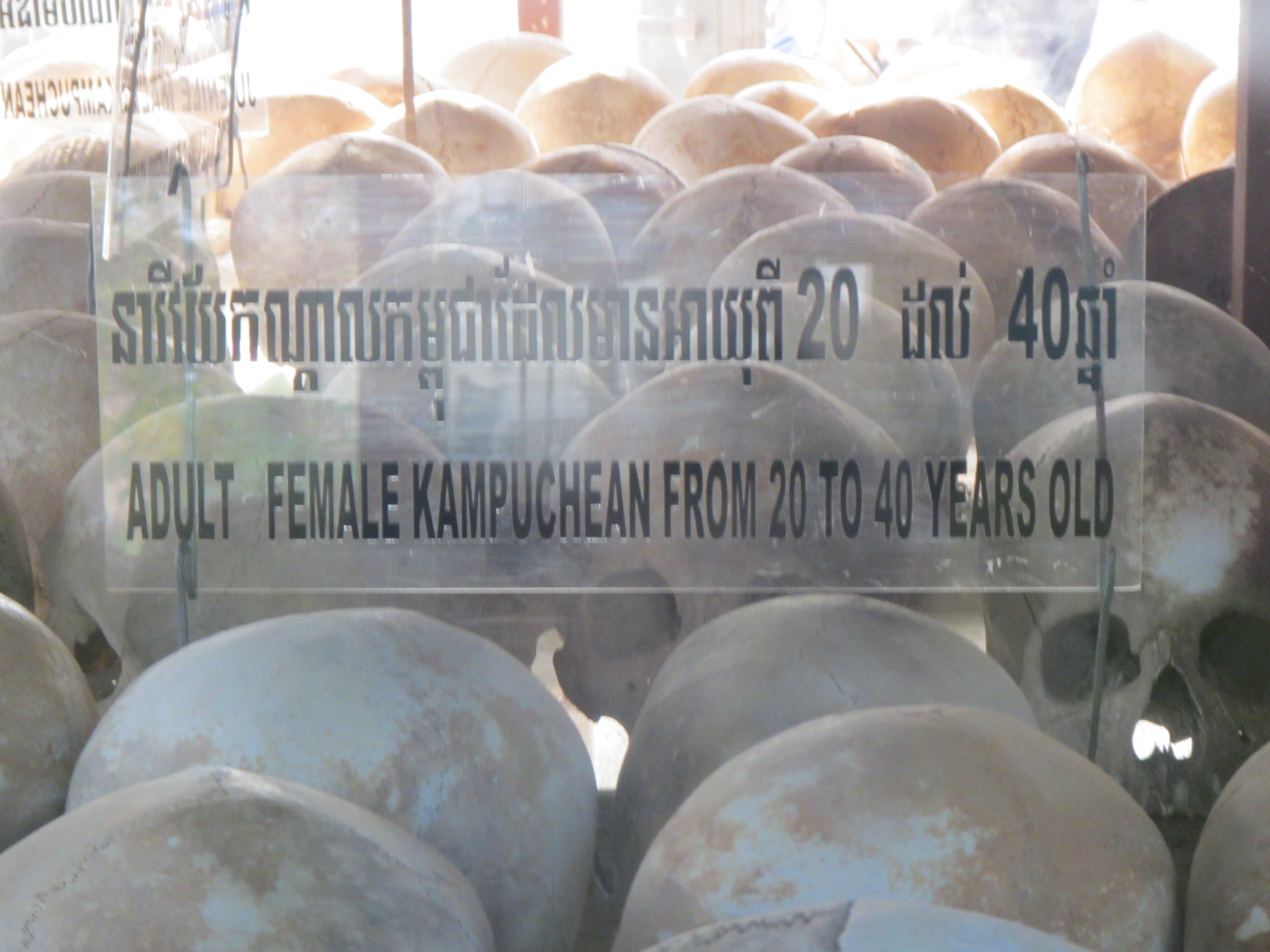
After touring Tuol Sleng, we went to Choeung Ek. It is a pleasant country place, surrounded by rice paddies, orchards, white hump-backed cows, and lotus root ponds. In the middle of the field stands a great tower of a stupa, its glass faces filled with skulls exhumed from the mass graves in and around the field. The audio tour is fantastically informative, giving information about the use of the site itself, about the history of the Khmer Rouge, stories of survivors and perpetrators of atrocities, and even a piece of classical music composed in response to the atrocities.

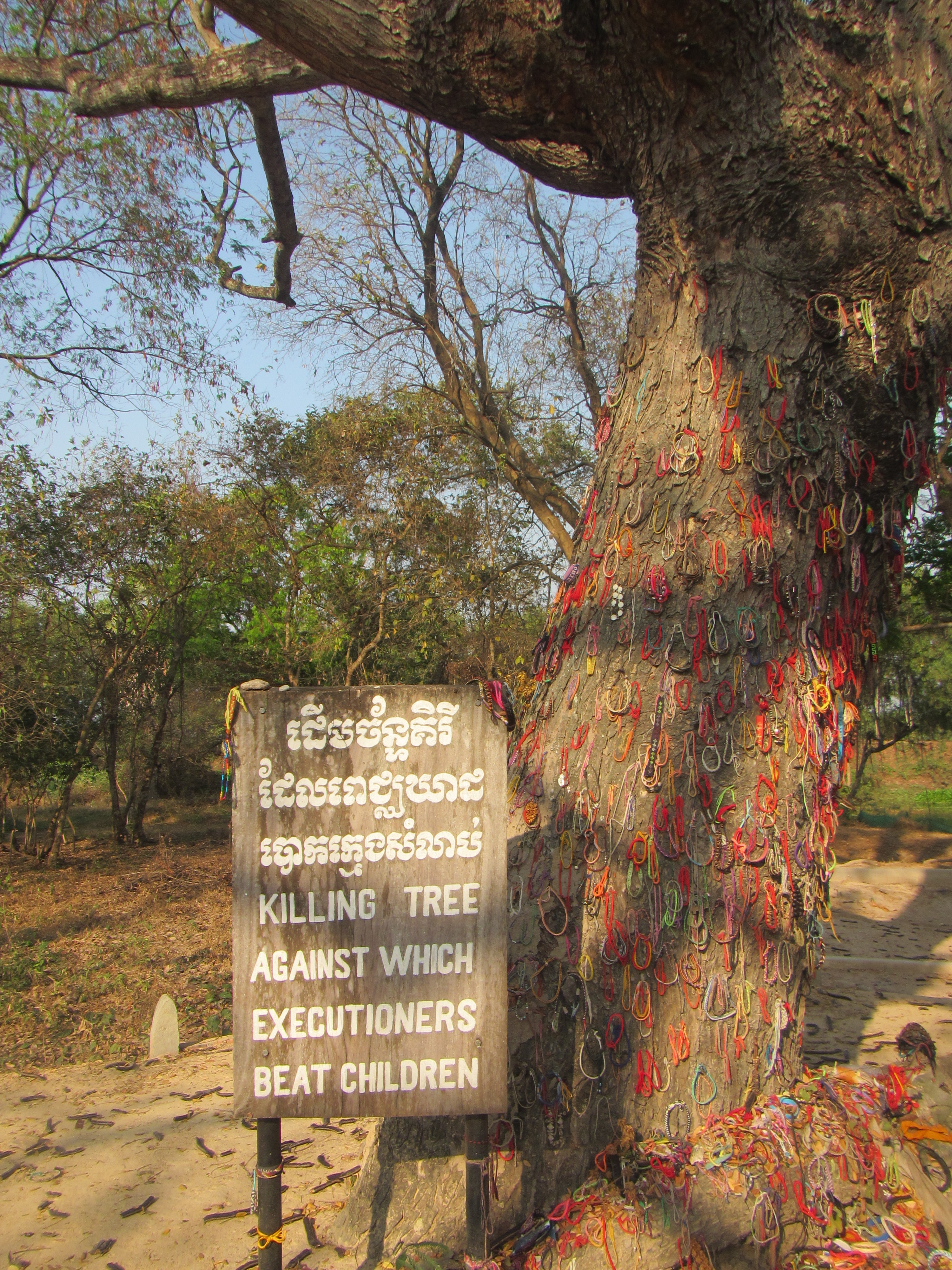
Being informative, it tells you just how bad the whole thing really was. Hideously bad. Shockingly bad. Babies-smashed-against-a-tree bad. They-used-farmtool-clubs-instead-of-expensive-bullets-and-then-DDT-to-finish-the-job bad. They-played-revolutionary-music-on-a-loudspeaker-while-killing-people-one-by-one bad.

IMG_2808IMG_2806

Sometimes people have told me I am too paranoid. It goes with the territory, I suppose, but I cannot look at such history and have any illusions that things are always going to be all right. You never know when something terrible will happen, and destroy your life and all you love. You have to make the most of every moment, and be wary enough to dodge before the gun is lowered against you, and fight politically for a just society. You shouldn’t live in fear, but neither should you live in the expectation of safety. What little we have has been painstakingly built through civilization, and this is why I get angry when some people, mostly men, predict the collapse of civilization with a gleam in their eye, as though they look forward to it. Anarchy means the strong will rape and kill middle aged women like me. Look at the evidence.

IMG_2813

– the Private Eye

PS – the governments of the West all supported the Khmer Rouge for decades because they opposed the North Vietnamese victors. This makes me ashamed.

PPS – the quibble is too stupid to write about after all this. Let me just say that I am a westerner and don’t want to turn all my business transactions into exclusive relationships, and I resent not having autonomy in travel. In short, I want to treat my tuk-tuk like an American taxi and it just doesn’t work easily that way.


Daily Budget in Siem Reap

A previous post mentioned our daily budget in Siem Reap was $80, with $30 for culture. Where does that go? Here’s an example day:

Culture: tickets to view temples were $40/person for 3 days, so ~$30
Room: $8
Morning coffee and breakfast: $4
Bicycle rental: $2
4 large bottles of water: $2
Two coconuts: $2
Sunscreen: $5
Deodorant: $2
Cold Pocari Sweat (Japanese Gatorade): $1
Lunch (splurge, at a fancy western place): $12
Dinner: $5
Shared ice cream cone: $2
One cocktail: $2.50
One beer: $0.50
Two soda: $2

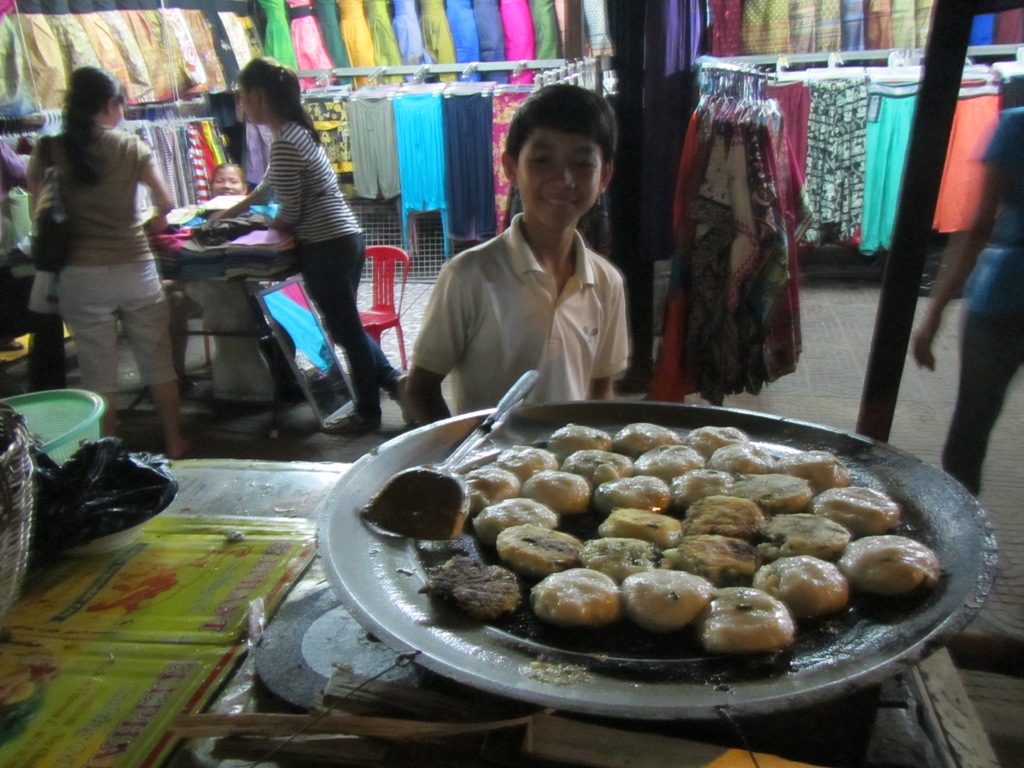
Here is the boy who makes spinach-filled little pancakes (well, when one of his parents is busy), The Private Eye’s favorite street food in Siem Reap ($1 for 3, with sauce):

Singapore-KL-SiemReap 016

— The Professor


Landmines

Cambodia’s severance from history is made much more acute by the atrocities of the Khmer Rouge and Pol Pot in period after the Vietnam War until the late 1990s. Accounts vary, but the goverment killed between 1.2 and 2 million people – approximately 10% of the population. Monks, intellectuals, anyone who could define the country culturally. Nearly 7000 temples were destroyed. In a period of 25 years, the Khmer Rouge destroyed almost all of the historical and cultural record, written, oral, and architectural, of Cambodia. The history and historical identity of the country was severed quite explicitly, suddenly, and intentionally.

The wars and conflict affect Cambodia today physically as well. There are many fewer treks here and minimal wilderness tourism compared with other countries we have visited, because the countryside is sprinkled with millions of mines and unexplored bombs. Many of these are American, placed in this country to stop the North Vietnamese supply-line alone the Ho Chi Min Trail through Laos and Cambodia during the Vietnam War. Many others were placed by the Khmer Rouge and the Vietnamese when they invaded. I encountered at least a half dozen beggars in Siem Reap who were missing limbs, claiming (and mostly likely truly) the cause was landmines.

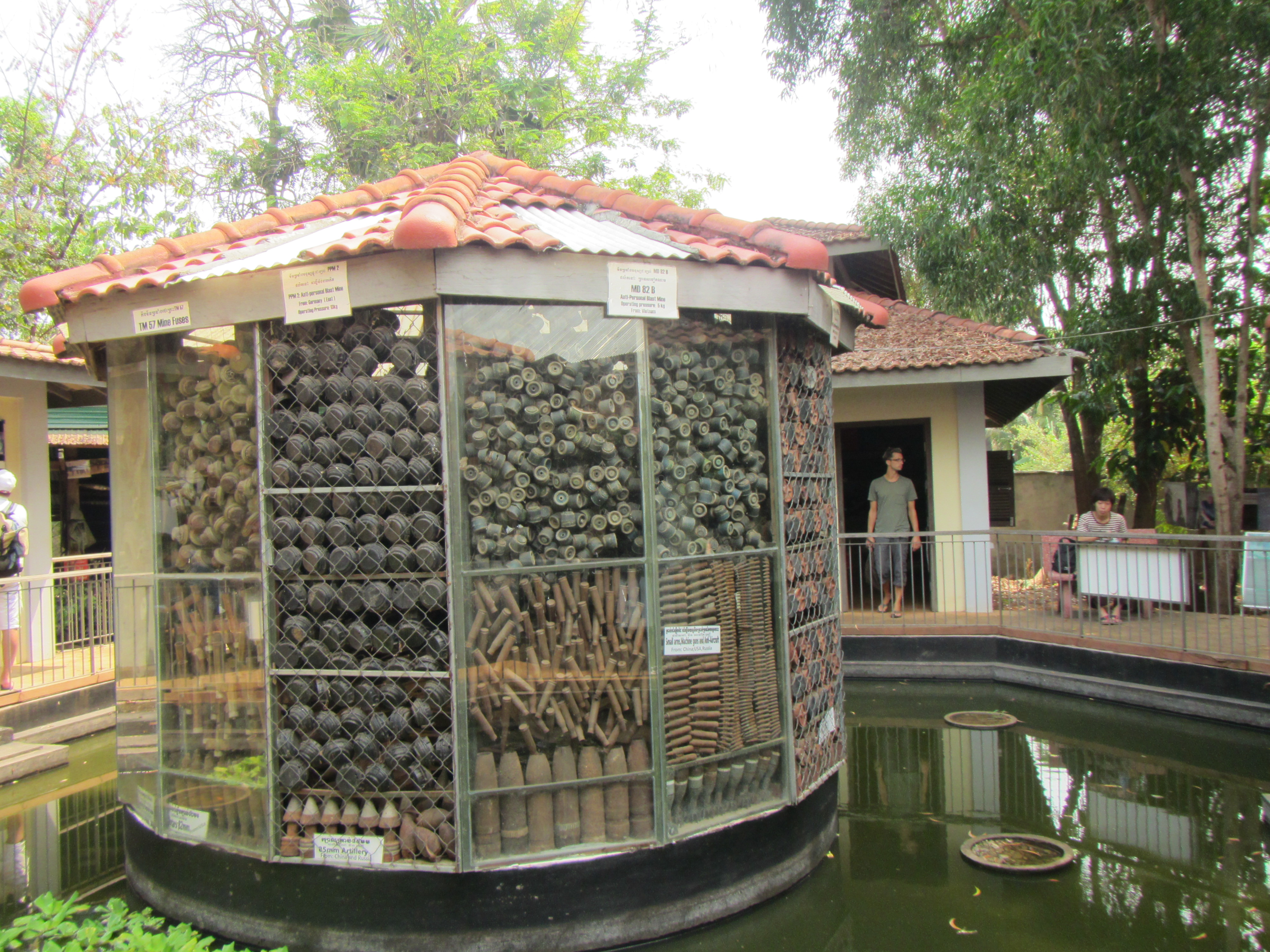
We went to a museum today that detailed one man’s efforts to help rid his country of this unexplored ordinance, or UXO. Aki Ra is famous for his personal quest – he has received numerous international awards and honors. He was taken as a child by the Khmer Rouge and his parents killed when he was 5; he spent over a decade fighting and laying mines, first for the Khmer Rouge, then against the Khmer Rouge, then for the Vietnamese. He chose his name – it is one of many that different people have given him (Akira), the one he liked most, and so he made it his own. He began clearing mines from around Siem Reap, and made a small museum near Angkor Wat of his efforts and the challenges Cambodia faces. The museum’s proceeds support a child care center for children injured by landmines.

IMG_2639

The idea that the wilderness is open and (for the most part) safe is something Cambodians can’t share. Wandering through fields, woods, or remote areas has the very real and commonly experienced threat of a explosive device. Some people seek them out, because the explosive and metal can be sold.

What chills me most about the Khmer Rouge is that it happened in my lifetime. The landmine museum compared it to the Holocaust, Rwanda, and Bosnia in scale and duration. In the moment, it’s easy to ignore the atrocities going on in the world. But after the fact, when the scale of the horror is clear, I wonder how we could have stood by and let it happen. It is hard and a problematic for individual nations to intervene, as then national agendas come into play. I understand (but don’t agree with) a conservative American objection to the United Nations, that it subverts national sovereignty, but it seems to me to be the organization best suited to protect people from governmental slaughter. After reading about Timor-Leste and the UN involvement, my feelings about Indonesia are more… complicated.

— The Professor