RSS

Category Archives: Uncategorized

Endgame Plans

We have finalized our plans for the end of our time in Southeast Asia. Our time in Siem Reap has been so fascinating that we want to spend some more time in Cambodia. So no quick trip to Vietnam. Instead, we are heading out this afternoon (Tuesday, March 5th) to the capital. Phnom Penh, where we hope to learn more about Cambodia’s history and the Khmer Rouge. We have a flight back to Bangkok on Friday. We will be spending Friday night in Bangkok proper: we figure we should experience it at least one night as backpackers in a guest house, and there are a few last errands we want to run. Saturday we will be heading to The Expat Teachers’ for the weekend. We will be meeting with students at their school on Monday, then flying out super early on Tuesday for Peru.

We splurged on our transit to Phnom Penh: a VIP bus with water, AC, wifi, and a free snack. $12 a person for a 6 hour trip, the extra $4 over just AC seemed worth it. Hopefully we will write an update or two on the ride, such as about the landmine museum, the silk farm, or the very cool rooftop restaurant we played pool at last night.

Singapore-KL-SiemReap 025

— The Professor


Cambodia: Siem Reap

When we departed for Southeast Asia, we had very few entries on our must-do list. There’s a trade off here. If you prepare a lot and figure out exactly what you’re going to do and you are unlikely to waste much time. But you’re also unlikely to take advantage of opportunities or discoveries as they arise. In our usual travel schedule, which for practical reasons is typically is 5-6 days, we try to follow the guideline that each person has one MUST, something we will so or do come hell or high water. For example, when we went to Paris, for The Professor it was the catacombs, for The Private Eye it was the unicorn tapestries at the Cluny. Of course there are lots of things we would like to do, but it’s OK if we don’t get to all of them, while missing a must is a calamity. Given the length of this trip, we gave ourselves a bit more flexibility than just one must each, but tried to keep the list short.

Angkor Wat was near or at the top of the list. Everyone who has traveled to the region and visited it almost always names it first. The Secretly American Englishman told us stories; The Professor’s Traveling Teacher Cousin recommended several days; almost every backpacker we’ve met has either been there or has it on the itinerary.

Our original thought had been to go early in the trip, perhaps after Laos. But the chilliness of Luang Prabang led us to yearn for beaches, and so we headed to Ko Tao and resolved to make Angkor Wat a bookend towards the end of the trip. And so, after the culture of Bali, the beaches of the Gilis, and the fast-paced modernity of Singapore and Kuala Lumpur, we flew to Siem Reap, Cambodia, the city a few kilometers from Angkor Wat and the center of its tourism industry.

The change from the metropoli of Singapore and Kuala Lumpur was wonderful. Here in Siem Reap, we are back in backpacker country, where a restaurant meal is $3, a beer on tap is 50 cents, and street food is typically $1. Our room, with daily cleaning and a fan (but no AC) is $8. Our daily budget is $80 for the both of us, thirty of which is for culture (museum tickets, passes to the temples, etc.).

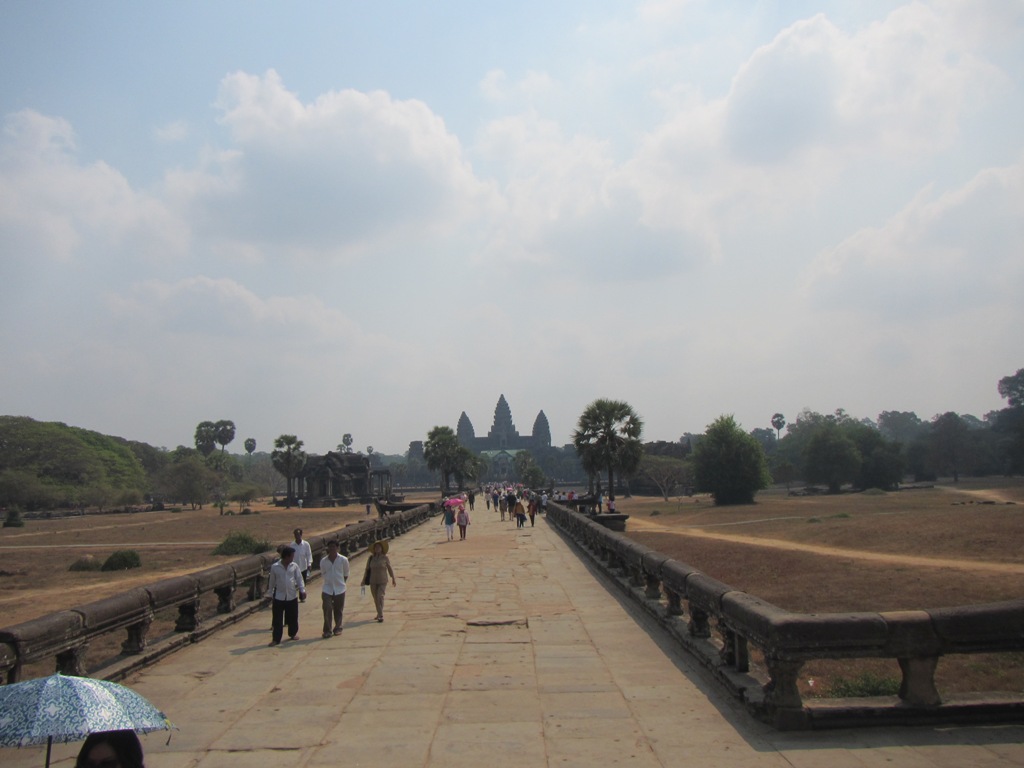
So what is Angkor Wat? If you don’t know, don’t worry – neither did The Professor until his Traveling Teacher Cousin mentioned it. Angkor Wat itself is an enormous temple, built in the 12th and 13th centuries at the height of the Khmer Empire. It is the largest religious structure in the world. But Angkor Wat is not alone. Around it are a multitude of other holy sites and temples of tremendous scale and intricacy, from the holy city of Angkor Thom to the lake temple of Preah Neak Poan. To give an idea of the scale: the lake temple is one of the minor sites, consisting of an artificial lake that is 900 meters long and 3.8 kilometers wide. That’s approximately 3.5 square kilometers of earth that was dug to a depth of several meters, in the twelfth century, so by manual labor. The Pyramids are enormous in their scale: now imagine if they were covered on every surface with intricate carvings of religious and mythological scenes. Some of the sites, such as Angkor Thom, cover square kilometers. These aren’t places you can view on foot – you either hire a tuk-tuk or use bicycles.

Singapore-KL-SiemReap 020

Our first day, an early flight out of Kuala Lumpur meant we were quite exhausted. So we found a place to stay, searched for good bicycles (knowing we would be on them a lot) for $1 a day, and explored Siem Reap a bit. It seemed like a really pleasant place, insofar as the people are friendly but much less pushy, selling-wise, than in some other places we have been.They’ll try to convince you to buy, but also appreciate when you joke about why you can’t ( “No tuk-tuk, we are already here!”) and will sometimes make jokes of their own (“best price, $1000 for you!). There is a river park running through the middle of town, and while the town isn’t fancy it seemed quite comfortable.

In short, a great place from which to go on marvel-viewing excursions. We have done three days of temple gazing. We took one day off in the middle to go to the National Museum, to get a helpful dose of knowledge to inform our second and third days.

The temples were built during a time of religious transition from Hinduism to Buddhism. Angkor Wat itself was build as a monument to the Hindu preserver of the universe Vishnu, but was converted to Buddhist use and remains a religious site. This means that there are monks who come to visit and take pictures, just like regular tourists! It also means that, unlike all the other temples with their spotless park-run toilets, you have to pay to use the bathroom at Angkor Wat.

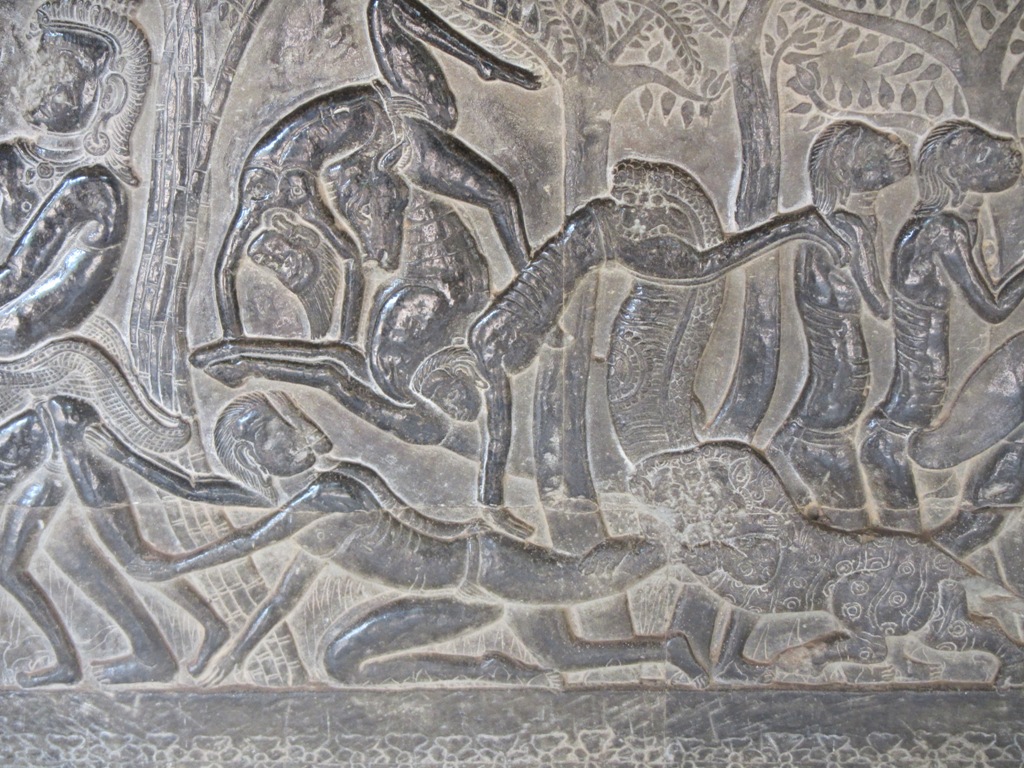
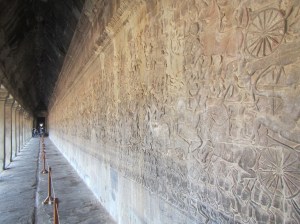
Not that that matters, of course. The building itself was awe-inspiring, a flaming mountain of stone covered with reliefs depicting stories ranging from the Ramayana to the Churning of the Ocean of Milk, a story as to how the gods and demons working together created the elixir of immortality. Additionally, there are endless reliefs of apsaras, beautiful dancing nymphs. We visited it twice, once at dawn when we watched the predawn light from a small, quiet structure with just a few other folks, and once in the late afternoon, when we climbed to the highest level and then descended and watched the clouds turn clear yellow over the walls from the eastern gate.

Singapore-KL-SiemReap 017

Atmospheric animal of the dawn: the white horse sleeping in the field near our mini-temple vantage, who would shake his neck with a jingle of bells every few minutes.

Educational animal of the dusk: the big monkey who robbed the Private Eye of her half-full large water bottle. Having faced off with a monkey for shoes in Luang Prabang, she found herself unwilling to risk a bite over a water bottle – thus encouraging the animal to rob more tourists, as The Professor has accurately pointed out. The monkey promptly opened and drank the contents of his robbery.

In contrast to the Hindu Angkor Wat, Angkor Thom is actually a walled city, with a central temple Bayon, which is covered with giant reliefs of Buddha’s face (said to strongly resemble the king). We explored the Bayon and the rest of the city after watching the sun rise over Angkor Wat. Only the stone structures remain, and a dry and flower-scented forest has grown up where houses and shops and even the wooden palace used to be. Being as it was 7 am, we had some of the smaller temples to ourselves, or almost. At one, a police officer was waiting. Assuming him to be on duty, we asked if we could climb the pyramidal structure. He said yes, and began ascending with us, and then The Private Eye remembered that this could be a scam that a guidebook had warned about. So we got off of the little temple, declined to light some incense with him, and got out as quickly and politely as we could.

Singapore-KL-SiemReap 019Singapore-KL-SiemReap 018

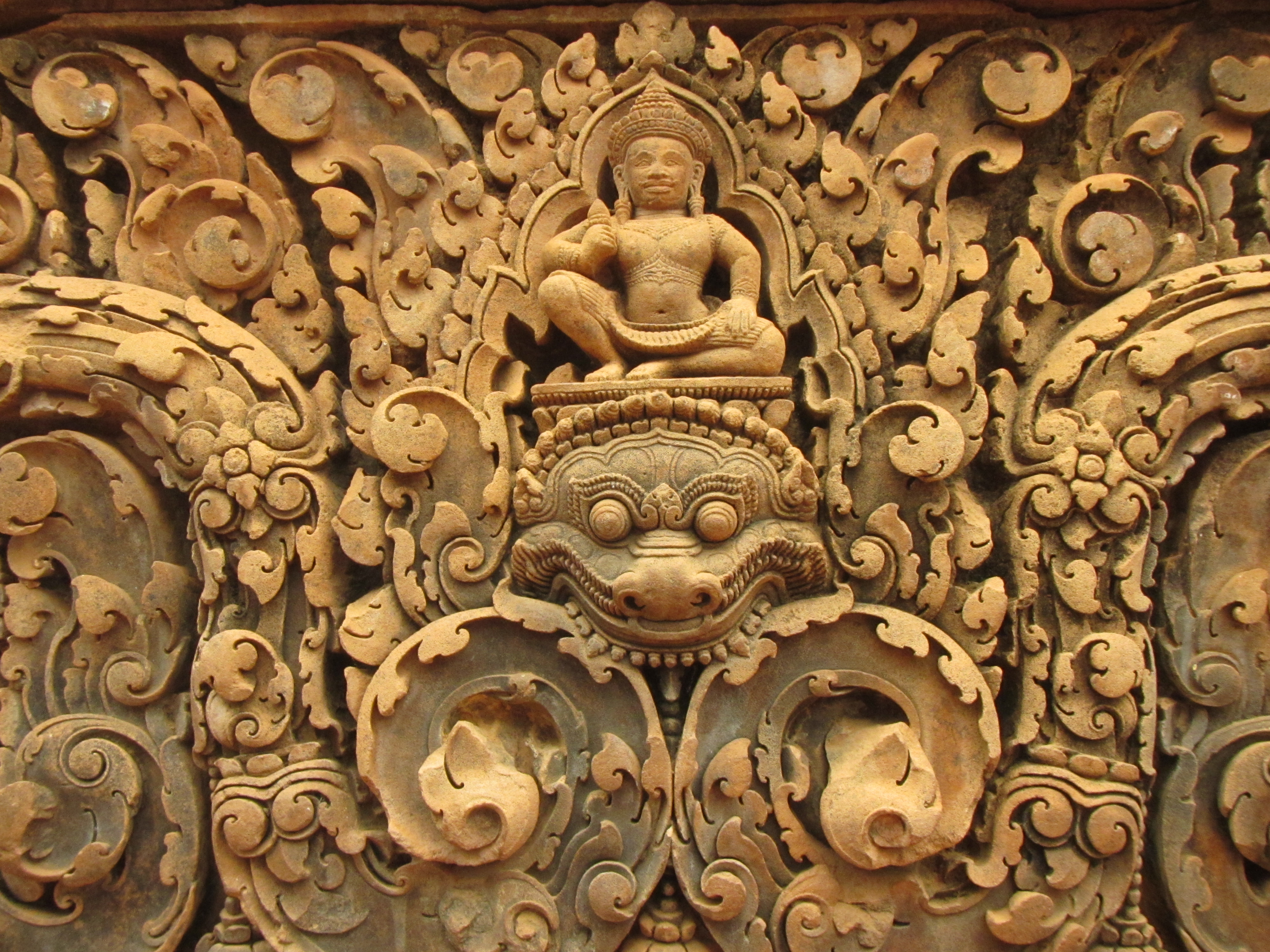
Yesterday, breaking from our usual habit of bicycling everywhere, we hired a tuk-tuk to take us to Banteay Srei, a Hindu temple carved of beautiful pink in sandstone In very intricate reliefs. Though a smaller temple, it was very much worth the trip. Each doorway featured a different scene from the Hindu religion, and they were NOT all the Ramayana. The flowers, the garlands, the apsaras, the monster faces, everything was just beautiful. And though it probably was not actually “built by ladies, no man’s hands could do that work”, we liked that it is presently called the Lady Temple anyway. It was not commissioned by the king, unlike the other temples – it was instead commissioned by an educated man, an advisor to the king, who clearly had wonderful taste. Apparently that particular pink sandstone is also better for carving than other stone.
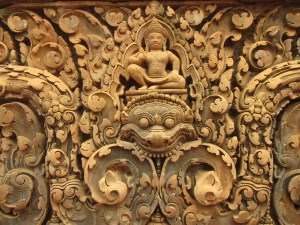
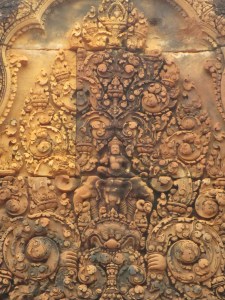
IMG_2605 IMG_2590

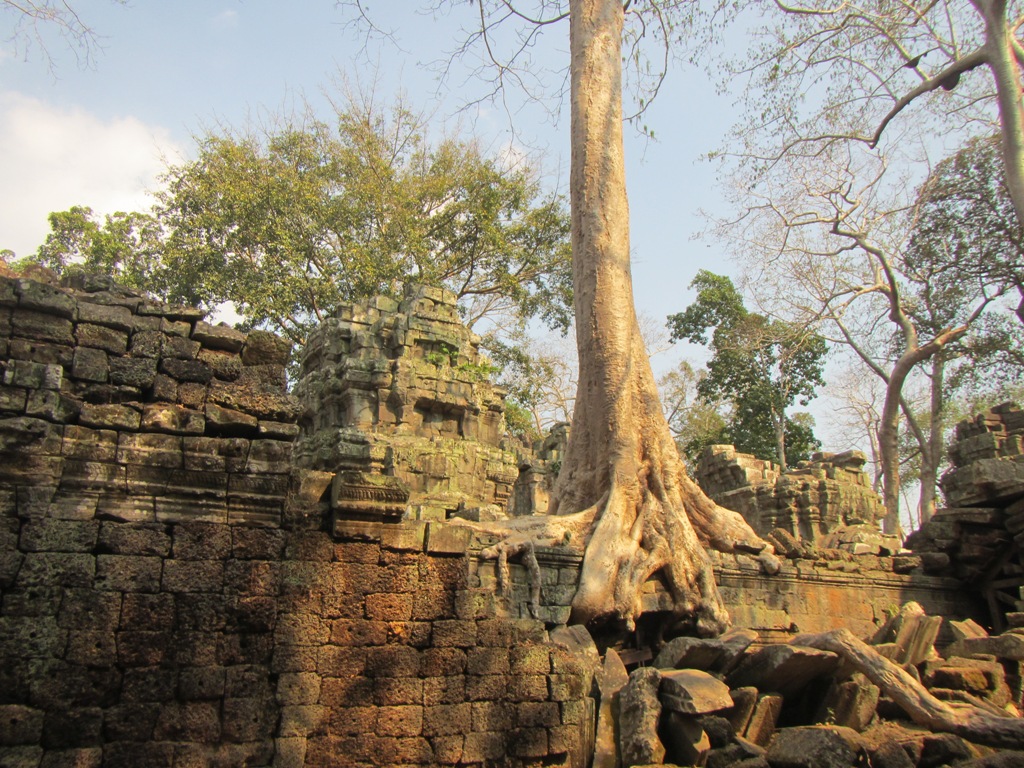
The Professor’s favorite temple: Ta Phrom, eerie in how it is overgrown not by vines, but by enormous trees that grew over decades or centuries:

Singapore-KL-SiemReap 015

What’s amazing about all of these temples, in their scale and number, is that the civilization that built them collapsed and abandoned most of them, much like the Maya abandonment of Tikal. We have read some claims that Angkor was the largest pre-industrial city in the world, larger than Rome. But unlike Rome, we know so little about it. Besides the carvings on its stone temples and the narratives of Chinese traders and diplomats, no written records survive. Why does Angkor Wat face west? When was it completed (we know approximately but not exactly)? We don’t know exactly why the Khmer Empire collapsed, though we know some of the historical factors concurrent to that time, such as the rise of the Thai empires, the Black Plague, and other events that must have impacted what had been the largest empire of Southeast Asia. Some of these temples, which must have taken thousands of people working for years, were completely lost and forgotten. Imagine living in a country that was once the greatest empire in Southeast Asia, but that being part of your identity is near impossible because nothing is known about it. So tourists come to wander these ruins, whose intricate carvings tell Hindu and Buddhist stories, and the only way to connect with them is in the present and the now, since the past is closed off.

Singapore-KL-SiemReap 022Singapore-KL-SiemReap 021

– the professor and the private eye, tag team


Unsolved mysteries of the Straights and the Archipelago

A few things we never did figure out during our weeks in Indonesia, Malaysia and Singapore:

1. Why are all t-shirts “oblong”?

2. What is up with all the faux Native American stuff? Kickapoo Soda, the “real American” “joy juice”? Apache brand? Stores of touristy Native American stuff like feather headdresses and peace pipes? Is there a factory for that crap here? One man in Yogyakarta told me that it is because their own tribal peoples in Kalimantan (Borneo) have similar dress, and once I saw some dancers from Borneo in the Chingay parade in Singapore, that made some sense. The outfits and feathered headgear did look similar to my untrained eye. But then I saw that there is a wild west show with American-type Indians in Panang, Malaysia. I definitely don’t remember hill tribe village shows in the U.S.!

3. Why is the air conditioning in Singapore and Indonesia pleasant, but frigid in Malaysia? Is it for the comfort of those in observant Muslim dress?

4. How can food be such a big deal and people eat so much yet everyone be so small? Is it because of the poor nutritional qualities of rice?

– The Professor and the Private Eye


Cambodia, Briefly

We have been in Siem Reap, Cambodia for the past few days. Angkor Wat and a huge collection of other mind-boggling temples are a few kilometers out of town, so this is where the tourists stay. A combination of very hot and humid weather, a traffic accident which means power is rationed in the region and so we only have electricity from 6pm-midnight, and a lot of bicycling and sight seeing has precluded us from writing details yet. Today, for example, we woke up at 3AM to eat some breakfast and have coffee before cycling to Angkor Wat to see it at sunrise; we spent about 8 hours in total viewing temples before coming back to the guest house for a nap, then early dinner, and now bed at 8.

The most striking thing so far is that we know very little about the temples (e.g., we do not know why Angkor Wat faces west, rather than east), because, in addition to killing 10% of the population (monks, teachers, you name it), the Khmer Rouge government (under Pol Pot) also destroyed almost all historical artifacts, records, and about 7000 structures (temples). So you have the largest religious structure in the world, and a dozen or so other mind-boggling architectural marvels, and know almost nothing about them. Like, why they were abandoned.

— The Professor


National Indentity

The history of these three nations formed after World War II – Indonesia, Singapore, and Malaysia – provided a contrast of how the past can shape the future. This is something The Private Eye and I have been talking a lot about as we wander, as her posts have alluded to.

First, one thing impressed upon us by the couple we met at Cocktail Cycle in Chiang Mai is that Indonesia is a somewhat precarious federation. On one hand, unity with Java provides economic opportunity and drives growth. On the other, Java is where the power lies, and other parts of Indonesia feel that, at times, they have to march to Java’s drum. So a bit like Germany and the EU, albeit without the wounds and distrust of the early 20th century. This became a bit clearer to me as I read about Papua, where armed uprisings against the government are not unheard of in very recent memory, and to which the government answers with executions of political leaders. I was unaware of Timor-Leste’s separation in 2002; The Private Eye commented that she remembered it, but it was at a time when terrorism was flooding international news out of the headlines.

Bali and the Gilis, while part of Indonesia, clearly had their own identity which was not strongly tied to the identity of Indonesia. This is in contrast to Yogyakarta, where Indonesian history was important and presented prominently. Both are technically Muslim nations, but Indonesia has a breadth of cultures and religions; while many of its citizens are Muslim, it seemed more an element of personal rather than national identity. Malaysia, at least Kuala Lumpur, defines itself very much as a Muslim nation, tying its identity to Islam in the Middle Ages and Renaissance.

This very strong Muslim identity makes sense given its history. Throughout the colonialism of the 15th to 20th centuries, the major point of conflict with European colonial powers was whether the people of Malaysia could continue to follow their own customs and religion. The pattern seemed to generally be that the Sultans would sign a treaty granting trade and military rights in return for cultural sovereignty, which the Europeans would soon break, and conflict followed.

This history of not only colonialism but also cultural and religious meddling sheds some light on Malaysia’s split with Singapore and Malaysia’s laws that favor ethnic Malaysians. Where Singapore was a city and port built by the British in the colonial era, Malaysia was a booming hub of trade when European powers arrived. Portugal’s initial efforts were diplomatic; when the Sultan of Malacca took members of the delegation captive and killed a few, Portugal sent a fleet and took the port by force. Colonialism kept Malaysians at the low rungs of the economic ladder. And so where Singapore wants equality among its ethnic groups, Malaysia wants to correct inequalities encouraged by past colonial politics.

And so, its heritage of Islam suppressed for so long, Malaysia, once independent, strongly asserted that part of its identity. The National Museum goes into the different Sultans and when they converted to Islam; the Islamic Art Museum is more notable than the National Art Museum; the space agency has exhibits tying modern concepts of the cosmos to Islam’s astronomers in Al-Andalus and North Africa. Singapore, meanwhile, looks solidly towards the future, less focused on history from 500 years ago.

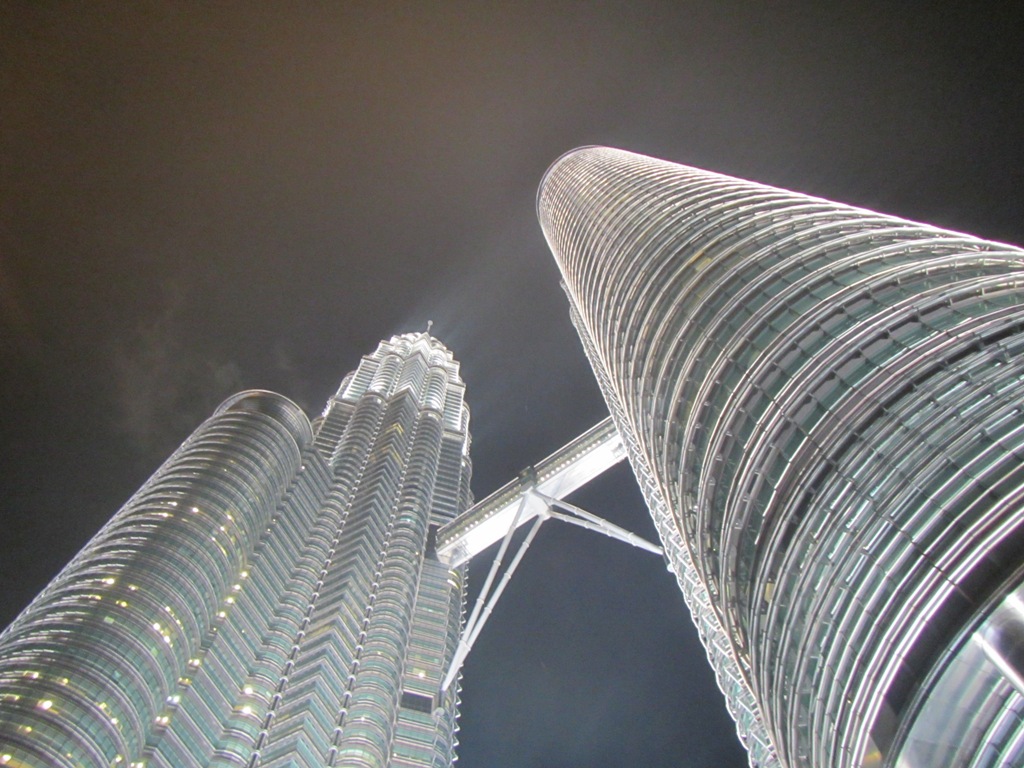
Malaysia is clearly prospering. The architectural icon of Kuala Lumpur, the Petronas Towers, are the office buildings for an oil company. And so Malaysia also shares that aspect of national identity with many Arab nations, although Malaysia also has a lot of agriculture. The Islamic world is vast. Remember World Without Oil, the game played on web bulletin boards a few years ago? I want to go back and see if anyone seriously explored the implications the end of oil will have to Islam.

— The Professor


Kuala Lumpur

Confession time: we totally did Kuala Lumpur in a Hemispheres magazine kind of way, only even shorter.

We flew in yesterday evening from Singapore, booked a decent room in an Indian-run Chinatown hostel, and ate nasi lempak for dinner (it’s a breakfast food) at a semi swanky rum bar with a Korean-looking piano lounge singer and a loud quartet playing cards and getting drunk at the next table over. We then hit the street market, where I bought four pairs of socks for less than $4. How can socks cost less than coffee? Why did I feel like I slipped down a rabbit hole into the ur-Asian city? Anyway, it was a new passport stamp dated to The Professor’s birthday, woo hoo!

This morning we arose and hightailed it to the US embassy, stopping only for street snacks and a bit of graffiti viewing along the way.

Singapore-KL-SiemReap 012

The Professor got some new pages added to his passport. Interestingly, the waiting room had a flatscreen showing advertisement videos for American universities and tourist destinations. The colleges included CU Boulder and Howard and a school in Missouri. They played up their science, business and law programs. I suppose people don’t send their kids away to another country for school for the sake of a literature degree.

Also interesting: aside from the Golden Gate bridge, the thing most used to sell Malaysians on San Francisco tourism are images of Chinese and Indian dancers! I imagine they have nonstop Bhangra here already in spades?

We next hailed a taxi to the National Museum, which traces the history of the Malay people from prehistory to the present. It’s a good museum, but we noticed something curious about the exhibits: all the artifacts illustrating the TYPES of objects that were important in the 1400s and earlier were 19th-century artifacts, until you got back to the Paleolithic-dig type stuff. I mentioned this to the professor, and he wondered aloud if they hadn’t all been taken during the colonial era.

Then we got to the next room, and found out that after conquering Malacca, the Portuguese man of war Alfonso de Albequerque loaded up a big old ship with Malaccan treasure for his king. The ship sank. Oh. THAT is who lost the would-be exhibits.

Well, him and his country, and then the Dutch, and then the English, and then the Japanese during the war. Suddenly, the whole Malaysian-preference thing in public policy made a lot more sense, problematic as that is as a moral matter for me and a practical one for the minorities here. You recall that policy, don’t you, from The Professor’s entries about Singapore?

That was my take away from the national museum, that Malaysia is a place rich in resources and blessed by the gods as a great trading location, and as such has rarely been left to her own devices.

Leaving the museum, we walked through a lovely lakefront park to the Museum of Islamic Art, which was dazzling in its breadth, beauty, and in the quality of its exhibits. The first floor features art and architecture from Southeast Asia, China, India, Africa, the Middle East and Europe. The second breaks it down into categories: embroidery and fabric arts, jewelry, ceramics, illuminated manuscripts (my favorite) and others. Takeaway feeling: Islam is HUGE, which is obvious but is different when you have it all illustrated for you. Definitely recommend this museum if you are in town.

We then went to the planetarium and space museum across the street and caught the planetarium show. The show and museum were both good, but what really caught my attention was the way that astronomy was depicted as an Islamic science. Rightly so, given how much Islamic scientists and mathematicians contributed to the field, particularly in the Middle Ages when progress in the sciences was so brilliant in the Islamic world and so lackluster elsewhere. But it was odd, odd to me to realize that, though these discoveries were not Malaysian, that the audience would feel they were part of their self-history because of the religious identity. It is… Different from how I perceive the world. Visually, it was also odd to see a star museum where the images of stars were surrounded by borders of Islamic geometric star patterns, and where the observatory sat atop a tower like a minaret. I liked it a lot.

We ate dinner at a mall food court in the iconic Petronas Towers, and blew off actually paying to ascend the towers in order to catch Cloud Atlas at the mall cinema. Good call! We learned that movie theaters are still where young people can go to cuddle when their parents might be a bit strict about their behavior elsewhere. So cute! The movie was fun, largely because it combines all of your favorite genres, so you can have your post-apocalyptic sci-fi, your high-seas adventure, your moody English prewar art lads and your Matrix all in one movie.

Singapore-KL-SiemReap 013

We came home, had a snack, and I tried durian. I wanted to like the reviled breadfruit. The king of fruits! I liked the juice. I liked it in baked goods. I even liked the faint odor of it. But reader, the fruit defeated me fresh-sliced and fragrant. It was gross. Although, I only got the 10 rumiah type, maybe the 25 rumiah one is better. For now I will stick with the mangosteen, queen of fruits, and the delicious juices of the soursop fruit and the kedongdong fruit.

We fly to Siem Reap tomorrow morning.

– The Private Eye

 
Leave a comment

Posted by on February 26, 2013 in Uncategorized


Singapore Details

Our flight landed at 6:00. After a brief bit of immigration (“Where is your next destination?” “I don’t know.” “Well, you have to write something.”), we took the MRT to our stop, Farrer Park. Life Is Too Short had arrived a few days earlier, and we arranged to meet up for dinner in our lobby at 8:30, wandering over to the Lavender Food Plaza, a hawkers plaza with twenty or so different stalls. We’ve returned there for every meal we have had in our neighborhood. Prawn noodles, Beijing lamain, Hainanese chicken rice, chicken Padang, all so good.

Since Luang Prabang, I’ve been longing for strong, rich coffee. Lao coffee is prepared with a large filter like a sock, filled with grounds, that sits immersed in the coffee. You mix the thick, brutally strong resulting coffee with hot water and condensed milk. Coffee in Thailand is often instant, and coffee in Indonesia (Bali Kopi, Lombok Kopi, Java Kopi) is served in a small cup, optionally with sugar but not milk, with the very fine coffee grounds forming a sludge at the bottom. And so, the rich, sweet coffee of Singapore, served just as in Laos, has been wonderful.

On Thursday, we met up with Life Is Too Short to go to the Singapore zoo. The delight with which The Private Eye and Life Is Too Short raced from animal to animal was hard to keep up with at times. By far the best part was an enclosed rainforest exhibit, surrounded by mesh so the butterflies wouldn’t escape. Mouse deer (neither mouse nor deer!) moved in the underbrush, ringtail lemurs sat on the railings, and enormous flying foxes, with wingspans over a meter, swooped above before gnashing on fruit hung 2 feet in front of you. For those who have been to the rainforest enclosure in the California Academy of Sciences, it was much like that, except out of doors and with many more vertebrates, enough that you seemed surrounded by them.

Picture 010Picture 009

Singapore is a big city, so surely it must have a nightlife. We met up again with Life Is Too Short to find a bar or club. Our part of town has numerous KTV lounges – karaoke. While you can’t see inside any of them, you can hear the singing within. Unfortunately, a bit of research discovered that public KTV lounges (as opposed to private karaoke rooms as in Japan) are where people go to meet friendly members of the opposite sex who work there. Most cater to men, but some cater to women. We tried going into one that billed itself as a pub/disco, but The Private Eye observed it was upstairs from a massage parlor, and we saw the entry has pictures of all of the women who worked there – “Like a menu!” she cried and we backpedalled to the street. At the suggestion of our front desk we went into one that, while it had some very friendly ladies, was very tame and not sleazy. For some reason, the bartender really wanted us to sing Hotel California – enough so the they queued it and assigned it to our table even though we didn’t request it! The Private Eye pulled it off well. But with two beers and a Pepsi being S26 (26 Singapore dollars, about $22) , we only had one round, and we quickly discovered they only put your song request on the queue when you order a drink.

We found out that a huge yearly parade, called Chingay, was on Friday and Saturday evenings. Tickets started at S28, hard to afford when our daily budget for all meals, transport, entertainment, and errands is S100. Talking with some locals, we found out that there’s a large free area, but you want to be early to get a good view. So we wandered downtown, stopped by an outdoor equipemnt store to get some last minute gear for Peru, walked through the colonial district, then the shopping insanity that is Orchard Road until 6 or so, finally making our way via MRT to the parade.

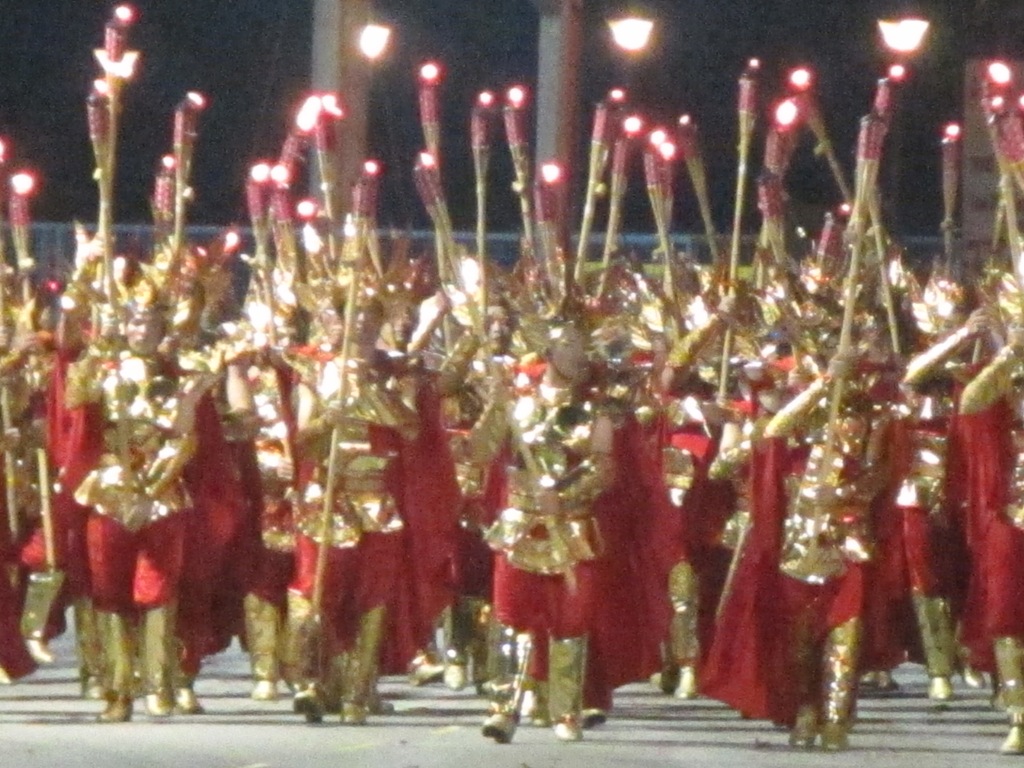
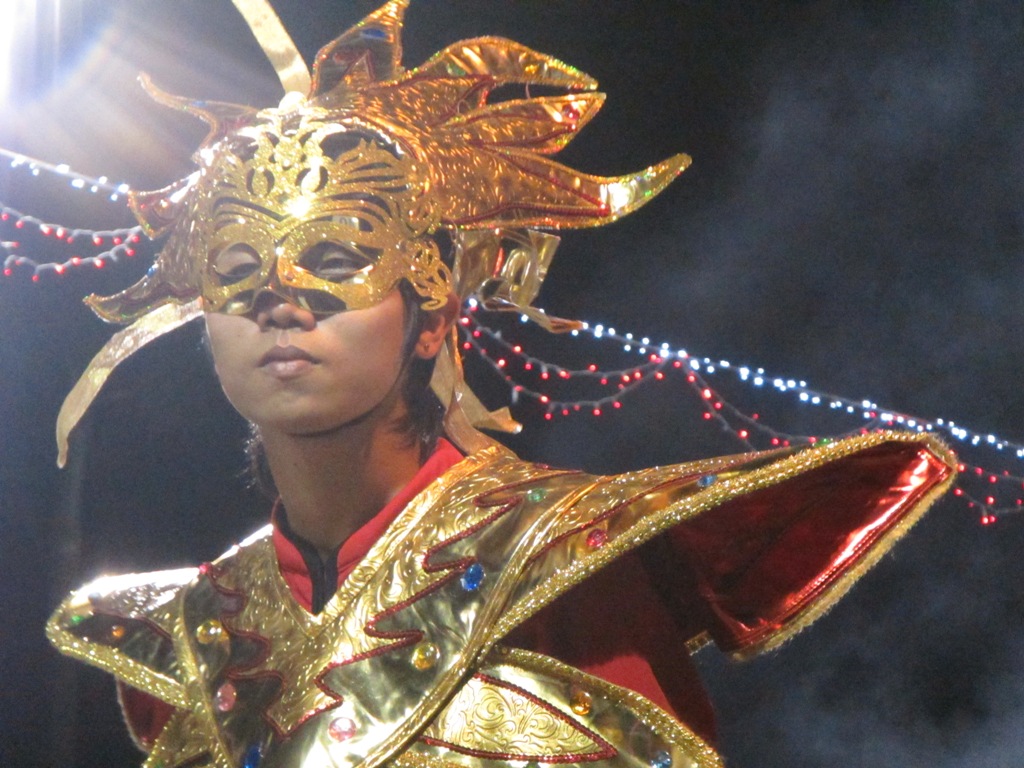
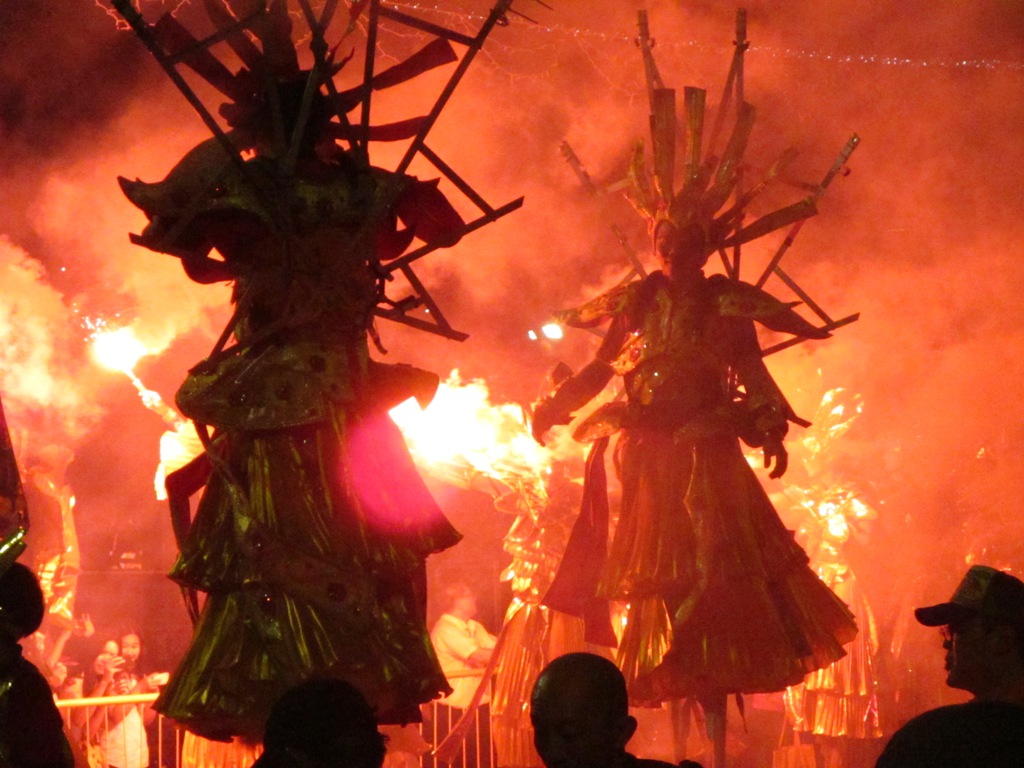
The parade was fantastic. It started with nearly a thousand dancers, had floats, dragons made from recycled plastic bottles, fire breathing, phoenix floats, and lasted for 90 minutes. All for free! The parade started in 1971, when Singapore banned fireworks. Words don’t do it justice:

Picture 011Singapore-KL-SiemReap 008Singapore-KL-SiemReap 007

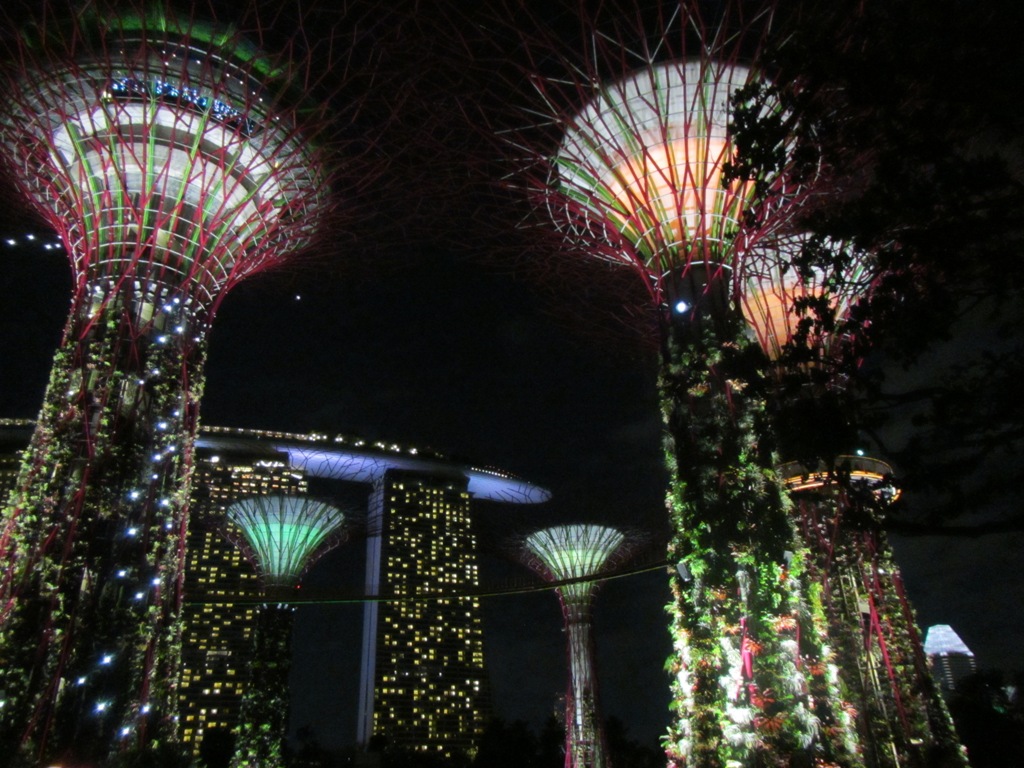
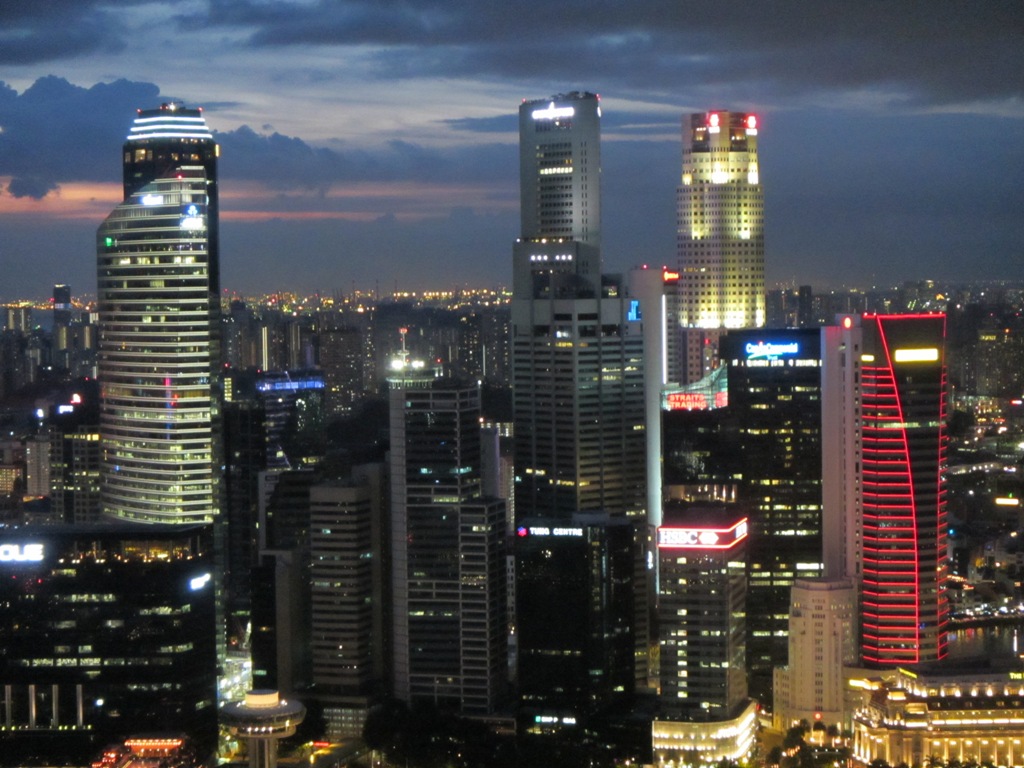
After the parade, we decided that we walk over to Marina Sands, an enormous hotel/casino complex. It’s the most iconic element of Singapore’s skyline: three huge towers in a slight curve, with an enormous open area, park, club, and pool sitting on all three that looks like a gargantuan ship aground in the sky. Unfortunately we were not up to the club’s dress code, so we wandered to the Marina Gardens, enormous steel structures (20-50m tall) that look like trees and are designed to be like them. They’re powered by solar panels atop them, have vines growing on their structure to perform photosynthesis, and, of course, light up and glow at night. Our feet exhausted from so much walking, we sat on some steps to watch the colors change and ebb, before catching one of the last trains back to Farrer Park.

Singapore-KL-SiemReap 010Singapore-KL-SiemReap 009

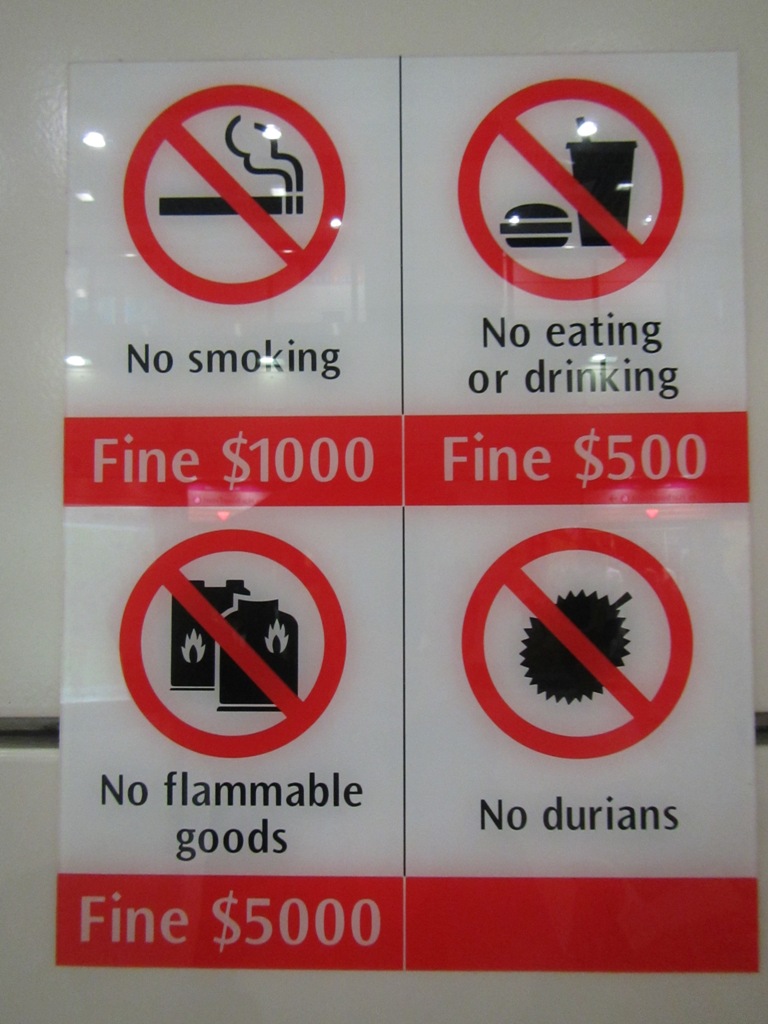
Today has been a slow day: laundry, hair cuts, some other practical things. The Private Eye and Life Is Too Short are back at the gardens to see them when they’re open; I’m back in the hotel stretching out my back, realigning some vertabrae I screwed up a decade ago. I guess I’m getting old. I had my first experience with the paternalism of Singapore: ibuprofen has to be bought over the counter, and sales are logged, so that a pharmacist can tell you know to take it properly. No matter that the instructions are different than every other place I’ve been. In Europe, you often buy 600mg pills; here, the pharmacist told me to take 1-2 200mg pills AND NO MORE. Oh, and here are the signs you see as you enter the subway:

Singapore-KL-SiemReap 011

We’ve booked a flight to Kuala Lumpur on the 25th, and it looks likely we will head to Siem Reap on the 27th, for a few days exploring Angkor Wat. After that, we have a bit under a week before we should return to Bangkok, and right now the top candidate is Hanoi.

— The Professor


Singapore

Oh, Singapore, you are a welcome home.

We landed in Singapore on the 20th, planning on staying just a few days. But we’ve loved it so much that we are now slated to depart on my birthday, the 25th. I want to copy The Private Eye and have a passport stamp on my birthday.

Singapore, a glittering, urban metropolis where everyone meets in hawkers plazas, food courts serving fantastic street food and dishes from China, Indonesia, India, and more. After 20 days in Bali, Jakarta, and the Gilis, the best Indonesian food I’ve had was here in Singapore. Admittedly, it cost $5 rather than $2, but still, it was vibrant and spicy and sharp in contrast to the comforting but ultimately a bit boring I found in Indonesia.

Singapore, a nation so small and dense that most people do not own a car, and so subway rides across 20 km are $2. Where the primary language is English in theory, but in day to day interactions it’s Chinese and many seem unable to speak much English. There are four official languages: English, Mandarin, Malay, and Tamil. So many signs are big and have three different alphabets on them. It’s illegal to sell chewing gum, spit on the street, or bring a durian into the subway.

Singapore, with an enormous zoo so fantastic it deserves a post of its own. Panda bears quietly napping, red pandas looking down at you from their den, flying foxes soaring above your head, false gurials, orangutans holding hands with keepers, Komodo dragons lazily sunning, and so much more. We arrived at noon, thinking we’d have plenty of time, and were some of the last to be shooed out at 6:30.

Singapore, whose Chingay parade began in response to the banning of firecrackers in 1972 and is now watched by over 1.5 million Singaporeans. Ten thousand participants, stilt walkers, floats, fire breathing dragons, visiting participants from other countries, all under the neon skyline and slowly rotating Singapore Flyer.

It is exhilarating to see Southeast Asia through a lens of ultra-modernity and prosperity.

— The Professor


Yogyakarta, Day 4

Our last full day in Yogyakarta was an educational one. First, we went to the Benten Vredeburg museum in the downtown. This is an old Dutch fort that was converted to a history museum of Indonesian independence and early national struggles. I really enjoyed the dioramas, which were high quality and probably took someone a long time to make. The stories they depicted bore a heavy stamp of “official history”, but as I was unfamiliar with a lot of the history and appreciated any education, this did not bother me all that much. It is amusing, though, how many were devoted to meetings, a dry subject when taken without the gloss of myth making.

Picture 001

Of course, for the many high-school history students there, we were part of the attraction. We starred in a lot of cell phone photos and made friends with their teacher.

We then got lost for a bit attempting to find the bus to Kaliurang. But eventually, we boarded a scrofulous foam-entrailed minibus which took us to the right village, and we chatted with an pleasant small scale businessman on the way. From Kaliurang, we attempted to board another minibus to the Ullen Sentalu museum. It was going there, but we were going to have to wait another hour for its regularly scheduled departure. Instead, we gave the driver an equivalent $3 to drive there right away.

I really liked Ullen Sentalu. It was up the slopes of the volcano, so the weather was cool. It has beautiful buildings on beautiful grounds, and is a gracious and personal museum of four sultan families of central Java, created and kept by one of those families. Especially charming was the room with many letters to a princess, encouraging her to keep up her strength and happy nature after her parents denied her marriage to her beau. They all had poetic phrases and photos of the sender; the girl’s parents eventually relented.

There is also a great collection of portraits both painted and photographed, an in-depth look at batik, and other quiet treasures. You have to have a museum guide to tour Ullen Sentalu, and ours, Tammy, was a real pleasure to talk to.

Picture 002

Afterward, we caught a cab home and went out for jackfruit curry. I liked the curry just fine, and the fruity pressed tofu quite a lot, but I couldn’t handle the solid fist of organ meat that came with it. Oh well, I just got more tofu.

On the following day, we flew to Singapore. I really like the Yogyakarta airport, which
is a startlingly good place to buy souvenirs. It was much better than Jakarta, where we had a layover.

Singapore began for us with meeting up with our friend Life Is Too Short, who we’d met in Luang Prabang. It was 8:30 pm by the time we were settled and ready for action, so we walked to the nearest hawker stall food court, the Lavender Street one about a block away. I ordered dumpling soup with greens, a plate of bao, and a juice from a fruit I had never heard of before. I sat down with The Professor and our friend, took a bite, and fell in love with Singapore. The fastest way to my heart really is through my stomach, I guess.

– The Private Eye


Yogyakarta and Indonesian Independence

Dear reader, I must be honest with you. I’ve been a bit deceptive in my descriptions of Yogyakarta, relying on the imagination rather than fact. When I wrote that Yogyakarta is unique in Indonesia in that it still has a monarch, a sultan, and that the city centers around his palace complex, called the kraton, I wrote the truth. But when I read those words, I imagine something from myth: gilded domes, brightly painted pillars, courtyards and steps of marble, and a dignified man sitting on a rug, sipping tea, with bodyguards and the smell of exotic spices. The reality is a bit less interesting: a wall, painted white, some streets, mostly western style buildings, and a thin, older gentleman whose father really liked photography. So much more similar to the king of Thailand than what at least my imagination conjures.

Much like the King of Thailand, the Sultan of Yogyakarta is loved by his people. Yogyakarta remains a monarchy because, when Indonesia sought independence in 1948-9, and different regions began to discuss the idea of forming one nation, the Sultan of Yogyakarta was strongly supportive and wanted to join the effort. Yogyakarta was the capital for a short period of time. Because the sultanate was so instrumental to the formation of the nascent nation, it received special dispensation to remain a monarchy. Recently the region had democratic elections, as part of a slow process of modernization: the people elected the sultan with an overwhelming majority,

In the United States, our war for independence was hundreds of years ago. The country has evolved and grown since, but the moment of national birth was before the industrial revolution. For Indonesia, however, this moment was just over sixty years ago, when politicians engaged with other countries, such as the U.S., and students took to the streets to fight the British and Dutch. Indonesia’s war of independence when my father was 9 years old – it still exists in living memory.

One wrinkle to this very recent birth and slow formation of a national character is how geographically and culturally diverse the country is. It is 70,000 islands, from Sumatra in the west to Papua in the east. It encompasses the funeral culture of Tana Toraja, the animistic Hinduism of Bali, the Dani of Papua who first met white people in 1938, and the bustling metropolis of Jakarta. Forging a national identity out of this patchwork of hundreds of previously independent cultural groups is a challenge – the closest analogy I can think of is India, except imagine if India’s regions were islands, and consider the greater isolation that brings.

Our next destination, Singapore, provides an interesting contrast to the path of building a national identity. Singapore was originally part of Malaysia. While there were significant cultural, religious, and political differences between it and the rest of the country, the belief was that seeking individual independence wasn’t feasible for political and economic reasons. But irreconcilable differences emerged very quickly, especially on questions of preferentially treating certain ethnic and racial groups. And so, more like China and less like Indonesia, Malaysia pursued a national identity in part defined along ethnic lines, leading Singapore and the rest of the country to part ways.

But unlike the tenor this idea takes in Europe and the U.S., where discriminatory policies are typically conservative (seeking to maintain the status quo), in Malaysia they are intended to change the status quo and build a Malaysian middle class to stand along side the wealthy other ethnic groups (e.g., Chinese). So more similar to some of the policies in Latin America.

These thoughts are jumbled and incoherent, mostly because I need to read more – these are based on impressions and observations whose supporting facts might be incomplete or incorrect. The world is more stable than it was just after World War II, but many nations are still figuring out a place and identity since their birth and creation, whether it be Indonesia, India, or Israel. An example I should look at is Italy and Garibaldi – something which I will most definitely do when visiting The Medieval Scholar in Siena this June.

— The Professor